Reach — technical SEO
Title, meta, canonical, headings, alt text, Open Graph, HTTPS, sitemap, hreflang and Core Web Vitals where available.


A free answer engine optimization (AEO) audit for Chrome and Edge. Three scores, the evidence behind every finding, and what to change first. Everything runs in your browser.
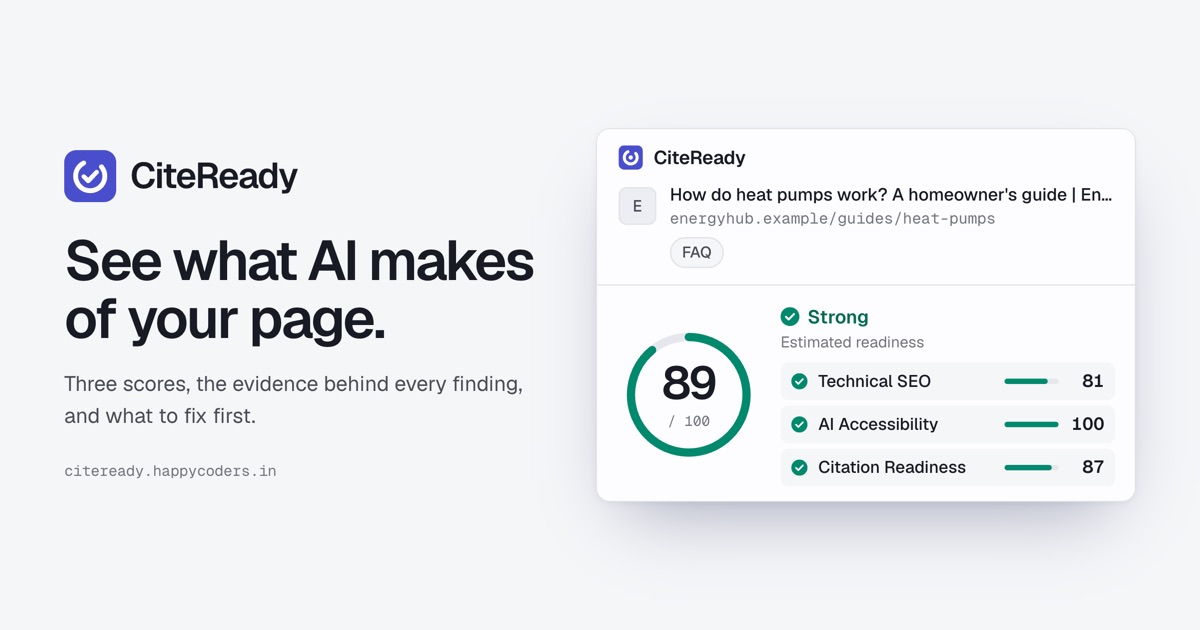
So you can see at a glance whether your problem is access, structure or substance.
Title, meta, canonical, headings, alt text, Open Graph, HTTPS, sitemap, hreflang and Core Web Vitals where available.
robots.txt checked for GPTBot, OAI-SearchBot, ChatGPT-User, PerplexityBot, ClaudeBot, Google-Extended, Googlebot and Bingbot.
A direct answer near the top, a definition, Q&A, fitting structured data, a named author, sources and a visible date.
Every finding shows what is there — and what the page already does well.
Eleven page types, so a poem is never told to add statistics and a privacy policy isn't marked down for citing no research.
A designed A4 PDF, Markdown for a developer, or CSV for every page.
Answer engine optimization (AEO) is structuring a page so AI answer engines can extract, attribute and quote it. Traditional SEO works to rank a page in a list of links; AEO works to make it usable as a source in a generated answer. It's also called generative engine optimization, or GEO.
Does the page say plainly what it is about — and is there a short answer near the top worth quoting?
Is anyone named as the author, with a date a reader can see and sources behind the claims?
Are GPTBot, PerplexityBot, ClaudeBot and the rest allowed to fetch it at all — and does the content exist before JavaScript runs?
Follows links from where you are and finds what hurts the whole site: orphan pages, broken links, duplicate and competing pages.
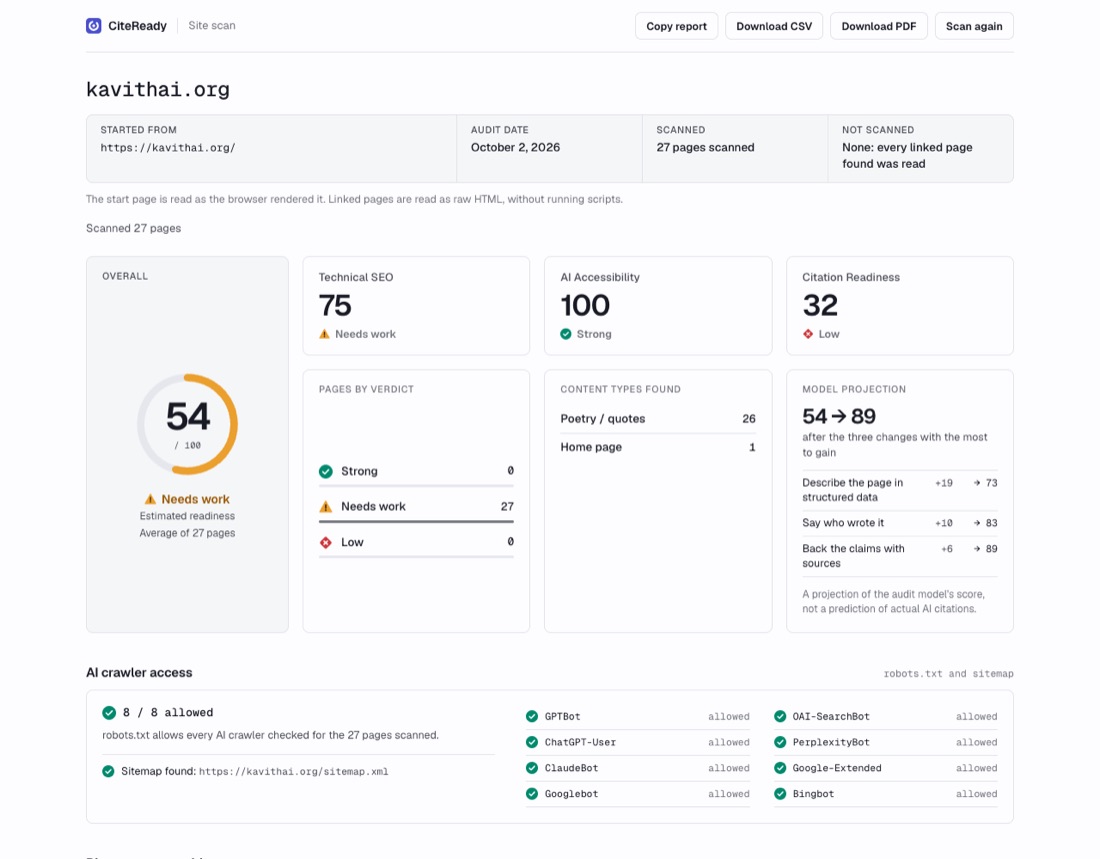
Built and checked against 197 real pages across five live sites, in English and Tamil.
They overlap more than they conflict. CiteReady scores both, and keeps them apart.
| Traditional SEO | Answer engine optimization | |
|---|---|---|
| Goal | Rank in a list of links | Be used as a source in a generated answer |
| Unit | The page | The passage |
| Wants | Keywords, links, authority | A clear subject, a short answer, attribution |
| Structured data | Helps rich results | Tells a machine what the page is |
| Authorship | A ranking signal | How a claim gets attributed |
| Access | Googlebot | GPTBot, PerplexityBot, ClaudeBot and others, each blockable separately |
Pages reachable only from menus, groups of pages that don't link to each other, mentions that should be links, weak link text, and broken links attributed to the page that contains them.
Near-duplicates compared by phrases your site doesn't repeat everywhere, keyword cannibalisation, duplicate titles/descriptions/H1s and conflicting canonicals.
Topic, a one-sentence answer, recognised entities, author, dates, factual claims, sources, canonical, structured-data types and language — the quickest way to discover your page is about something else.
A designed A4 PDF with a twelve-section site report, Markdown for a developer, or CSV for every page.
Install and audit. There is nothing to register and nowhere for your data to go.
The extension keeps no history and reports nothing back.
Access to the current tab when you click the icon, and the ability to run the audit on it.
The page, its robots.txt, its sitemap and, in a site scan, its linked pages — always without your cookies.
Find what a machine can't read on your pages, and what to fix first.
Audit a client's site in a minute and hand over a PDF you didn't have to write.
See structured data, headings, canonicals and crawler rules judged against what the page actually is.
We'd rather say this than have you find out.
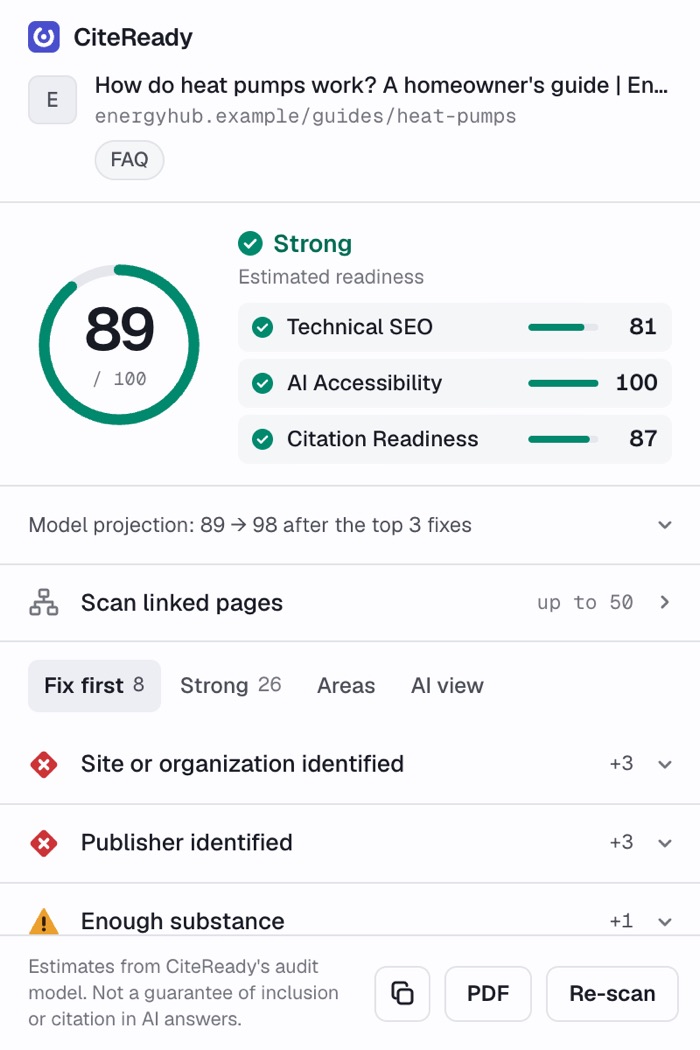
No — and be wary of tools that claim to. It measures your page against the signals that make it readable, attributable and quotable.
No. It only reads. Nothing is edited, submitted or stored, and requests are made without your cookies.
Nothing. No account, no paid tier. Audits run on your own device, so there is no server bill to pass on.
Run a site scan. CiteReady reads your robots.txt and reports, for each of eight AI crawlers, whether it is allowed on the pages it scanned.
Any ordinary web page. Browser pages, extension stores and PDFs can't be read by extensions, and CiteReady says so rather than failing.
Yes. It reads Tamil question forms, units, month names and bylines, and measures length in characters so languages with long words aren't penalised.
No. Audits run locally, so there are no credits. A single site scan reads up to 50 linked pages; run as many scans as you like.
Both. The same extension, from each browser's store.
Write to the people who built it. We answer from Thoothukudi, usually the same day.