How to Build an Image Carousel in JavaScript Without a Library
Build an image carousel in plain JavaScript and CSS — no jQuery, no Slick, no Swiper. Scroll snap, arrows, dots, keyboard and touch, in about 60 lines.
Read article


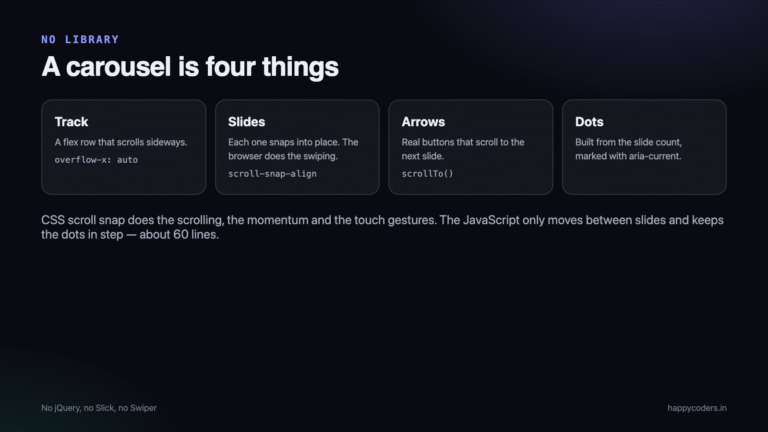
Build an image carousel in plain JavaScript and CSS — no jQuery, no Slick, no Swiper. Scroll snap, arrows, dots, keyboard and touch, in about 60 lines.
Read article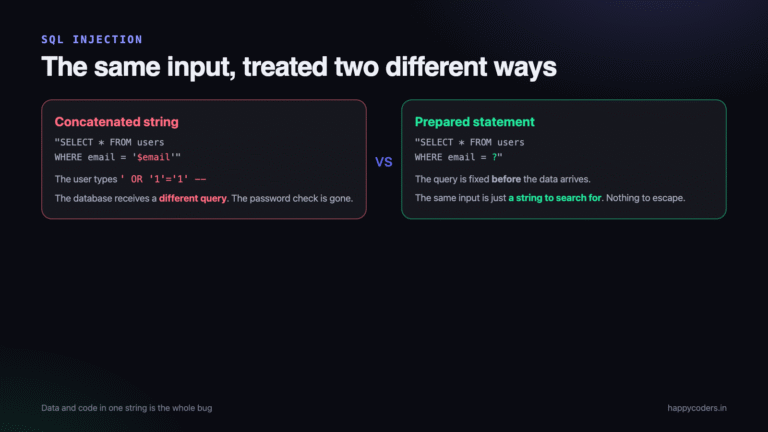
SQL injection in PHP explained with real vulnerable code, how an attacker exploits it, and the one fix that actually works: prepared statements with PDO and MySQLi.
Read article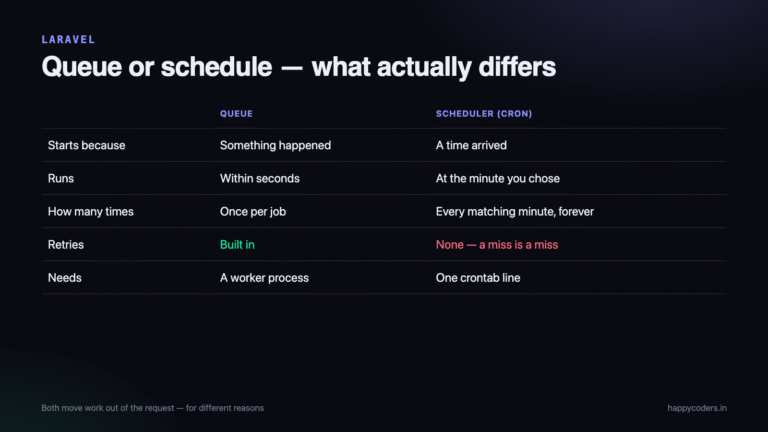
Laravel queues and cron jobs solve different problems. What each one is for, how the scheduler actually uses cron, and how to decide which to reach for.
Read article
Structuring large projects using SCSS helps you maintain clean, scalable, and well-organized styles as your application grows. You can split your styles into smaller partial files like variables, mixins, base styles, components, and layouts, making the code easier to manage. Using the @use rule, you can import these files in a structured way while avoiding […]
Read article
Creating dynamic styles using SCSS allows you to generate flexible and reusable CSS based on variables, functions, and logic. By combining features like variables, mixins, loops, and conditionals, you can adapt styles dynamically for different themes, screen sizes, or components. This approach reduces repetition and makes your code more scalable and easier to maintain. SCSS […]
Read article
Using conditionals in SCSS allows you to apply styles based on specific conditions, making your code more dynamic and flexible. With @if, @else if, and @else, you can control how styles are generated depending on variables or logic. This is useful for handling themes, color variations, or different layout behaviors. It helps reduce repetition by […]
Read article
Using loops in SCSS allows you to generate repetitive styles efficiently without writing the same code multiple times. SCSS supports @for, @each, and @while loops, which help create dynamic classes for spacing, grids, or utility systems. The @for loop is useful for iterating a set number of times, while @each works with lists or maps, […]
Read article
Importing files in SCSS helps you organize your styles into smaller, manageable pieces and reuse them across your project. The older @import rule allows you to include one SCSS file into another, but it is now deprecated and not recommended for modern projects. Instead, you should use @use, which loads files with better scoping and […]
Read article
Using @extend in SCSS allows you to share styles between selectors without duplicating code. It works by inheriting the styles of one selector into another, helping you maintain a cleaner and more efficient stylesheet. This is especially useful for applying common styles like buttons, alerts, or utility classes across multiple elements. Unlike mixins, @extend merges […]
Read article
Using SCSS functions allows you to create dynamic and reusable logic for styling values in your stylesheets. You can define a function using @function and return calculated values with @return, making it useful for tasks like color manipulation, spacing calculations, or unit conversions. Functions help reduce repetition and keep your code more organized and efficient. […]
Read article