Overtime is one of those subjects where every Indian employer is fairly sure they know the rule, and no two of them describe it the same way. Some say double wages. Some say one and a half times. Some say it does not apply to salaried staff. Some say it does not apply to IT at all.
The reason for the confusion is that the answer genuinely depends on which Act covers you and which state you are in, and those two facts change the rate, the daily limit, the quarterly cap and the records you have to keep.
This is a practical guide to getting the arithmetic and the records right. It is written from the position of a company that builds time-tracking software and has had to implement these calculations, not from a chair in a law firm. Treat it as a starting point and have a labour lawyer confirm your policy against your own state’s Act before you apply it to anybody’s salary.
Which law applies to you
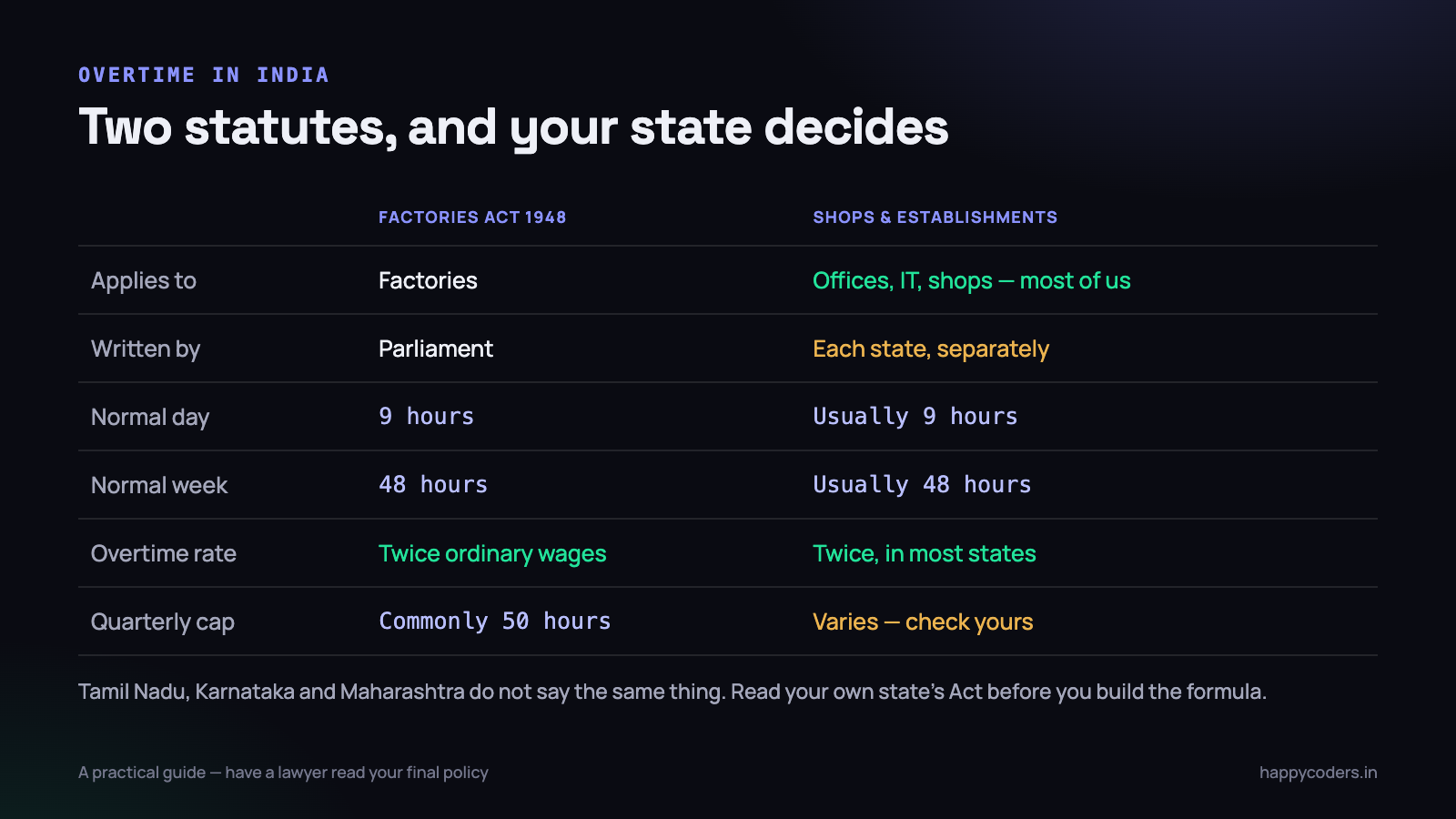
For most readers of this article the answer is the state Shops and Establishments Act, not the Factories Act. Knowing which one is the first step, because everything downstream depends on it.
The Factories Act 1948
This covers factories — broadly, premises with manufacturing using power and ten or more workers, or without power and twenty or more. It is a central statute, so the core provisions are the same everywhere. It sets a normal working day of nine hours and a normal week of forty-eight, requires a weekly holiday, and provides that a worker who works beyond nine hours in a day or forty-eight in a week is entitled to wages at twice the ordinary rate for the excess.
It also caps overtime. The commonly cited figure is fifty hours in a quarter, with state amendments and exemptions altering it in practice. And it requires registers of overtime to be maintained and produced on inspection.
State Shops and Establishments Acts
Offices, shops, IT companies, agencies, hotels and most other commercial establishments fall under the Shops and Establishments Act of the state they operate in. Tamil Nadu, Karnataka, Maharashtra, Telangana and the rest each have their own, and they are not identical.
The broad pattern across most states matches the Factories Act: a normal day of around eight or nine hours, a normal week of around forty-eight, overtime at twice the ordinary rate of wages, a cap on how much overtime is permitted in a period, and a requirement to keep a register. But the specifics differ, and so do the exemptions — several states have issued notifications exempting IT and ITES establishments from some provisions, usually subject to conditions about hours, records and consent.
Those IT exemptions are the source of the belief that overtime does not apply to software companies. Read the actual notification for your state before relying on that. They are typically conditional, they are periodically renewed or allowed to lapse, and they rarely exempt an employer from keeping records or from paying for hours worked.
The labour codes
The four consolidated labour codes passed in 2019 and 2020, including the Code on Wages and the Occupational Safety, Health and Working Conditions Code, are intended to replace much of this patchwork. Implementation has been staggered and state rules have followed at different speeds. The safe position is to comply with the Act that currently applies in your state and to keep an eye on notifications, rather than to build a policy on a code that is not yet in force where you are.
What counts as ordinary wages
This is where the arithmetic most often goes wrong, and it is worth settling before touching a calculator.
“Twice the ordinary rate of wages” is not twice the CTC and not twice the gross. Under the Factories Act, ordinary rate of wages means basic wages plus allowances, including the cash equivalent of concessional food grain, but excluding bonus. State Acts define it in their own terms. In practice most Indian employers compute overtime on basic plus dearness allowance, and some include other regular allowances.
The two decisions you have to make and write down are these. First, which salary components form the ordinary wage. Second, what your monthly divisor is — twenty-six working days is the conventional figure, but thirty is also used, and the two produce noticeably different hourly rates.
Neither decision has a single right answer that fits every establishment. What matters is that you make both explicitly, document them, apply them consistently to everybody, and can explain them. An inconsistent divisor applied differently to two employees is a much bigger problem than choosing the less generous of two defensible ones.
Computing overtime from a daily hours figure
Once the wage base is settled, the calculation itself is simple arithmetic. Here it is end to end.
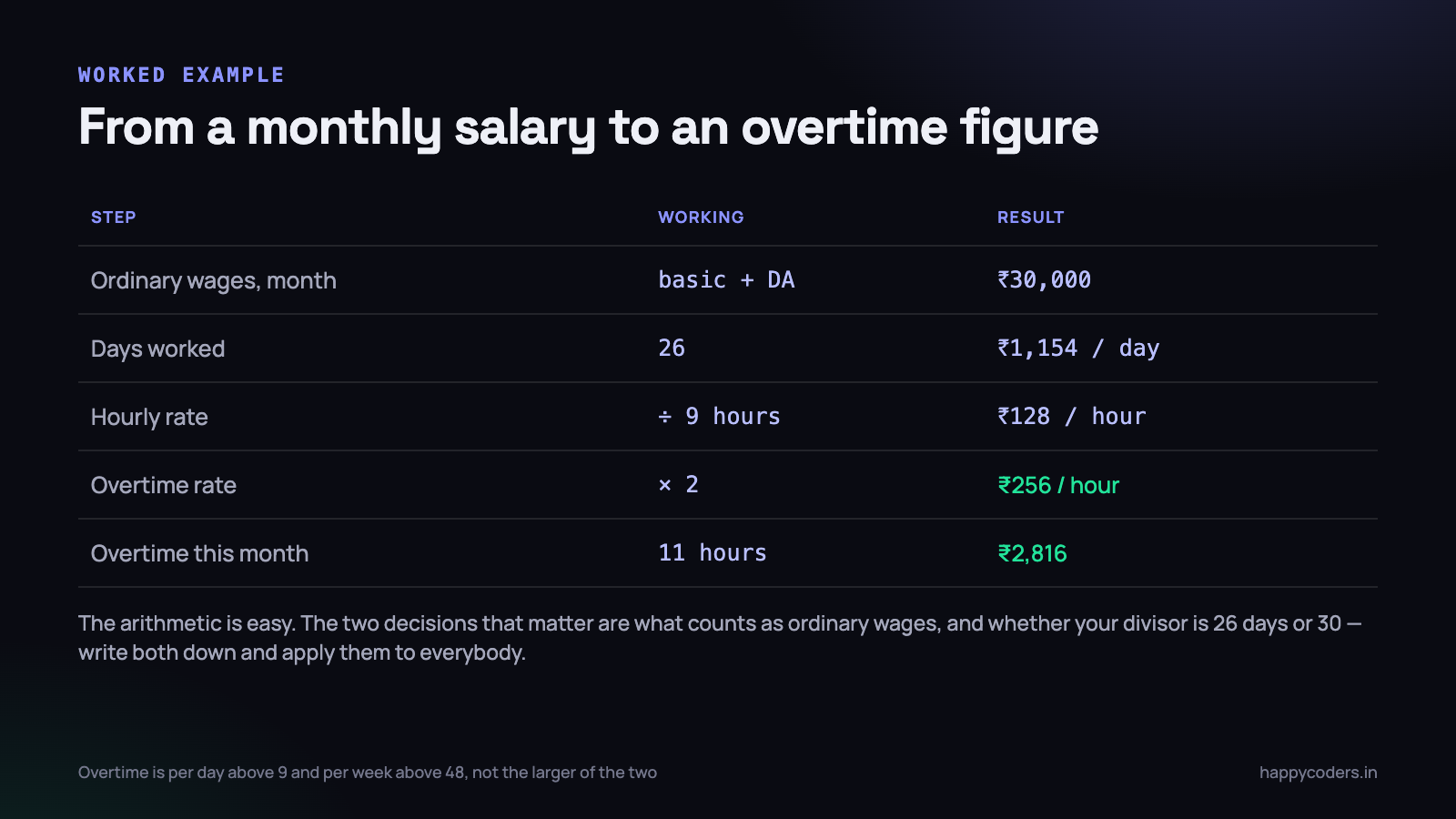
- Take the ordinary monthly wage. Say basic plus DA is ₹30,000.
- Divide by the monthly day divisor to get a daily wage. At 26 days, that is ₹1,154.
- Divide by the normal daily hours to get an hourly rate. At 9 hours, ₹128 per hour.
- Double it for the overtime rate: ₹256 per hour.
- Multiply by overtime hours in the period. Eleven hours gives ₹2,816.
The daily and weekly tests are both live
A point that trips people up: overtime is generally assessed on a daily basis and a weekly basis, not on whichever is more convenient. Hours beyond nine in a day attract overtime even in a week that totals under forty-eight. Hours beyond forty-eight in a week attract overtime even if no single day exceeded nine.
Consider somebody who works 9, 9, 11, 9 and 9 hours across five days. The total is forty-seven hours, which is under the weekly limit, but Wednesday produced two overtime hours. A system that computes overtime only from the weekly total records nothing, and is wrong.
What to do about breaks
The nine-hour figure is working hours. A lunch break is not working time and should not be counted towards it, which is precisely the thing a signature at 9:30 and another at 18:40 cannot tell you. This is the practical argument for recording start, end and break rather than a single daily total: without it, your overtime figure is either inflated or is based on an assumption you cannot evidence.
It is also why attendance data for remote and hybrid staff has to be real timestamps rather than a message in a group. A day recorded as “present” is not a day from which overtime can be computed.
Who is outside the overtime provisions
Most Acts carve out a small category of people, usually described as those in a position of management or employed in a confidential capacity. The category is narrower than employers like to believe, and it is defined by what the person actually does rather than by what their visiting card says.
Calling somebody a team lead does not place them outside the provisions. A person who writes code all day, reports to a project manager and has no authority to hire, discipline or commit the company to anything is not in a position of management, whatever the designation. Tribunals look at the substance of the role.
The practical consequence is that designations invented for client-facing reasons — and Indian IT companies invent a lot of them — should not be doing legal work. If you intend to treat a role as exempt, be able to describe the actual authority that makes it so.
Night shifts and other conditions
Several state Acts and notifications attach conditions to working outside normal hours that have nothing to do with pay. Where women are permitted to work night shifts, the permission is typically conditional on transport being provided, on adequate security, on written consent, and on a minimum number of women being present on the shift. Some states require specific approvals. These conditions are separate from overtime and are checked separately, and failing them is a compliance problem even where every rupee of overtime was paid correctly.
There are also usually rules about the spread-over — the total elapsed time from start to finish including breaks, commonly capped around ten and a half or twelve hours — and about a mandatory rest interval after a set number of continuous hours. Both are worth checking, because a system that computes overtime correctly can still be recording days that are not permitted at all.
Comp-off, and how it becomes a dispute
In Indian IT and services companies, statutory overtime payment is often not what actually happens. What happens is compensatory off: work the Saturday release, take a day later.
Used honestly, comp-off is a reasonable, mutual arrangement that many employees prefer to a payment. Used the way most companies use it, it is an undocumented debt that disappears.
Why it goes wrong
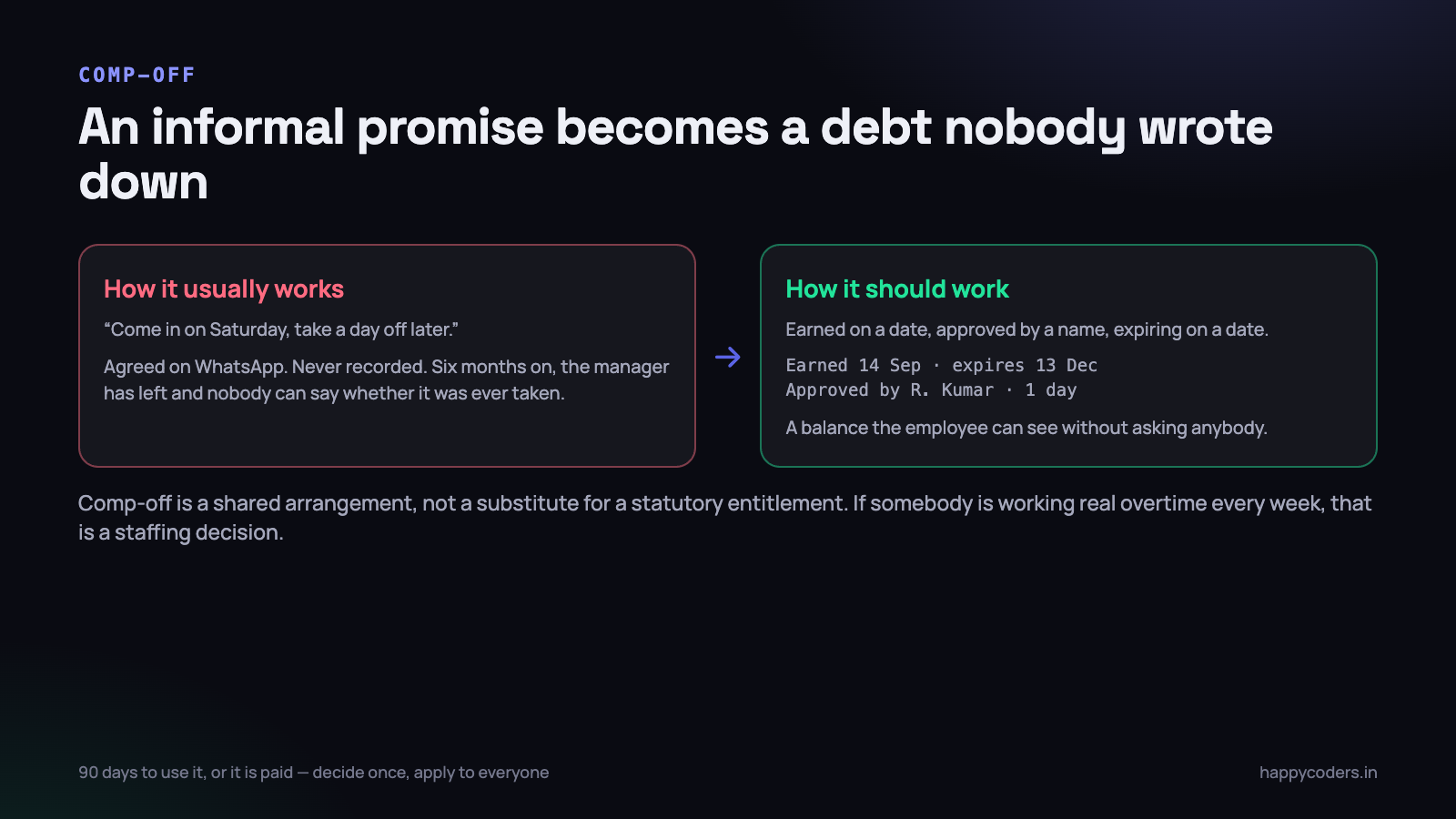
The arrangement is agreed verbally or in a chat. It is not recorded anywhere that HR can see. The manager who approved it moves teams or leaves the company. Six months later the employee asks for the day and nobody can establish whether it was ever taken, whether there were two days or one, or whether it has expired.
Multiply that by twenty employees and a couple of years and you have a liability nobody has measured, plus a steady trickle of conversations that each end with somebody feeling short-changed.
How to track it fairly
- Record it as a leave type with a balance, in the same place as annual and sick leave. Not a spreadsheet, not a chat thread.
- Each entry has an earned date, an approver and a reason. “Earned 14 September, release weekend, approved by R. Kumar.”
- Each entry has an expiry. Ninety days is common and reasonable. Without one, comp-off accumulates indefinitely and becomes an unfunded liability on your books.
- Decide once what happens on expiry — lapsed or paid — write it in the policy, and apply it to everybody including managers.
- The employee can see their own balance without asking anyone. This removes most disputes before they start, because errors get raised in week one rather than at appraisal.
- Round it in units people understand. Half days and full days. Tracking comp-off in minutes creates arguments about arithmetic instead of about fairness.
Comp-off is a mutual arrangement, not a substitute for a statutory entitlement where one applies. And if the same people are working genuine overtime every single week, that is not an overtime question at all — it is a staffing or estimating question, and no leave policy will fix it.
What records to keep
Both the Factories Act and state Shops and Establishments Acts require registers, and the forms differ by state. Rather than memorising form numbers, keep the underlying data in a shape from which any required form can be produced.
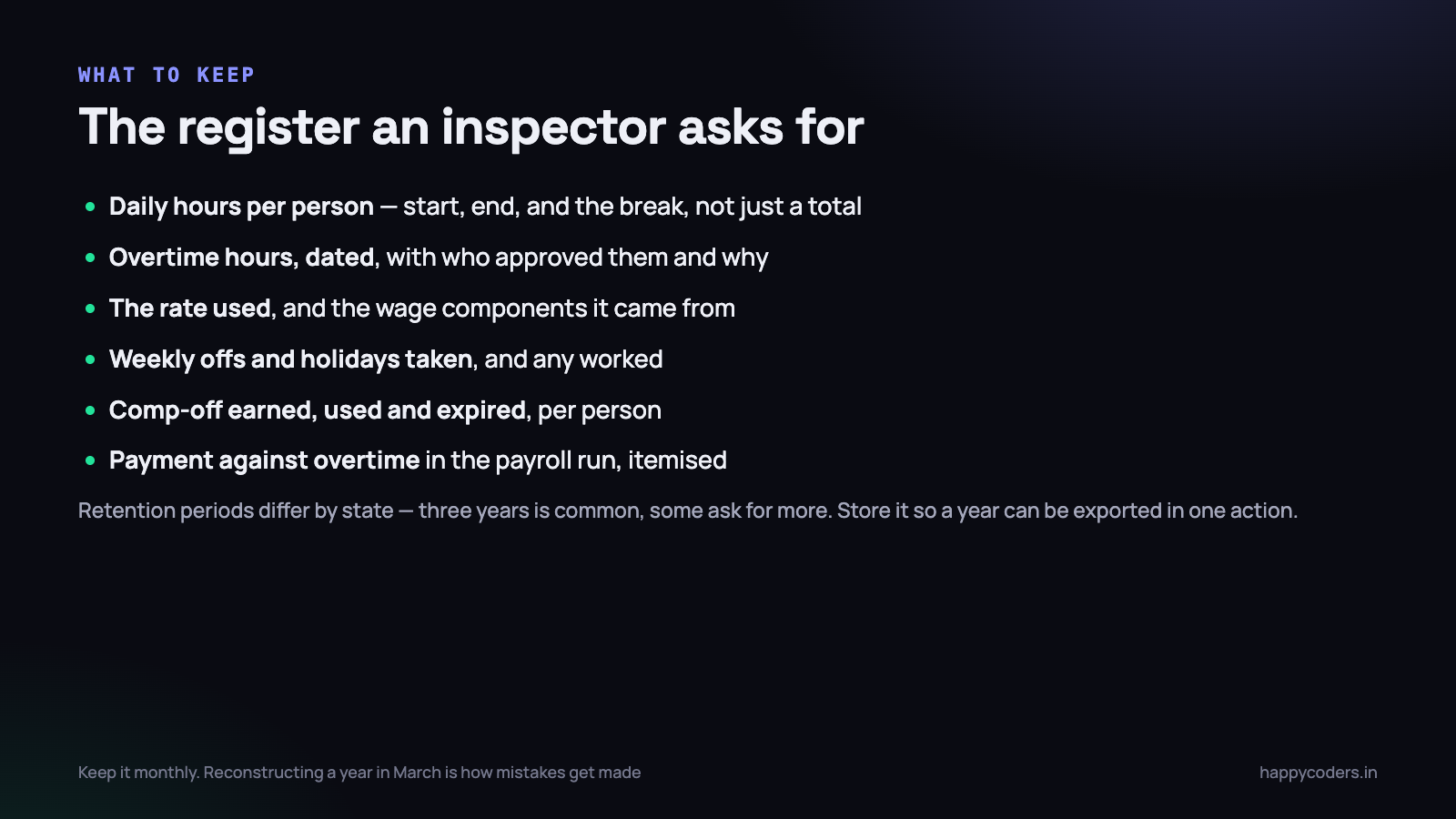
- Daily hours per person — start time, end time and break, not just a total. Everything else derives from this.
- Overtime hours, dated, with an approver. Overtime that nobody approved is a problem whichever way it is eventually resolved.
- The rate used and the components it came from, so a figure from eight months ago can be explained without rebuilding it.
- Weekly offs and holidays, including any that were worked.
- Comp-off earned, used and expired, per person, with dates.
- The payment itself, shown as a separate line in the payroll run rather than folded into gross.
Retention periods vary by state; three years is a common minimum and some require longer. Store the data so that a full year can be exported in one action, because the situations in which somebody asks for it — an inspection, an audit, a dispute — are never situations with time to spare.
Keep it monthly
The single most useful operational habit here is to close overtime every month, alongside payroll, rather than at the year end. Reconstructing eleven months of daily hours in March is how errors enter a record, and a record with known errors in it is worse than useless in a dispute.
Five mistakes we see repeatedly
- Assuming salaried staff are exempt. Being paid monthly rather than daily does not by itself remove an entitlement. Exemptions come from the Act and from state notifications, not from the payment frequency.
- Paying 1.5 times because that is the figure from elsewhere. Indian statutes generally say twice the ordinary rate. Check your state and do not import a number from a foreign jurisdiction or from a payroll template.
- Computing overtime on gross salary. Overtime is computed on ordinary wages as the Act defines them, which is usually a narrower figure.
- Only checking the weekly total. The daily test is separate and produces overtime in weeks that look compliant.
- Letting comp-off live in chat. Every company that does this has an undocumented liability. Most discover its size during a resignation.
Before you build the formula into anything
If you are configuring a payroll or attendance system to compute overtime, settle these six questions first and write the answers down. They are the questions that determine every figure the system will produce.
- Which Act applies to this establishment, and in which state?
- What is the normal daily limit and the normal weekly limit you are applying?
- Which salary components make up ordinary wages?
- Is the monthly divisor 26 or 30?
- Is overtime approved in advance, and by whom?
- What is the cap per quarter, and what happens when somebody reaches it?
Every one of those is a policy decision rather than a technical one, and every one of them will be questioned eventually. Deciding them in a document takes an afternoon. Discovering them one at a time through complaints takes a year.
What to do on Monday morning
- Establish which Act covers you and download your own state’s Shops and Establishments Act. Read the sections on hours, overtime and registers. It is shorter than you expect.
- Check whether an IT or ITES exemption notification applies in your state, whether it is current, and what conditions it carries.
- Write down your wage base and your divisor, and confirm payroll is already using them.
- Pull last month’s daily hours and count how many days exceeded nine hours and how many weeks exceeded forty-eight. You may find there is no overtime to speak of, which is also a useful answer.
- Add comp-off as a proper leave type with a balance and a ninety-day expiry, and load the outstanding ones people can evidence.
- Send the whole thing to a labour lawyer for one hour of review before it touches a payslip.
Happy Tracker records start, end, break and daily hours per person, holds leave and comp-off as balances employees can see themselves, and exports a month or a year of the underlying data. The overtime policy is still yours to write, and still worth a lawyer’s hour.