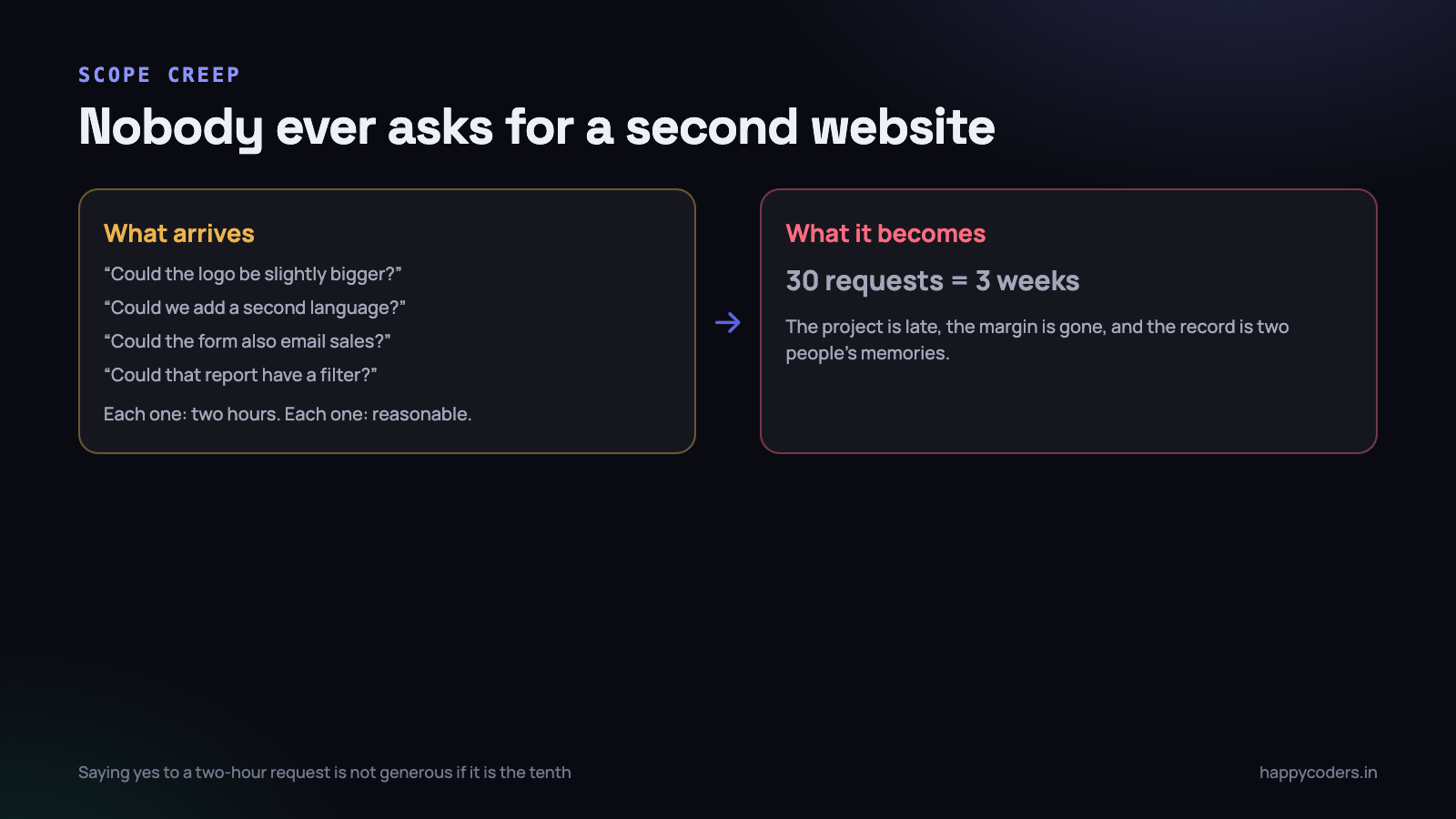
Nobody ever asks for a second website. They ask whether the logo could be slightly bigger, whether there could be a second language, whether the form could also email the sales team, and whether that report could have a filter on it.
Each request is reasonable. Each takes a couple of hours. Thirty of them is three weeks, and by the time anybody notices, the project is late, the margin is gone, and the conversation has become an argument about what was promised — which is a conversation nobody wins from memory.
What scope creep actually is
It is worth separating three things that get called the same name, because they need different responses.
- A change request. The client wants something genuinely new, knows it is new, and expects to discuss it. This is healthy. It is how projects improve.
- Scope creep. Small additions that nobody classifies as changes, because each one on its own is too small to be worth the paperwork. This is the dangerous one.
- Under-quoting. The work was always this size and you estimated it badly. This is not the client’s fault, and treating it as creep is how a good relationship goes wrong.
Telling these apart requires a record. Without one, every overrun looks like the client’s fault to you and like your fault to them, and both parties are arguing sincerely.
Where it comes from
Almost always one of five places, and knowing which lets you address the cause instead of the symptom.
- A vague proposal. “Responsive design” means four breakpoints to you and every device that exists to them. “Basic reporting” means three reports to you and whatever they need to them.
- Verbal additions. Agreed on a call, never written down, remembered differently by each side.
- Unbounded revisions. The proposal does not say how many rounds, so the number is infinity.
- A new stakeholder. Someone joins in month two with opinions and no knowledge of what was agreed.
- Politeness. The most common cause. A small request arrives, saying no feels petty, and you say yes thirty times.
That last one deserves attention because it is entirely within your control and it is where most of the damage originates. Saying yes to a two-hour request is not generous if it is the tenth one.
Record three things, and the argument disappears
You do not need a formal change-control process. You need three pieces of information, captured as work happens rather than reconstructed afterwards.
1. Hours against tasks, not just against the project
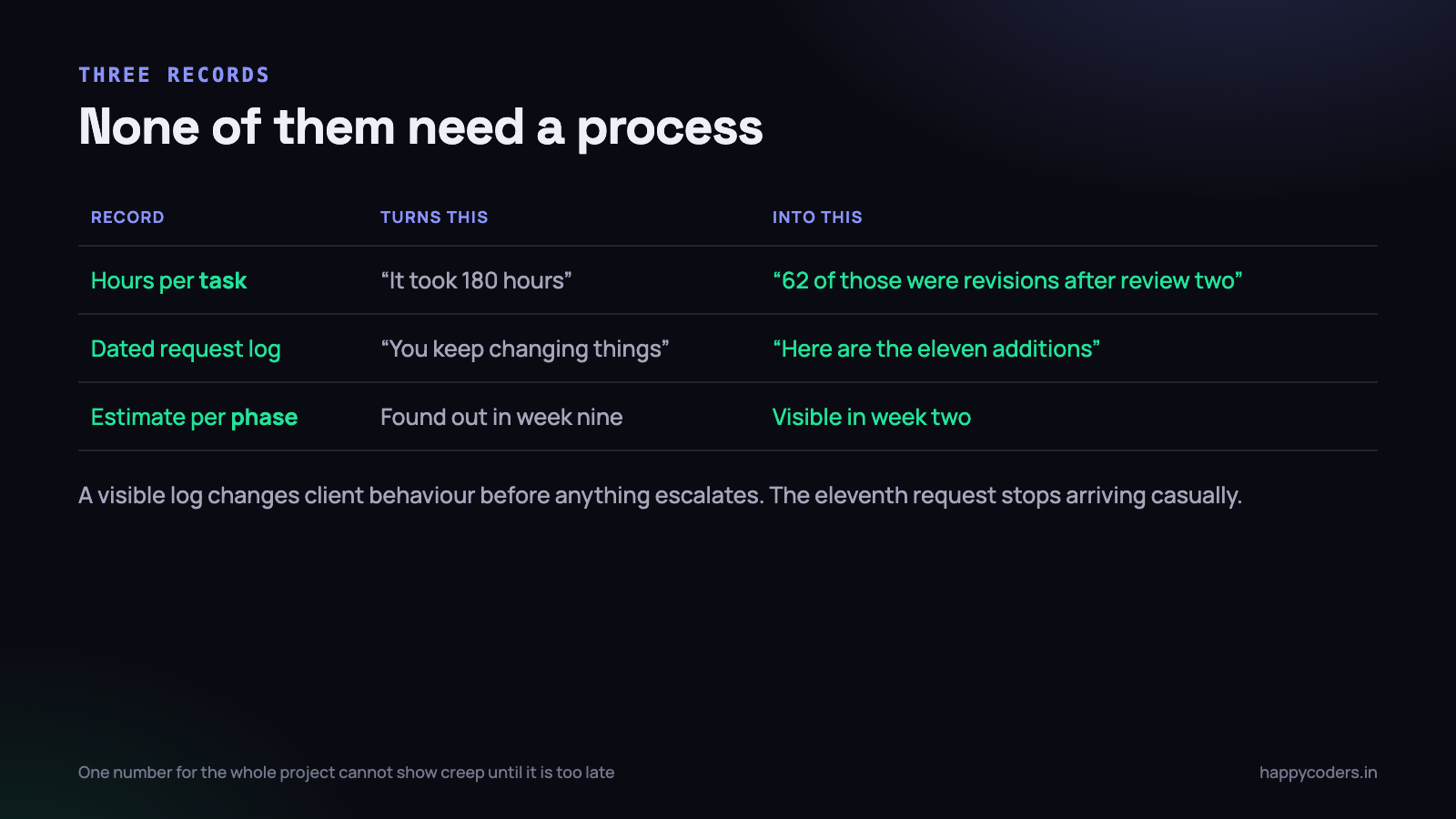
“The project has taken 180 hours” starts an argument. “The project has taken 180 hours, of which 62 were revisions after the second review” ends one, because it is specific and checkable.
This is the single most valuable thing tracked time gives you, and it only works if the task breakdown is granular enough to separate building the thing from changing the thing. Two tasks per project is not enough. Fifteen is usually plenty.
2. A dated log of requests
Every addition, with the date and where it came from. A shared document is fine; a task in the project board is better. It does not need approval workflow — it needs to exist and to be visible to the client.
The magic of this is not that it wins arguments. It is that a visible log changes client behaviour before anything escalates. When somebody can see that this is the eleventh addition, the eleventh request tends not to arrive casually.
3. The original estimate, per phase
A single number for the whole project cannot show you creep until it is too late. Estimates per phase — design, build, content, testing — let you see the overrun in week two, when it is still a conversation, rather than week nine, when it is a dispute.
Catch it in week two
The reason creep becomes a crisis is timing. Raised early it is a small adjustment; raised late it is an accusation about the past. Three signals worth watching for.
- A phase crosses its estimate while still in progress. Not after — during. Any weekly check on hours-versus-estimate per phase will show this.
- Revision time exceeds build time on any deliverable. Almost always means the brief was not agreed, and the fix is a conversation about the brief, not more revisions.
- The request log passes about five entries with none of them formally agreed. The number matters less than the fact that nobody has counted.
Set one of these as a weekly two-minute check. It is the cheapest insurance in project management, and almost nobody does it because there is no moment in the week when it obviously belongs.
How to raise it without damaging the relationship
This is the part people avoid, and avoidance is what turns a manageable overrun into a bad ending. The wording matters more than the data.
Raise it early and matter-of-factly
“I want to flag something while it is still small” is a completely different conversation from “we need to talk about the budget.” The first is professional. The second is a complaint.
Present the record, not the grievance
“Here are the eleven additions since we started, and here is what they have added to the timeline” is a fact. “You keep changing things” is an accusation, and it will be answered with one.
Offer three options, not one bill
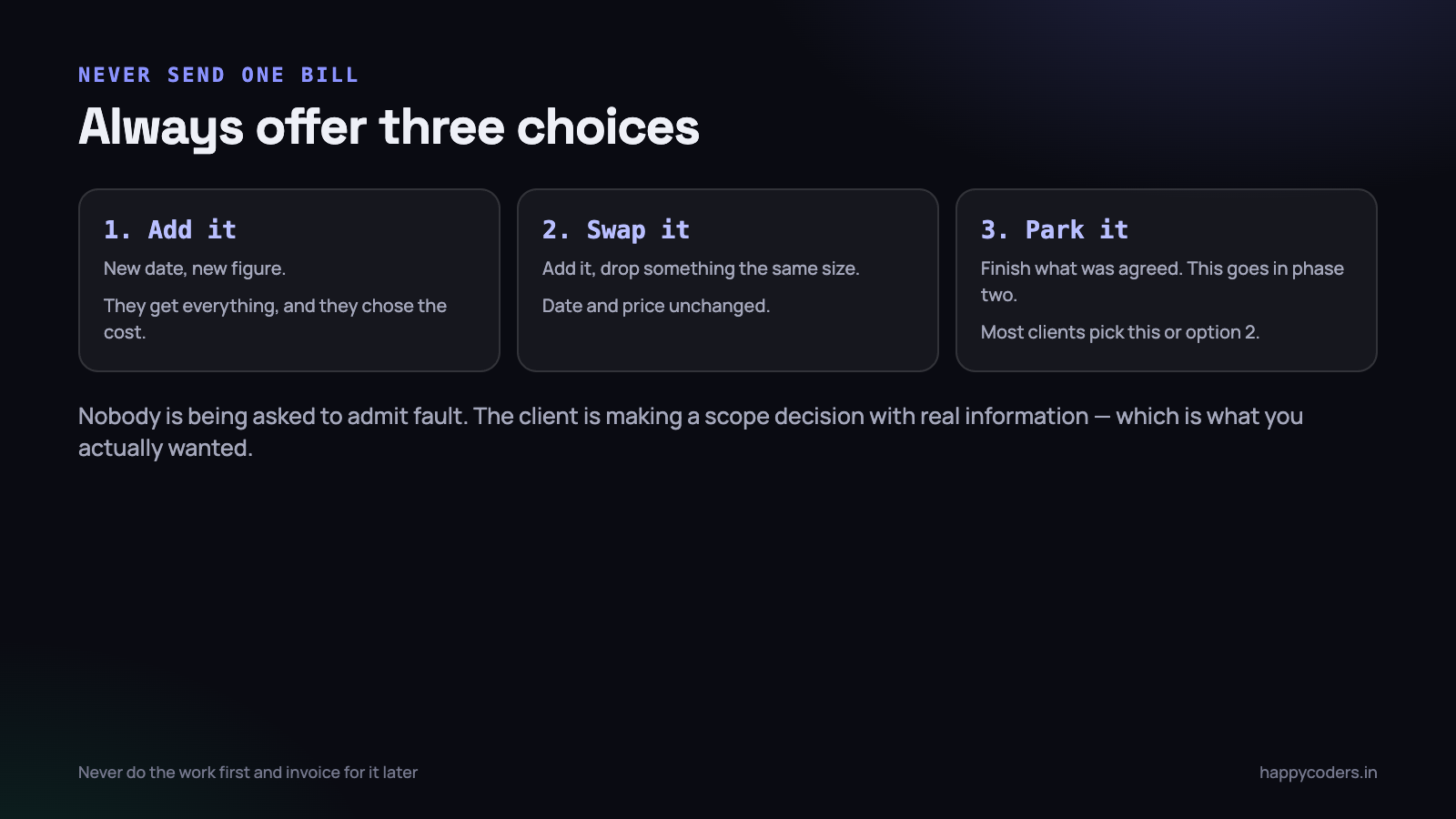
This is the most useful single technique in the whole article. Never present a change as a demand for more money. Present it as a choice the client makes:
- Add it, extend the timeline and the cost. Here is the new date and the new figure.
- Add it, and drop something of similar size. The date and the cost stay where they are.
- Park it for phase two. We finish what was agreed, and we do this next.
Most clients pick option two or three, and both are fine outcomes. The important part is that the client is now making a scope decision with real information, which is what you actually wanted. Nobody is being asked to admit fault.
Never do the work first and invoice for it later
A surprise line item on a final invoice does more damage to a relationship than any difficult conversation in month two. If the client has not agreed to it in advance, you are not billing for extra work — you are presenting a bill for something they believed was included.
A worked example
A ₹2,40,000 website project, quoted at 160 hours across four phases, for an eight-week delivery.
By week three the design phase has taken 54 hours against an estimate of 40. Small, and easy to ignore. The project manager checks the task breakdown and sees that 22 of those hours are revisions after the second review — more than the 18 hours spent on the first design. The request log has six entries, all verbal, none agreed.
Raised in week three, the conversation is two minutes long:
- “Design has taken 54 hours against 40, and 22 of that is revisions after sign-off. I want to flag it now rather than at the end.”
- “Here are the six additions since we started. Three of them are genuinely new — the second language, the sales email and the report filter.”
- “So: add all three and move the date by nine days, or add the language and drop the filter, or we finish as agreed and pick these up in phase two.”
The client picks the third. Nobody has been accused of anything, the relationship is intact, and the project finishes on time at the quoted price — with a phase two conversation already open.
Now the same situation, raised in week eight instead. The project is 40 hours over, the invoice has to change, the client remembers the additions as clarifications rather than requests, and nobody has a record. That is the same facts, five weeks later, and it is a dispute.
Four sentences worth having ready
Most of this comes down to being able to say something in the moment, without preparing for it. These four cover the majority of situations.
- For a small request, in the moment: “Happy to do that — let me add it to the change list so we can see where we are on time.” Nothing is refused, and the request is now counted.
- For the fifth small request: “That is the fifth addition this month, which together is about a week. Shall we look at what to move?”
- For something genuinely new: “That is outside what we scoped, and it is a good idea. Give me an hour and I will come back with what it costs and what it does to the date.”
- For a new stakeholder reopening a decision: “That was signed off in week two — here is the note. We can change it, and here is what changing it costs.”
None of these say no. That is deliberate: the goal is never to refuse work, it is to make sure every addition is a decision somebody made with the cost visible, rather than something that happened.
Fix the proposal, so it happens less
Most creep is created at proposal stage and only discovered at delivery stage. Four changes prevent a surprising amount of it.
- Write what is not included. A short “not in this scope” list is the highest-value paragraph in any proposal. Content writing, data migration, third-party licence costs, training, hosting, post-launch support.
- Put a number on revisions. “Two rounds of revisions per deliverable; further rounds quoted separately.” One sentence that prevents the most common overrun there is.
- Define the vague words. If the proposal says “reports”, list them. If it says “responsive”, name the breakpoints. Every undefined word is a future disagreement.
- Name the approver. One person on the client side who can say yes. Without this, a new stakeholder in month two can reopen anything.
None of this requires a lawyer or a longer document. It usually makes proposals shorter, because specificity replaces hedging.
When it is your fault
Sometimes the record shows something uncomfortable: there were only two additions, and the project still ran 60% over. That is not creep. That is an estimate that was wrong.
This is genuinely valuable to know, and only tracked time will tell you. The right response is to absorb it, say so if asked, and change the next quote — which is the whole reason for measuring in the first place.
Over a few projects this is where the real money is. Most agencies discover a consistent pattern — testing is always under-estimated, or content always takes three times longer than planned — and adjusting for it improves every future quote. Blaming the client for a bad estimate costs you both the relationship and the lesson.
One habit, if you only adopt one
Put a two-minute check in the calendar every Friday: hours so far against estimate, per phase, for every live project. That is it. No process, no meeting, no document.
Almost every scope disaster is a problem that was visible in week two and looked at in week nine. The check does not prevent creep — nothing does — it just moves the discovery forward by six weeks, which is the entire difference between a short conversation and a dispute.
The short version
- Separate change requests, creep and under-quoting. They need different responses.
- Track hours against tasks, not only projects, so revisions are visible separately.
- Keep a dated, visible log of every addition. The visibility alone slows it down.
- Estimate per phase so you see the overrun in week two.
- Raise it early, with the record rather than the grievance.
- Offer three options; never send a surprise invoice.
- Write what is not included, and put a number on revisions.
- When the data says the estimate was wrong, fix the next quote.
Happy Tracker records time against projects and tasks with sprint-level reporting, so the difference between building something and revising it is visible while the project is running rather than after it has finished. It is free for up to five users with no time limit.