A monthly retainer is the best commercial arrangement a small agency can have. Predictable revenue, a client who already knows how you work, no sales cycle, no proposal writing. It is also the arrangement that most reliably becomes unprofitable without anybody noticing, because there is no single moment where it goes wrong.
A project that overruns announces itself: the date slips, and somebody has to explain. A retainer that overruns just feels busy. The same fee arrives on the same date, the invoice is never disputed, and eighteen months later your best developer is spending three days a week on an account that stopped covering its cost sometime last winter.
What follows is the small amount of structure that prevents that: how the creep is different, the hours bank and rollover rules, the monthly statement, the over-run conversation, and the annual review that should be in the contract from day one.
Retainer versus project, and why the creep is a different shape
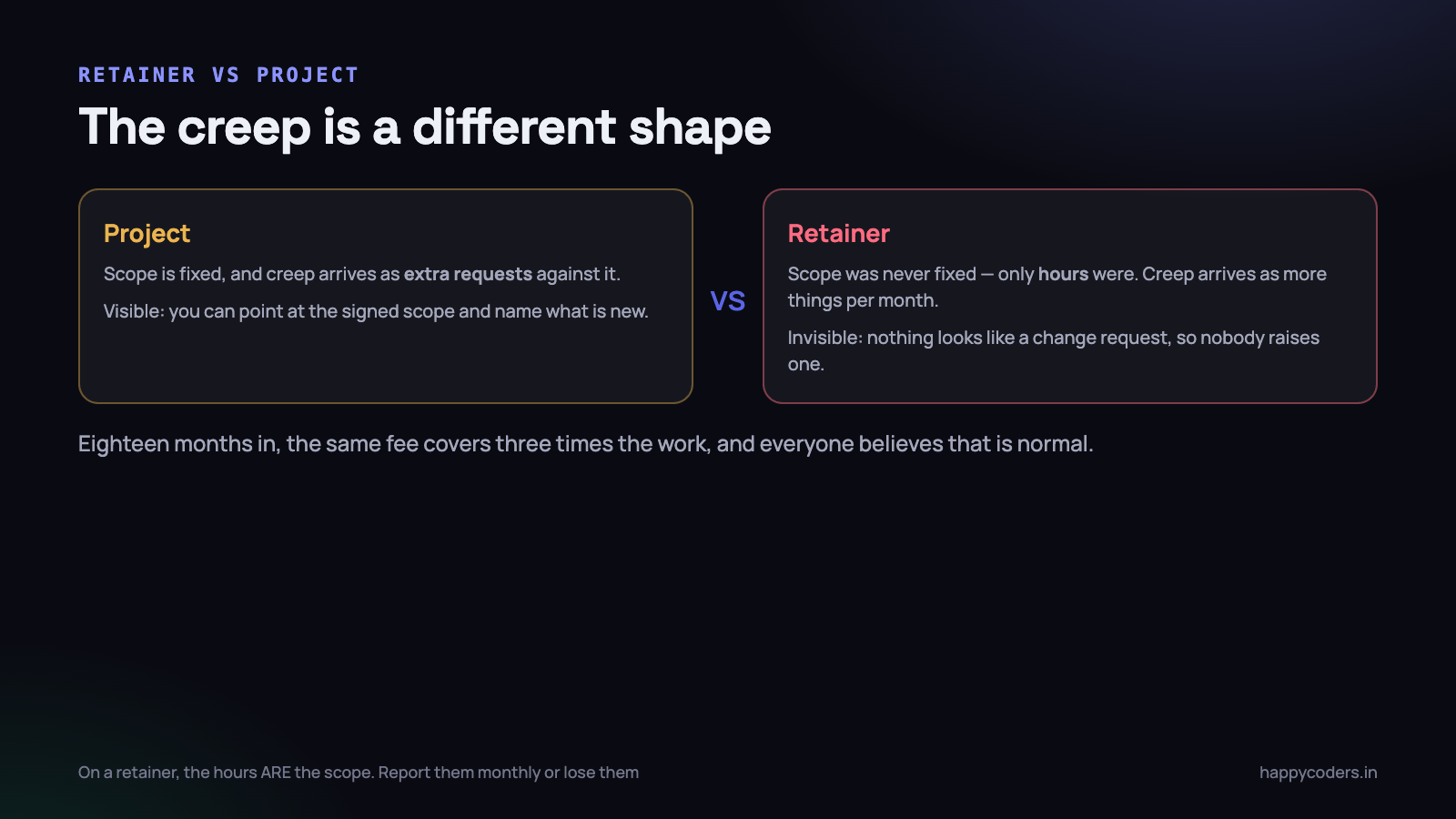
On a fixed-scope project, scope is the thing that was agreed. When the eleventh request arrives, there is a document it is not in, and that document does the work of raising the question for you. Awkward, but structurally simple — and covered in our post on handling scope creep.
On a retainer, scope was never fixed. What was fixed was hours. The client bought 40 hours a month and a response commitment; what those hours get spent on was deliberately left open, because flexibility is most of what they are paying for.
That is the trap. When a new kind of work arrives — the client’s new marketing site, a second brand, an integration with their warehouse system — there is no document it falls outside of. It is just this month’s work. Nobody raises a change request, because nothing looks like a change.
The growth is real and gradual. Year one: a website, some support, a few landing pages. Year two: the same, plus an e-commerce integration and monthly reporting. Year three: all of that, plus a second brand and a staging environment that somebody on your team maintains. Same fee, every month, and every step felt reasonable at the time.
On a retainer, the hours are the scope. If you are not reporting hours to the client every month, you have no scope at all — only a fee and a growing set of expectations.
The hours bank
Treat the retainer as a bank account with a monthly deposit rather than a subscription to your availability. It is a small mental shift and it changes every subsequent conversation, because a balance is something both sides can look at.
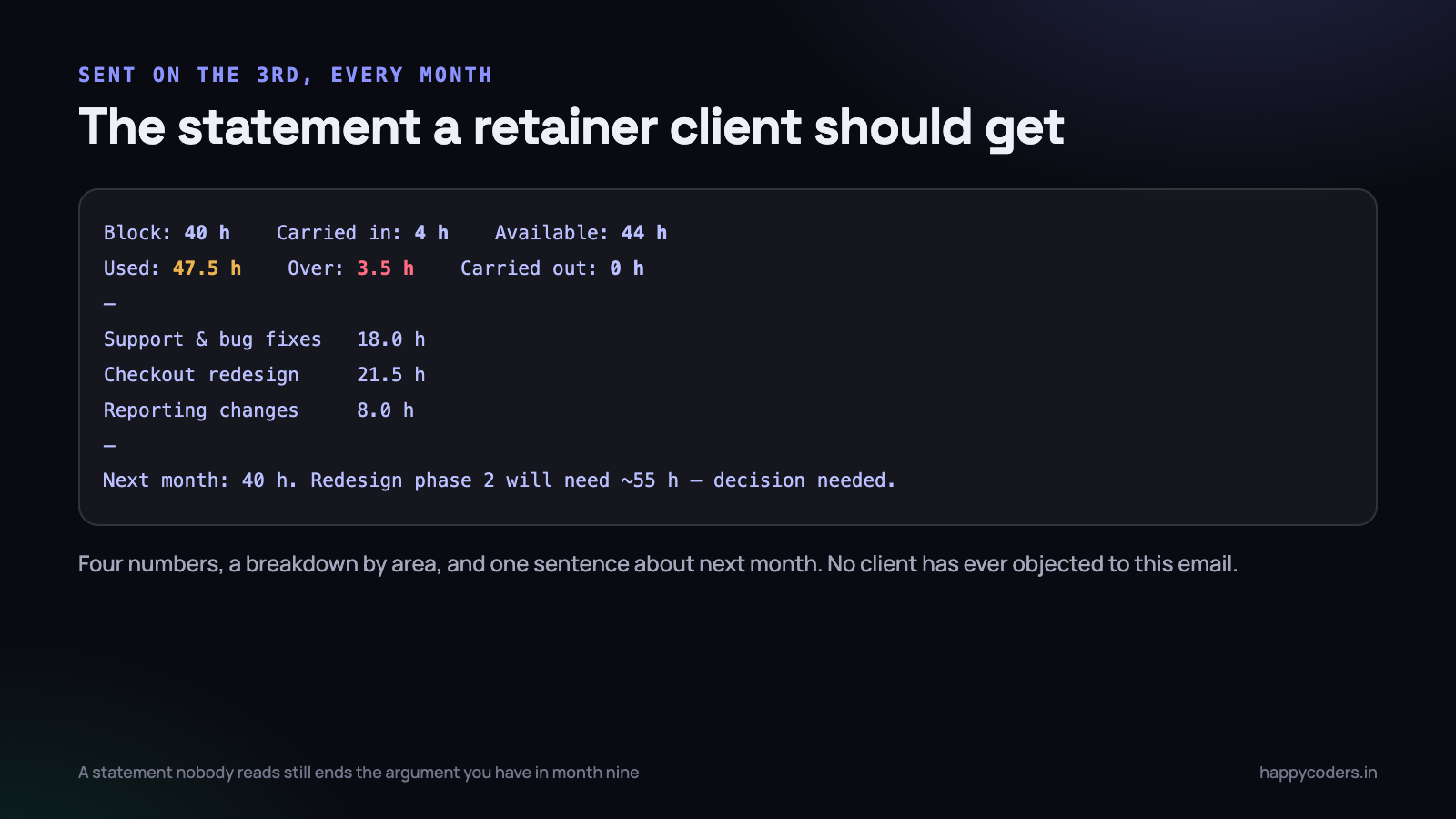
Four numbers define it: the monthly block, what was carried in, what was used, and what is carried out or billed as overage. Every retainer argument I have seen came from one of those four never being written down.
Rollover, and why unlimited is a trap
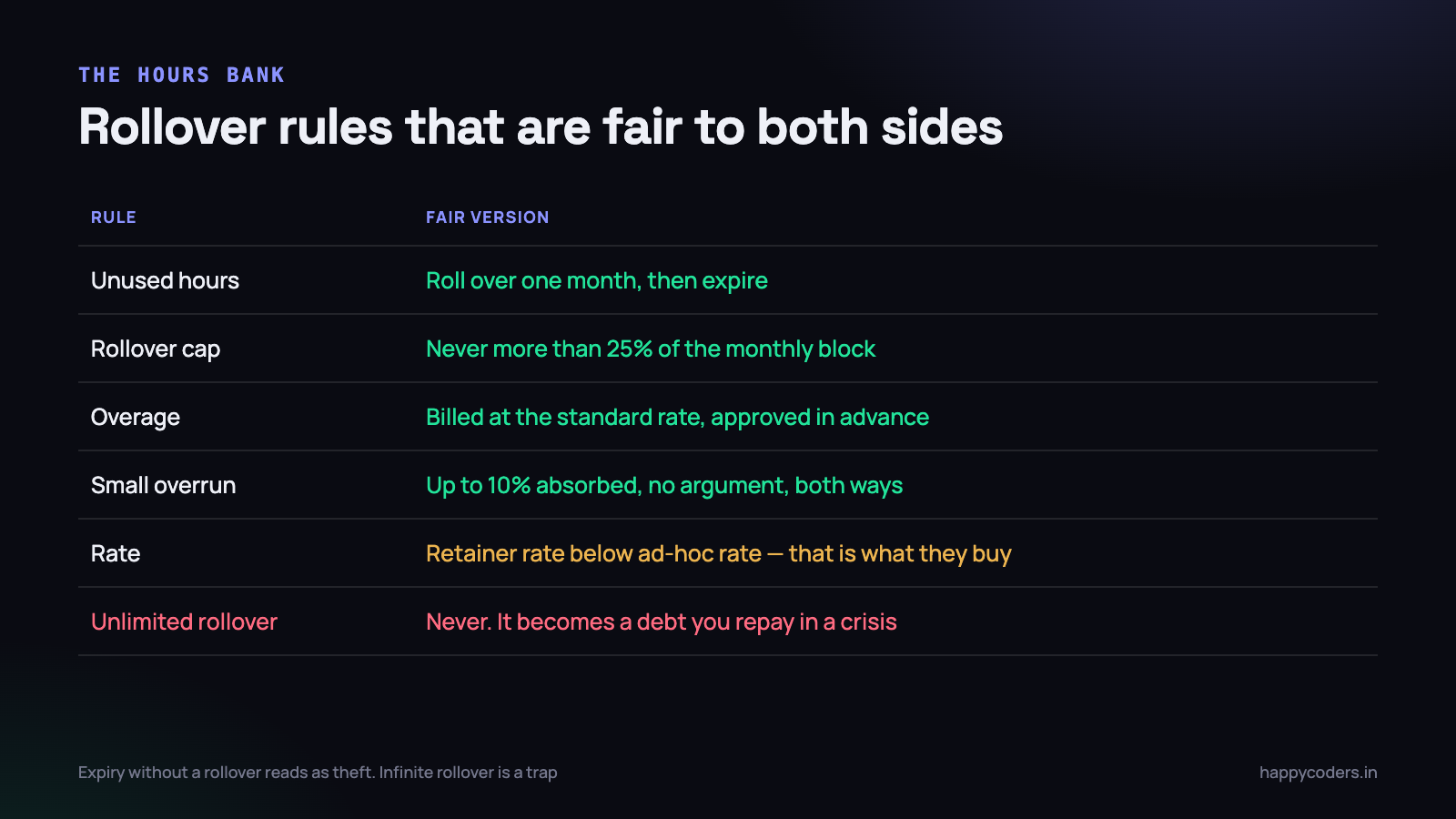
If a client uses 31 hours of a 40-hour block, what happens to the nine? There are three common answers and only one of them is fair.
- Use it or lose it. Simple, and clients hate it — reasonably, since a quiet month is often quiet because the client was waiting on you.
- Unlimited rollover. Feels generous and is a trap. Eighteen months of small underuse builds a 60-hour balance, which the client will spend all at once during their busiest fortnight, when you have no capacity. You have accepted a debt repayable on demand at a time you cannot choose.
- One month, capped. Unused hours roll forward one month and then expire, with the rollover capped at about 25% of the block. Fair to the client, bounded for you, and easy to explain in one line.
The capped version works because it matches the real reason retainers exist. The client is buying reserved capacity, not storing credit. Capacity you reserved in March cannot be delivered in November; that is the honest basis for expiry, and clients accept it when it is said that way.
Overage, and the 10% band
The other direction needs a rule too. Hours beyond the block are billed at the standard hourly rate, and — this is the part people skip — they need approval before the work happens, not after. An overage invoice for work the client did not know was over is how retainers end.
Add a tolerance band in both directions: up to 10% over is absorbed, no conversation, and up to 10% under does not trigger a credit note either. Without this you spend every month arguing about two hours, which is worse for the relationship than the two hours are worth.
The rate itself
The retainer rate should be meaningfully below your ad-hoc rate — 10 to 20% is typical. That discount is what the client is buying with their commitment, and the overage rate should be the standard rate, not the discounted one. Both of those are easier to establish at signing than to introduce in year two.
The monthly statement
One email, sent on about the third working day of every month, is the single highest-value habit in running retainers. It takes ten minutes if your tracking is set up properly, and it prevents almost every difficult conversation that retainers otherwise produce.
It has four parts:
- The four numbers. Block, carried in, used, carried out or over. Put them on one line at the top, where they cannot be missed.
- A breakdown by area. Not forty task lines — three to six groupings the client thinks in: support and bug fixes, the checkout redesign, reporting changes. They want to know what the month bought, not what each developer did on Tuesday.
- Anything unusual. The incident that cost six hours. The week their approvals were slow and the team was idle. Say it in one neutral sentence while it is recent and unremarkable.
- One sentence about next month. “Next month is the standard 40 hours. Phase two of the redesign is roughly 55 hours, so we should decide whether to spread it over two months or add a block.” This is the sentence that does the actual work.
That last line is why the statement matters. It moves every capacity decision from the end of a month, when it is a complaint, to the start of one, when it is a choice the client gets to make. A client who chose the extra block does not dispute the invoice for it.
Send it even in a boring month. Especially in a boring month — a statement that only appears when there is bad news trains the client to dread it. If the tracking gives you the numbers, this is copy, paste and one sentence of thought.
The month that runs 40% over
It will happen: an incident, a launch, a client whose own deadline moved. Forty hours booked, fifty-six used. What you do depends almost entirely on when you noticed.
If you notice during the month
This is the good case, and it is the reason to check the balance mid-month rather than at the end. At around 75% of the block used, send three lines: “We are at 30 of 40 hours with ten days to go, mostly the checkout work. At this rate we will land around 56. Do you want us to continue and bill the overage, hold the redesign until next month, or stop at 40?”
Almost every client picks one of the three without complaint, because they are being given a decision rather than a bill. The ones who choose to stop at 40 were never going to pay the overage happily, and you have just found that out for free.
If you notice at month end
Harder, and part of it is yours. You did the work without asking, so you carry some of the cost of not having asked. A reasonable split: bill the overage that came from work they explicitly requested in writing, absorb the part that came from your own estimate being wrong or from an incident on your side, and say plainly that you will flag it mid-month in future.
Do not silently absorb all of it while feeling aggrieved. That is how a retainer becomes permanently unprofitable — the client learns that 56 hours costs the same as 40, and next month they ask for 56 again, entirely innocently.
If it happens three months running
Then it is not an overrun, it is the real size of the account, and the block is wrong. Stop treating it as an exception and propose the correct number: “We have averaged 54 hours over the last three months. I would rather move the retainer to 55 hours at the retainer rate than keep sending overage invoices — it is cheaper for you and more predictable for both of us.”
That is an easy conversation to have with three months of tracked hours in front of you and an impossible one without them.
The annual review
Put a review date in the contract at signing. Not because you expect trouble, but because a scheduled review is a normal business process, while an unscheduled one is a confrontation the client did not see coming.
Before the meeting, look for these five signals:
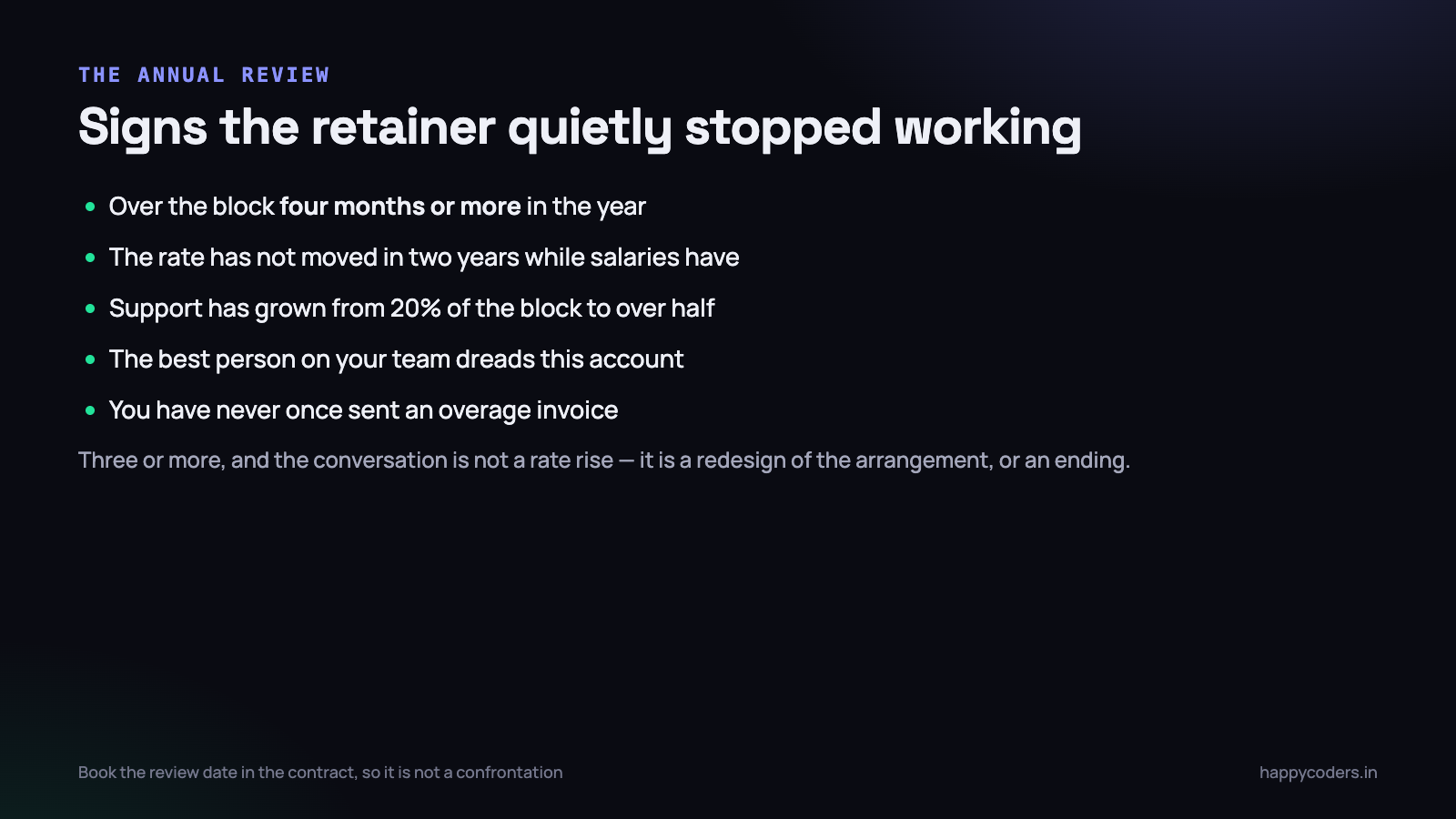
- Over the block four months or more in the year. Once or twice is normal variation. Four times is the wrong block size.
- A rate that has not moved in two years while salaries have. In India, developer costs have moved enough that a flat rate for three years is a real-terms cut of a fifth or more.
- Support growing from a fifth of the block to over half. This is the classic decay pattern. The interesting work that made the account worth having has been squeezed out by maintenance.
- Your best person dreads the account. Ask them directly. This is a commercial signal, not a morale one, and it usually precedes a resignation or a quality problem.
- You have never once sent an overage invoice. Either the account genuinely runs under, or you have absorbed every overrun for a year and called it relationship management.
Three or more and the honest conversation is not a 10% rate rise. It is a redesign: change the block, split support onto its own smaller retainer with a defined response time, move project work back to being quoted per project, or end the arrangement cleanly.
Ending a retainer well is an underrated skill. Give a long notice period, offer a transition, and say the real reason plainly. Agencies that do this get referrals from clients they resigned. Agencies that let an account rot until somebody snaps do not.
Clauses worth writing down at the start
None of this needs a lawyer. One page, agreed at signing, in ordinary language:
- The block and the rate. Hours per month, the retainer rate, and the standard rate that overage is billed at.
- Rollover. One month, capped at 25%, expires after that. In one sentence.
- The tolerance band. Up to 10% either way is absorbed without adjustment.
- Overage approval. Work beyond the block is flagged and approved before it is done.
- What the hours cover. Development, review, deployment, and meetings about the work. Say explicitly whether client calls and reporting come out of the block, because this is the most common single disagreement.
- Response time, if any. If you are promising four-hour response on production issues, that reserves capacity and should be priced.
- The monthly statement. That you will send one, and by when. Committing to it in the contract makes it a habit rather than a favour.
- The review date. Annual, in a named month, to reassess the block and the rate.
- Notice. Thirty or sixty days, both ways, so neither side is trapped.
The clause people fight over later is the fifth one. A client who believes their weekly status call is free, and an agency that logs it against the block, will have that argument in month four. One sentence at signing prevents it entirely.
What the tracking has to give you
All of this rests on hours you can actually report, which means a few specific things from whatever you use:
- Hours against tasks within the retainer, so the monthly breakdown by area is a query and not an hour of reconstruction.
- A running month-to-date total you can check on the 15th, which is what makes the mid-month conversation possible at all.
- Meeting and admin time logged too. If calls come out of the block, they have to be tracked, or your statement understates the month and you have quietly given the hours away.
- An export the client can read without you rebuilding it in Excel.
Happy Tracker covers that part: time against tasks and projects, a month-to-date view per project, and an export for the statement. It will not tell you whether the retainer is profitable — that needs your people costs and the fee alongside the hours, which is arithmetic you do once a year in a spreadsheet. What it gives you is the hours, which is the input nobody has when this conversation goes badly.
What to do on Monday morning
- List every retainer you run, with its monthly block, its fee, and the hours actually used each month for the last six months.
- Mark any account that has been over block three times or more. Those are your real problems, in order.
- Draft the monthly statement template once, with the four numbers at the top, and send it for every retainer this month.
- Put a mid-month reminder in your calendar to check month-to-date hours against the block for each account.
- Write the one-page clause list and attach it to the next retainer you sign.
- For your oldest retainer, book the review conversation now — that is the one most likely to have quietly stopped working.
The whole system is about ten minutes a month per client once the template exists. What it buys is that you find out an account is in trouble in month two rather than in year two, while changing it is still an ordinary business conversation.