
Who Should Be an Admin, a Manager, and an Employee
Roles get set up in the first ten minutes of using a new tool, by one person, who is in a hurry. The usual result is that everybody is an administrator, because that was fastest and nothing bad happened immediately.
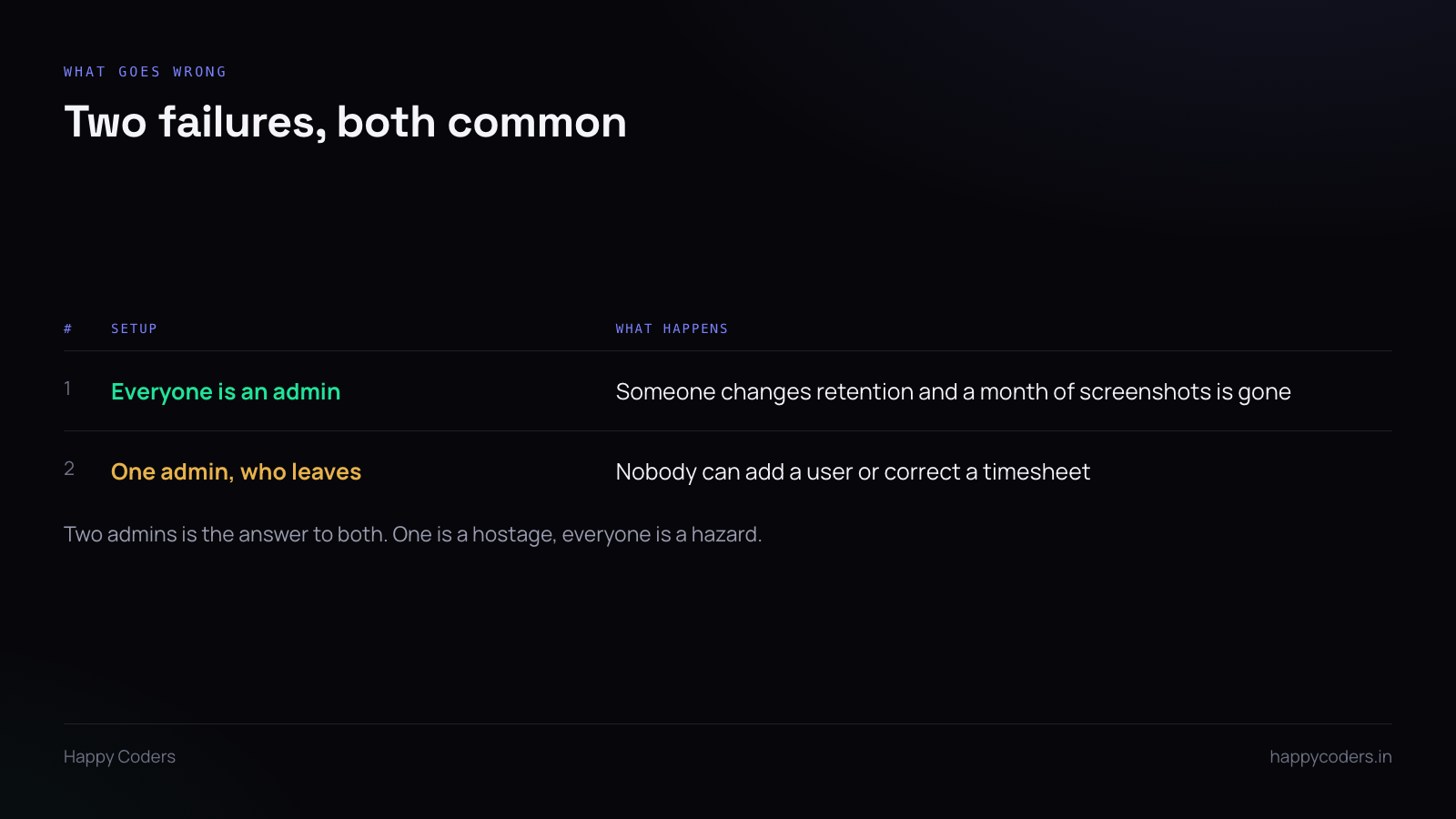
Something bad happens later, and it is always the same two things.
What the roles are actually for
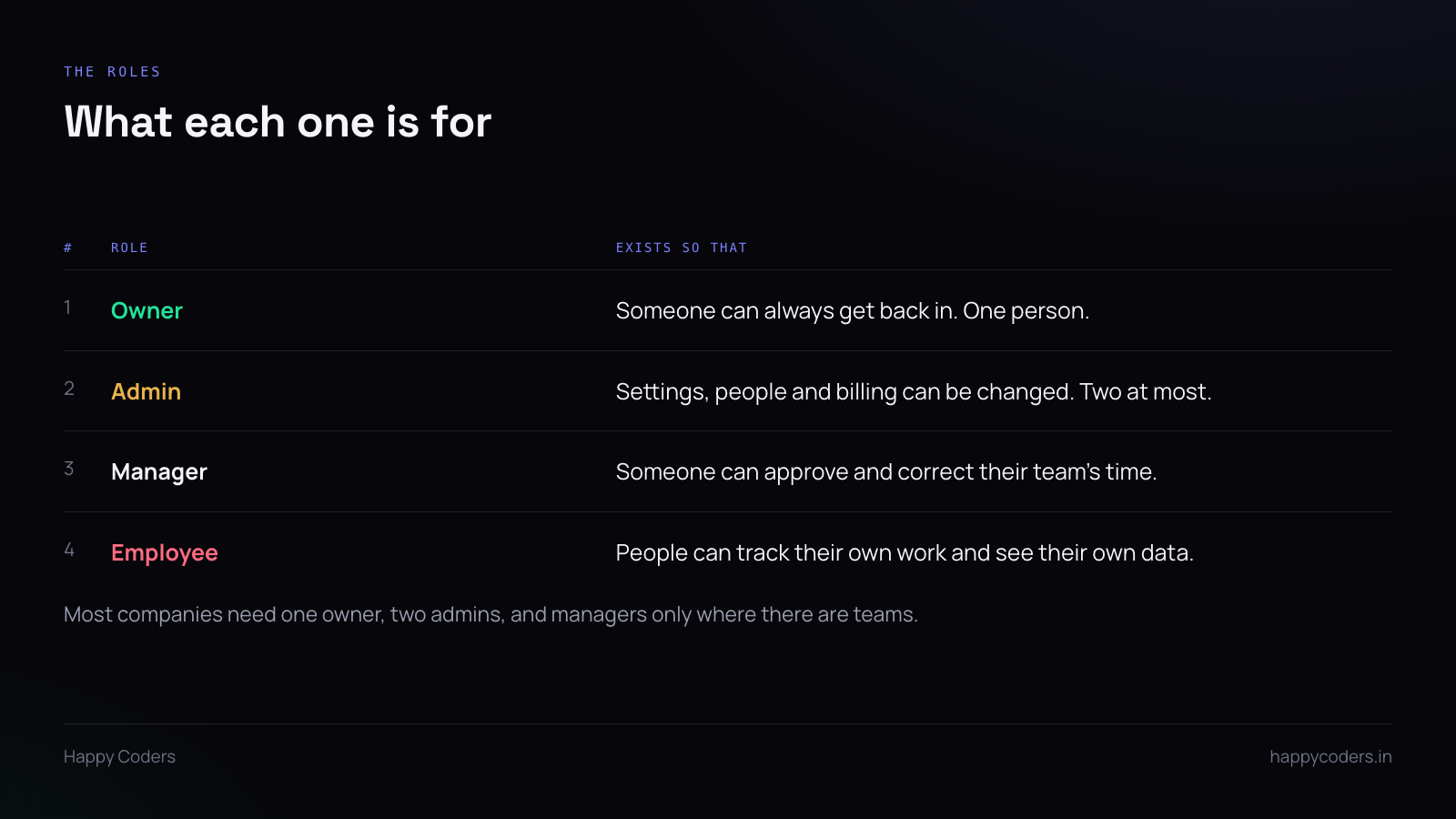
Owner exists so that somebody can always get back in. It is the account that cannot be locked out, cannot be removed by anyone else, and holds the billing relationship. One person. Usually whoever signed up.
Admin exists so that settings, people and plans can be changed without going through the owner for everything. Adding a new joiner, changing the screenshot interval, correcting a timesheet, buying seats.
Manager exists so that someone close to the work can approve and correct it. A manager sees their team’s time, approves their weeks, and fixes the forgotten clock-outs. They do not touch company settings or billing.
Employee tracks their own work and sees their own data — their time, their screenshots, their activity, their leave. That last part matters more than it sounds: a person who cannot see what is recorded about them experiences the tool very differently from one who can.
Failure one: everyone is an admin
Nothing goes wrong for a month. Then somebody, meaning well, changes a setting.
Retention is the one that hurts. A person tidying up reduces screenshot retention from fifteen days to three, and three days later twelve days of screenshots are gone from everyone’s history — including the week a client is about to query.
Others: someone changes the screenshot interval and staff notice the rhythm change and assume a decision was made about them. Someone removes a user who left and takes their history with them, depending on how the tool handles deletion. Someone turns off the browser clock-in restriction because it was inconvenient for them that morning.
None of these people did anything malicious. They had a button and a reason.
Failure two: one admin, who leaves
The opposite, and it arrives at the worst time.
One person set everything up. They leave, or go on holiday, or simply change phone and lose access. Now nobody can add the new joiner starting Monday, nobody can unlock a device, nobody can correct a timesheet before invoicing.
Two admins. Not one, not everyone.
Managers: only where there are teams
Do not make someone a manager because they are senior. Make them a manager because there is a group of people whose time they are responsible for approving.
In a team of eight there is often no manager layer at all — one admin approves everyone and that is fine. The role earns its place at the point where one person cannot sensibly review every week, which is somewhere around fifteen or twenty people.
Two rules worth enforcing in the tool
Nobody approves their own timesheet. Including the most senior person present. The entire value of approval is a second pair of eyes, and a self-approval is a click with nobody behind it. If your tool does not block this, make it a rule and check it occasionally.
Every correction is recorded. Admins and managers need to edit other people’s entries — somebody will forget to clock out and it has to be fixed before invoicing. What makes that safe rather than alarming is that the change is written to an audit log with a name against it.
An edited timesheet with a trail is a corrected record. The same edit without a trail is a disputed one, and the dispute surfaces months later when nobody remembers.
Acting as someone else
Some tools let an admin view the product as a specific member, to reproduce a problem or file leave for someone who is in hospital. That is genuinely useful and it needs one thing to be safe: both identities recorded on every action taken.
If the log says the member deleted their own entry at 11pm, and in fact an admin did it while impersonating them, you have a record that is confidently wrong. That is worse than no record.
The five-minute review
Once a quarter, open the people list and read it.
How many admins are there? Is anybody on it who left? Is anybody a manager with nobody to manage? Is the owner still someone who works here?
Roles drift. Somebody gets admin for an afternoon to do one thing and keeps it for two years. The list is short and reading it takes five minutes, which is less time than the first thing that goes wrong.