When it is only you, time tracking is bookkeeping. You log hours so you can invoice correctly and know whether a job was worth it. Nobody else sees it, nothing is at stake in how you describe your own day.
The first employee changes that completely, and it changes on their first morning.
What is different
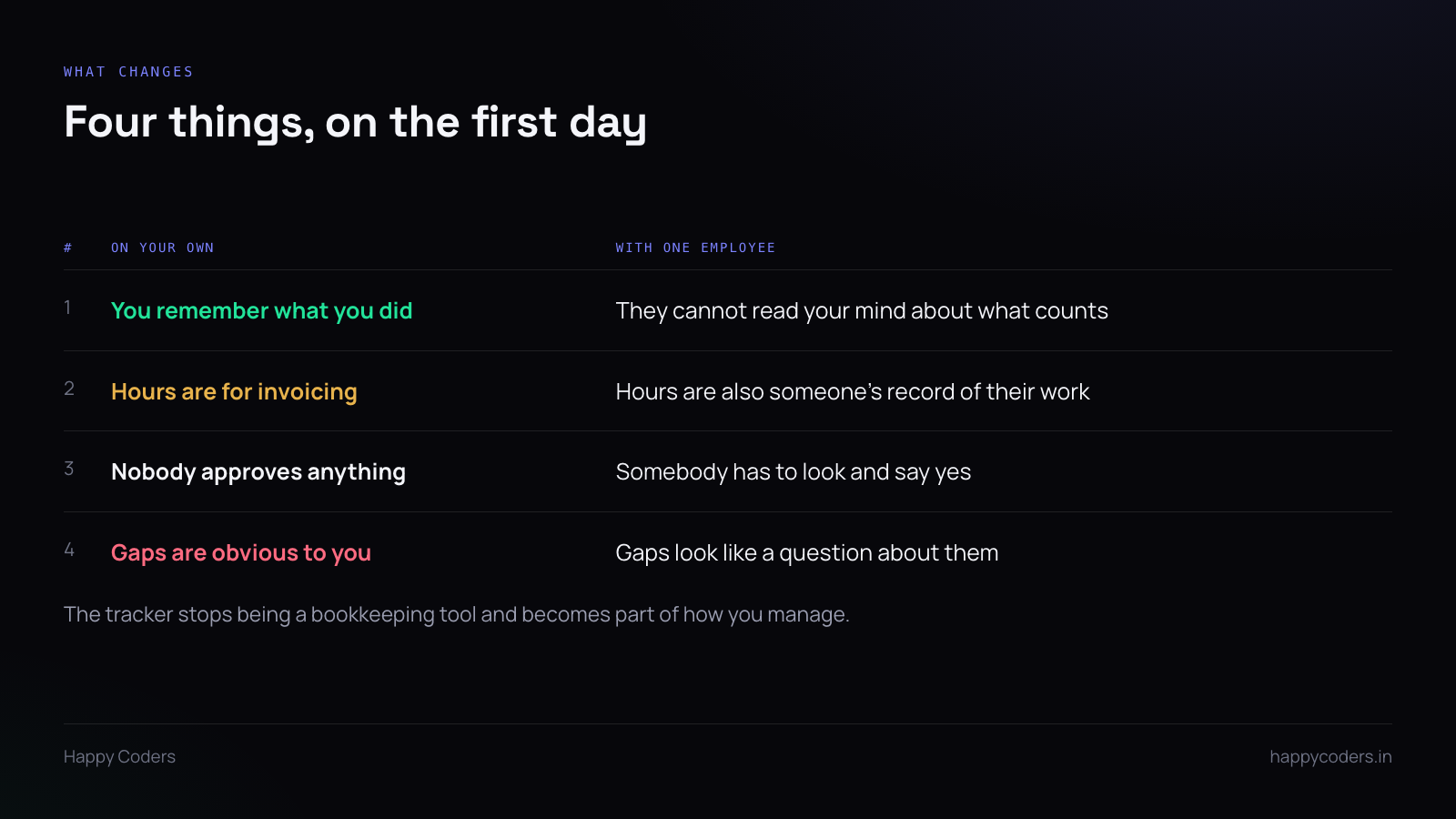
They do not know what counts. You have never had to define it. Does reading documentation count? Does the half hour spent helping someone else? Does the client call that was mostly social? You answered these implicitly for years; now somebody is going to ask, and if you do not have an answer they will invent one.
The timesheet is now a record about a person. Your own gaps meant nothing. Theirs look like something that needs explaining, whether or not you intend them to. That shifts how it feels to fill in, and it shifts what people write.
Somebody has to approve. You never approved your own work. Now there is a weekly moment where you look at their hours and say yes.
The tool is part of how you manage. Not an accounting tool any more. What you look at, what you comment on, and what you ignore teaches them what you care about.
Decide four things before they start
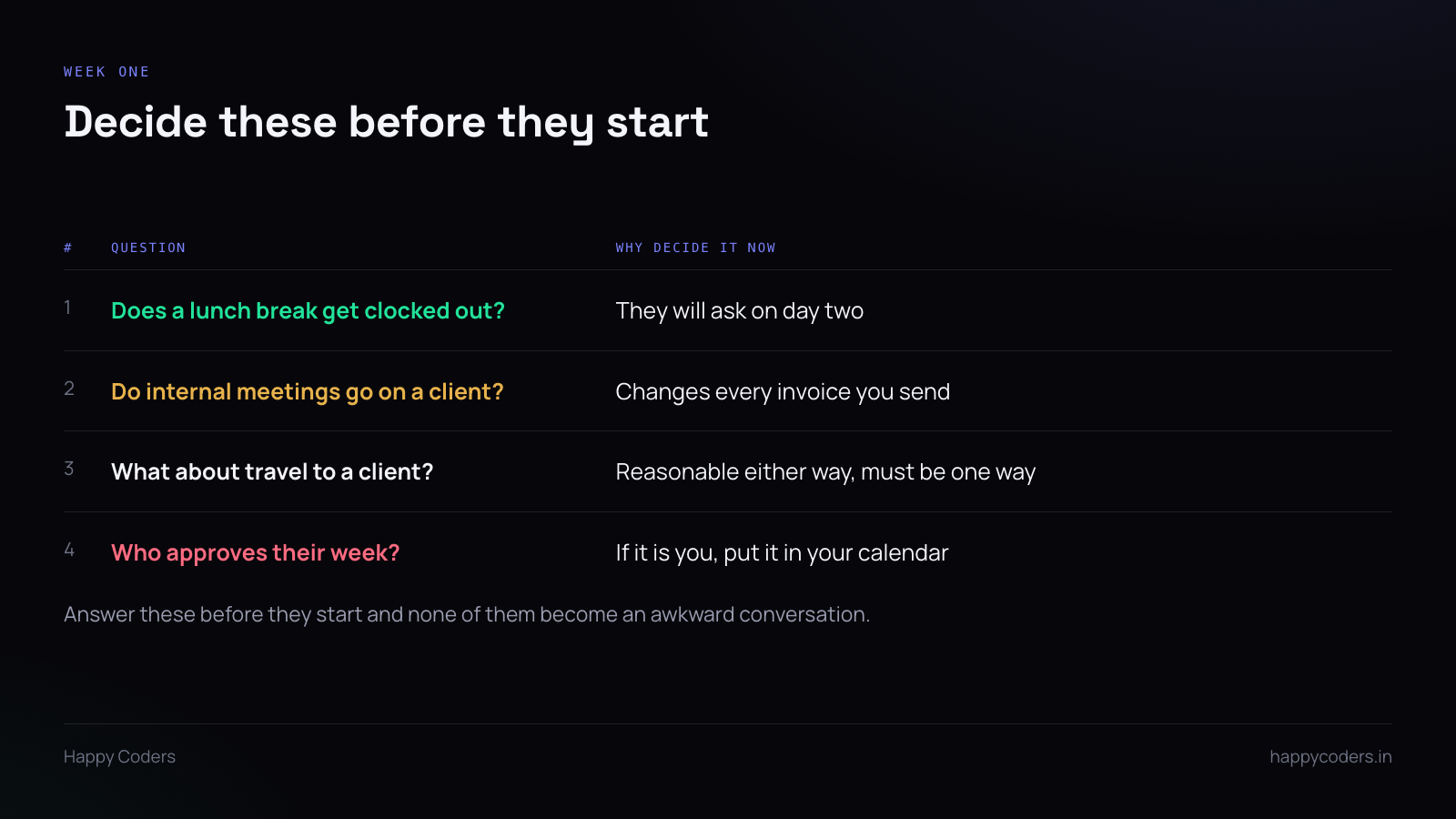
These come up in week one regardless. Deciding them in advance makes them administrative; deciding them in response to a question makes them a negotiation.
Breaks. Does lunch get clocked out? Either answer is fine and the team should know which. If you say nothing, half will clock out and half will not, and the hours become incomparable.
Internal meetings. A standup about a client’s project — is that billable to the client, billable to internal, or not tracked? This one changes every invoice you send, so decide it with the invoice in mind.
Travel. Two hours to a client’s office and back. Billable, non-billable, or half? All three are defensible. Only one can be the rule.
Who approves. With one employee it is you. Put it in the calendar on a fixed day, because an approval that happens when you remember will happen twice.
Say what the hours are for
This is the conversation that decides how the next year goes, and it takes two minutes.
The honest version is usually: we bill clients for time, so the hours have to be accurate, and when a client queries an invoice this is what we show them. That is a reason anybody understands.
What it is not for: measuring how hard someone works. If a new employee believes the timesheet is a productivity score, they will manage it, and from then on you have a document that reflects what they think you want rather than what happened.
Worth saying the second part explicitly, because they will assume it otherwise. Everyone has worked somewhere the timesheet was used that way.
Do not start with monitoring
Whatever you intend long term, the first employee’s first week is the wrong time to introduce screenshots.
The signal is bad in a way that is hard to recover from — on day one, before they have done anything, you have told them you do not trust them. Hours against projects is enough to run the business. If you later need more, that is a conversation with a reason attached, which is a different thing from a default.
Look at it weekly, and say something
Two minutes on a fixed day. Not to check up on them — to catch the thing that is wrong before it reaches an invoice.
The most useful habit is to say something when it is fine. “Week looks good, approved” costs nothing and establishes that approval is routine. If the only time you ever mention the timesheet is when something is wrong, the timesheet becomes a thing that only brings bad news, and people start managing it accordingly.
The first month will be untidy
They will forget to clock in. They will log a day to the wrong project. They will clock in and leave it running overnight at least once.
None of that is a character problem and treating it as one is the fastest way to teach somebody that the timesheet is a trap. Fix the entry, say what happened, move on. By week four it is habit and you will not think about it again.