There is a thing your business does once a month. The client report that pulls from three systems. The reconciliation. The invoice run. The export somebody has to clean up before sending.
It takes two hours, and about forty minutes of that is remembering how.
Monthly is the worst frequency
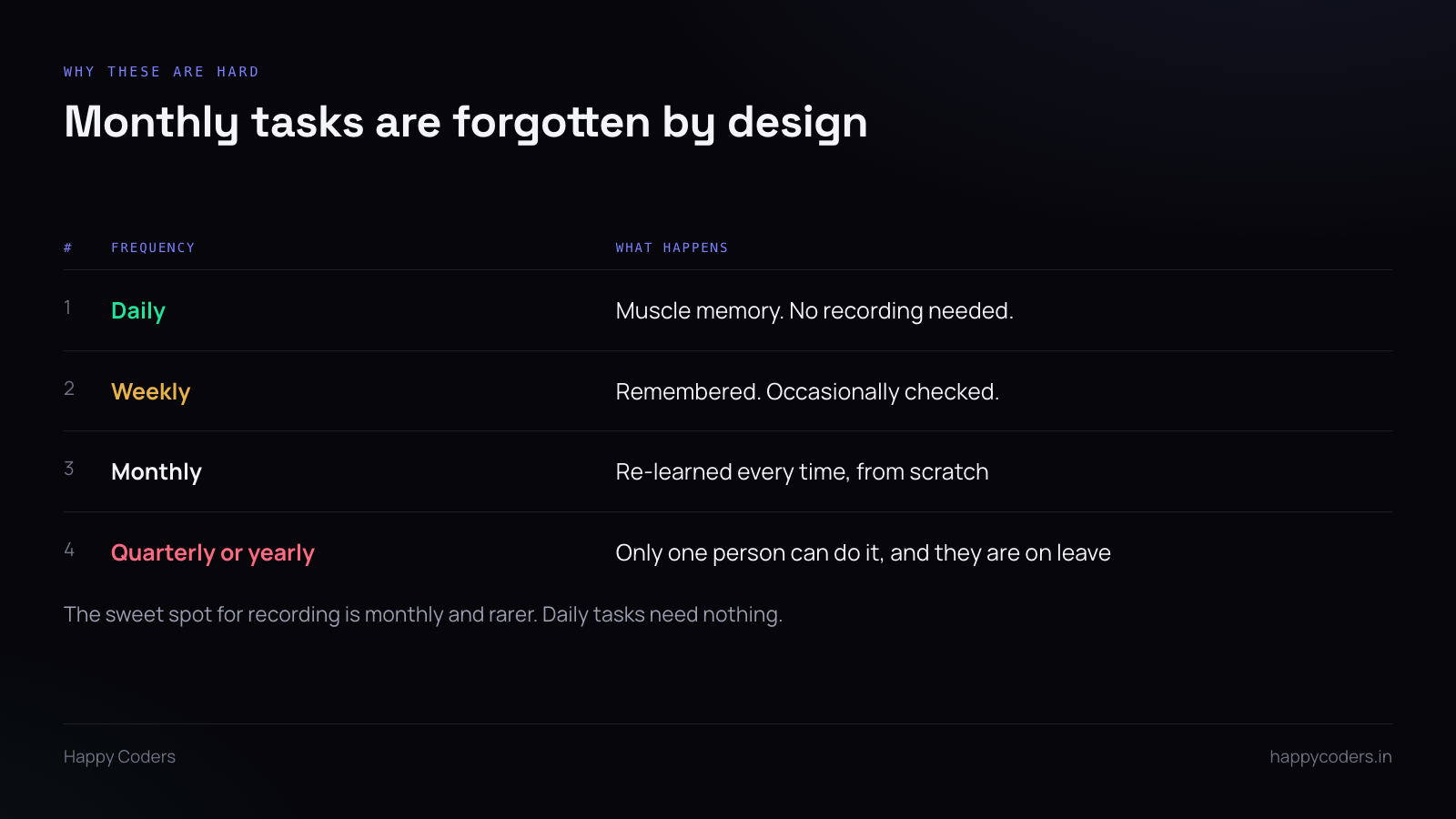
Daily tasks become muscle memory and need no documentation. Weekly tasks stay in reach.
Monthly is the gap. Four weeks is long enough to forget the order, which screen the setting was on, and the step that has to happen before the other step or it fails silently. So every month somebody re-derives it, and it takes longer than it should.
Quarterly and yearly are worse still, with an extra problem: usually only one person has ever done it, and the first time they are unavailable it turns out nobody else can.
Record it while doing it
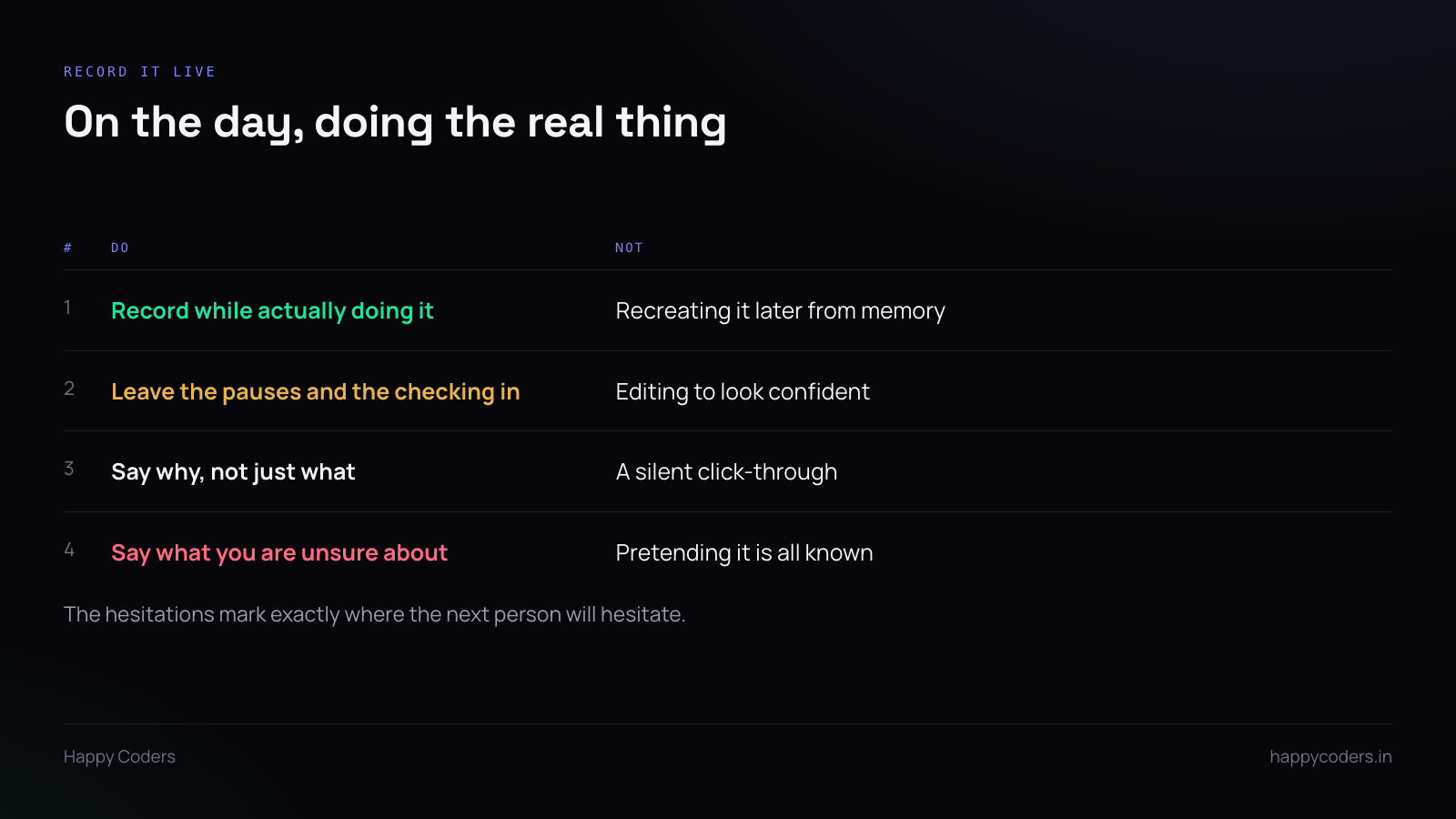
Not afterwards, not as a demonstration. On the day, doing the real thing, with the real data.
The difference matters. A recreation skips the parts that are obvious to you in the moment, and the obvious parts are exactly where somebody else gets stuck. Doing it live means the recording contains the hesitation where you checked something, and the hesitation is information.
It costs almost nothing. You were doing the task anyway; recording adds the time it takes to press a button.
Say why, not only what
The clicks are the easy half. The valuable half is the reasoning.
“I am running this before the export because if you do it after, the totals are a month behind.” Nobody would get that from watching. It is the thing that took somebody three months to learn and will take the next person three months unless it is said out loud.
Say the things you are unsure about too. “I am not actually sure why this field has to be set, but if you leave it blank the report comes out empty.” That is more useful than a confident explanation that is wrong, and it tells the next person where to be careful.
Leave the mistakes in
You will click the wrong tab. Something will take longer to load than you expected and you will say so. You will realise halfway through that you forgot a step and go back.
All of that stays. The wrong tab teaches which tab is wrong. The slow load tells the next person it has not frozen. The forgotten step is the single most useful moment in the file, because it is the step everybody forgets.
Resist re-recording for a clean take. A clean take is a worse recording.
Name it so it is found in a month
2026-10-monthly-client-report.mp4, not Recording 2026-10-12 11-04.mp4.
Better still, put it where the task is managed — attached to the recurring task, or linked from the calendar entry, so the person doing it next month finds it without looking.
The recording that exists but is not findable at the moment of need has not saved anybody anything.
Re-record it when it changes
Monthly processes drift. A system updates, a step moves, someone changes the format.
Because these recordings are cheap — you record while doing the task anyway — redoing one is almost free. Record it again any month where something was different. The old one can go.
This is the real argument for recording rather than writing these up. A written procedure for a monthly task goes stale and nobody updates it, because updating it is a separate job. A recording is updated by doing the task with the recorder on.
Start with the one that scares you
Every business has a monthly or quarterly task that only one person can do, and everybody knows which one.
Record that one next time it comes round. Not because the person is leaving — because the month they are ill is not the month to find out that the process lived entirely in their head.