Recording a meeting you are in is a different thing from recording your screen alone. Other people are in it, they did not necessarily choose to be, and the file afterwards is a record of things they said while thinking out loud.
Worth doing in some cases. Worth being deliberate about in all of them.
Say it, out loud, at the start
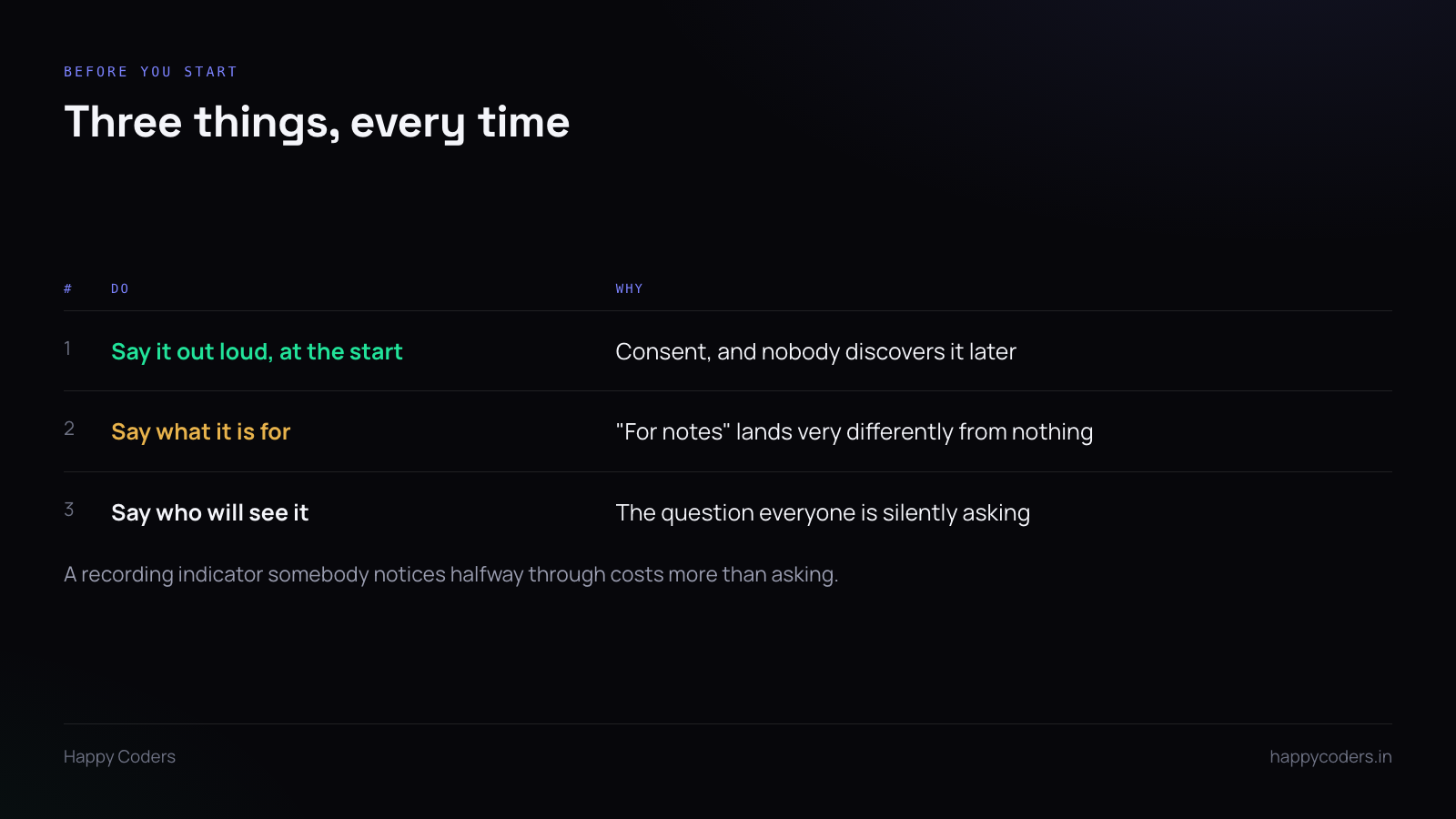
Not in the calendar invite. Not in a message beforehand that half of them did not read. Out loud, in the first ten seconds, before anything else.
“I am recording this so I can write the notes up properly afterwards — it is just for me and the team working on this.”
Three things in one sentence: that it is happening, why, and who sees it. That is all anybody needs, and it takes five seconds.
The alternative — somebody noticing a recording indicator at minute twenty — costs far more than asking. They will spend the rest of the meeting wondering what they said in the first twenty minutes, and the useful part of the conversation is over.
If anyone says they would rather not, stop recording. One person’s discomfort is worth more than your notes, and the person who objects is usually the one who was about to say something candid.
Where it is genuinely useful
A client explaining what they want. They will describe it once, in their own words, with the nuance that gets lost in the summary. Six weeks later when the requirement is disputed, the original sentence is worth having.
A technical handover or a training session. People who were not there need it. That is the whole reason.
A meeting where you are presenting and also need the notes. You cannot talk and write at the same time. The recording lets you do one and reconstruct the other.
Where it is not
Anything about a person. Performance, a complaint, a disagreement between two people. Recording changes how everyone behaves, and the recording itself becomes a document in whatever happens next.
Early thinking. The meeting where nobody knows the answer yet and people are floating half-formed ideas. That conversation only works if people feel free to be wrong, and a recording removes that.
Anything where one person has much less power than the others. Consent given by someone who does not feel able to object is not really consent.
The recording is usually not what anyone wants
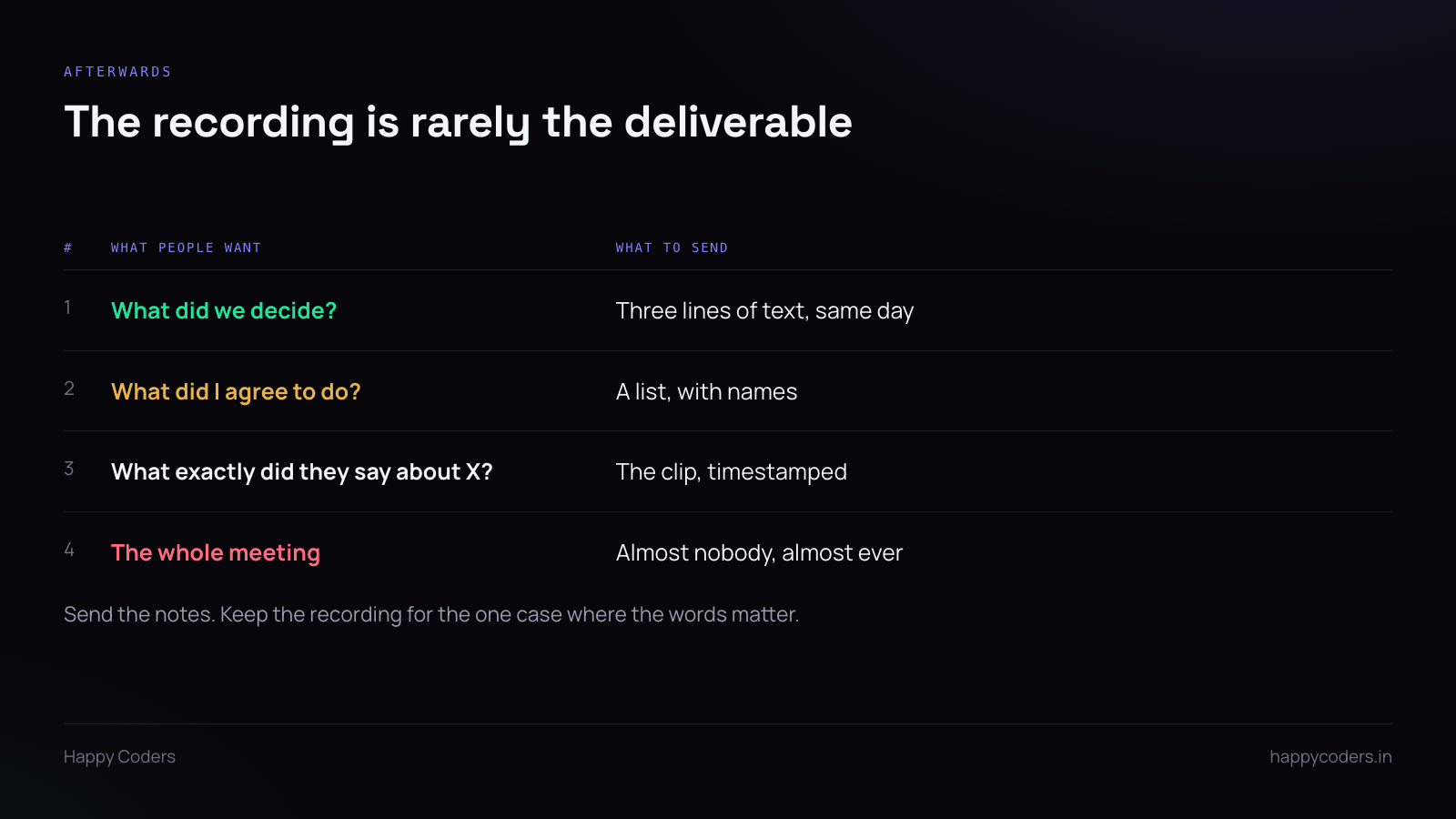
Here is the thing that catches people out. After the meeting, you have a fifty-minute file. Nobody is going to watch it. Not the person who missed it, not you.
What people actually want is three lines: what was decided, who is doing what, what is still open. That takes ten minutes to write from the recording, and it is the thing that gets read.
So treat the recording as a working file, not a deliverable. Send the notes the same day. Keep the recording for the one case it is for — when somebody later asks what exactly was said about something, and you can send ninety seconds with a timestamp instead of an argument.
Practical notes
Record system audio and your microphone. On a video call, system audio is everyone else and the microphone is you. Miss one and you have half a conversation.
Check before the meeting, not during. Thirty seconds of test recording, played back, confirms both tracks are present. Discovering at the end that only your voice was captured is a particular kind of annoying.
Keep it local. A meeting recording has other people’s voices in it. Where it is stored is a decision, not a default — a recorder that saves to a local folder you choose is easier to reason about than one that uploads on completion.
Name it for the meeting, not the date. 2026-10-10-acme-scope-discussion.mp4 is findable. Recording 2026-10-10 14-02.mp4 is not.
Delete it when it has done its job
Once the notes are written and circulated, most meeting recordings have no further purpose. They are a record of colleagues and clients talking unguardedly, sitting on a laptop indefinitely for no reason.
Keep the ones that will be needed — a requirement that will be disputed, a training session for future joiners. Delete the rest when the notes go out. That is also the answer you want to be able to give when someone asks what happened to the recording of the meeting they were in.