A project finishes. Somewhere there is a folder with thirty recordings in it — walkthroughs, bug reproductions, a handover from the developer who left in March, two demos, and eleven files called “Recording 2026-08-14 11-42-03”.
Nobody opens it again. It sits there for three years, occupying space and holding a client’s data, until somebody tidying up either deletes all of it or none of it.
Twenty minutes at the end of a project is enough to do this properly, and the end of a project is the only time anyone will.
Three piles
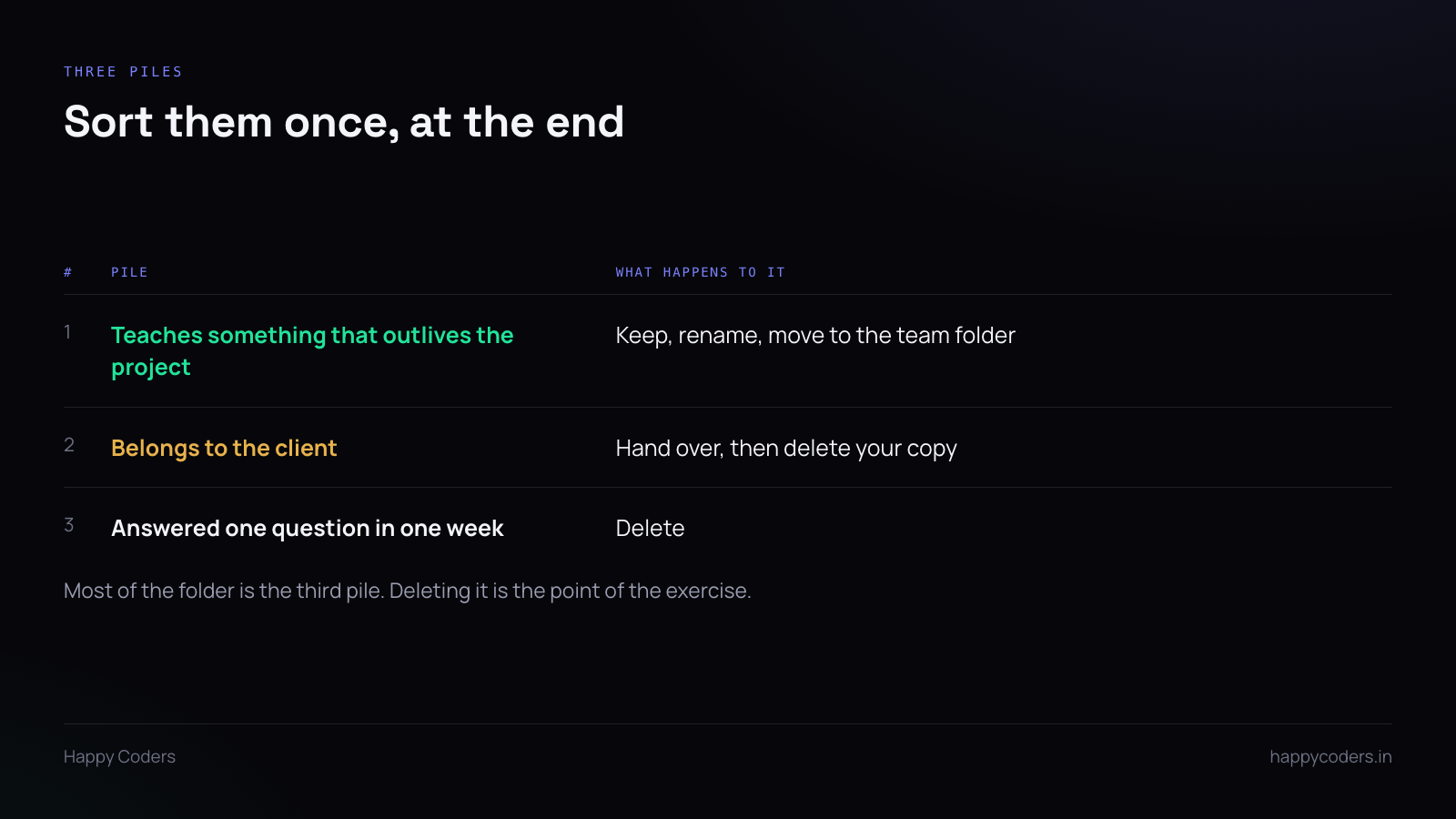
Keeps teaching. The recording of how your deploy works, how the monthly report is assembled, what the failure looks like when the queue backs up. These are about your systems, they apply to the next project, and they are the reason the folder is worth sorting at all.
Belongs to the client. Walkthroughs of their system, recordings of their data, the handover session with their staff on camera.
Answered one question, once. The clip showing where a button moved to in July. The bug reproduction for something fixed in August. Real value at the time, no value now.
Most of the folder is the third pile. Deleting it is most of the benefit.
The ownership question
This is the part people avoid, and it is the part that matters.
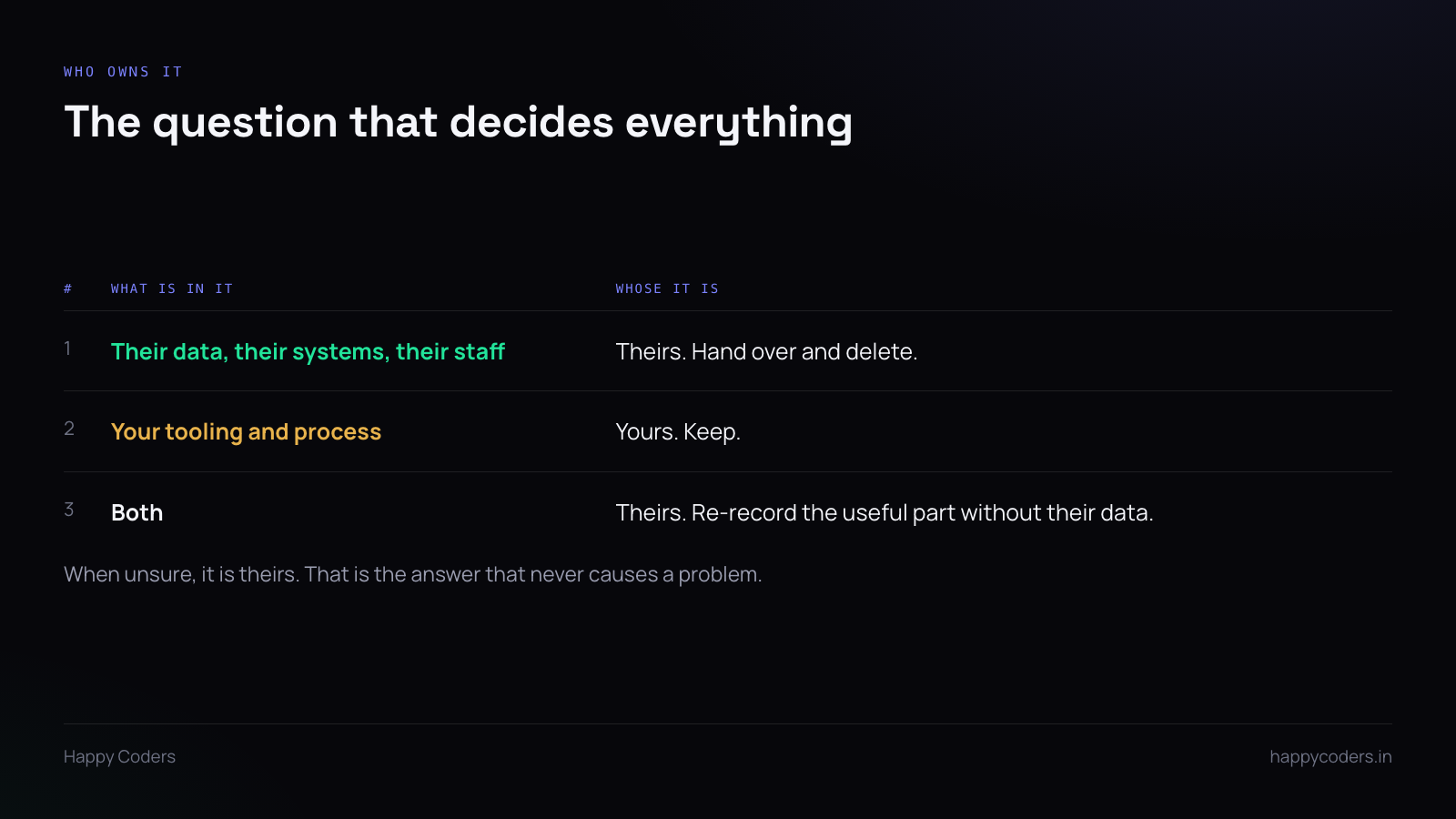
A recording of your deploy script is yours. A recording of the client’s production dashboard with their customer names on screen is theirs, whatever your contract says about work product — the contract covers the code, not a video of their data sitting on your laptop.
For anything in that second category: hand it over, then delete your copy. If it is useful to you as well — it shows a technique you want to keep — re-record the useful part against demo data. That takes ten minutes and leaves you with something you can keep without reservation.
When it is genuinely unclear, treat it as theirs. That is the answer that never causes a problem later.
Three things that are not optional
Anything with credentials in it is deleted, and the credential rotated. If a recording ever showed an API key, a token, a connection string or a password manager with an entry open, deleting the file is not enough — you do not know who watched it. Rotate it.
Anything with a person’s face or voice who has since left. The handover recording from the developer who left in March is useful and it is also a recording of a former employee. Keep it if it teaches something; do not circulate it, and delete it when it stops being useful.
Anything on a personal drive moves or goes. This is the most common way recordings are lost: the useful ones live in the account of whoever made them, and that account gets deactivated. Move the keepers to a team location on the day you sort.
Renaming is the whole job
A recording you keep and cannot find is a recording you deleted, slowly.
Rename every keeper to what it teaches, with a date in a sortable format:
2026-08-14-monthly-client-report-walkthrough.mp42026-09-02-deploy-with-the-manual-step.mp42026-09-28-what-the-queue-backlog-looks-like.mp4
Somebody in eighteen months will search for “deploy” or “queue”. They will not search for August.
Write the one-line index
In the same folder, a text file with one line per recording: the file name and what it shows.
Thirty seconds to write, and it is the difference between a folder somebody uses and a folder somebody has to watch their way through to understand.
Put it in the project close
This never happens on its own. It happens when it is a line on whatever checklist marks a project finished, next to the invoice and the handover.
Sorting recordings sounds like housekeeping. What it actually prevents is the two real failures: the useful recording that was lost because it lived in a leaver’s drive, and the client’s data that was still on a laptop two years after the engagement ended.