The spreadsheet worked. For a long time it worked better than any software would have, because it was free, everybody already knew it, and it did exactly what you told it to.
Then the team got to eight people, three of them stopped filling it in reliably, somebody overwrote a week by sorting without selecting all columns, and the monthly invoice started taking a whole morning.
So you move. The question nobody plans for is what happens to the three years already in the sheet.
Do not import three years
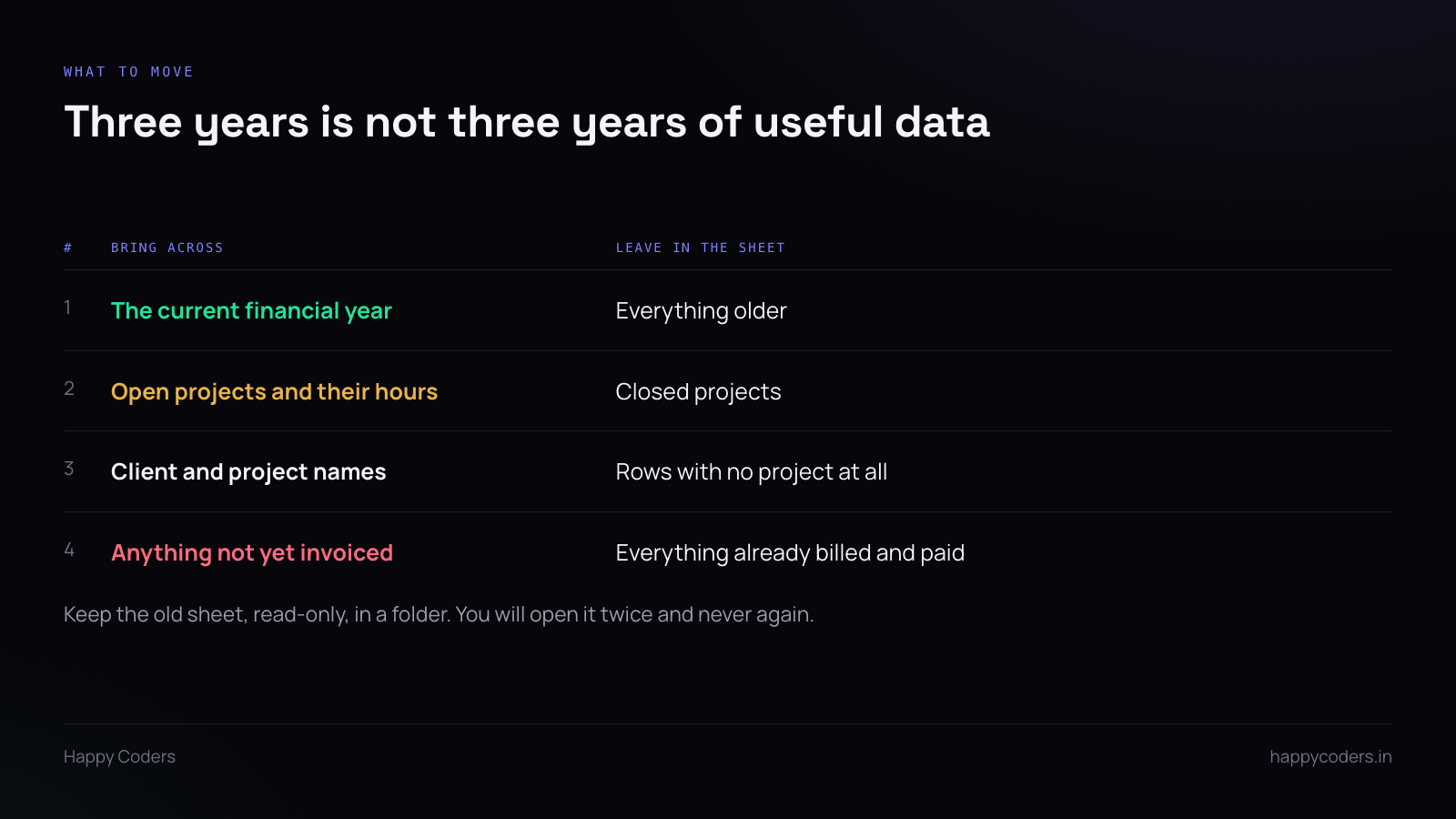
The instinct is to bring everything, because it feels like throwing away work otherwise. It is the wrong instinct, and here is the test: when did you last open a row from two years ago?
Old time data has almost no forward use. It does not help you quote, because your rates and your team have changed. It does not help you invoice, because it is all billed. It will not reconcile cleanly against the new tool’s structure, because the project names have drifted.
What it does do is make the new system messy on day one, which is exactly when people are deciding whether to trust it.
Bring the current financial year, open projects, and anything not yet invoiced. That is usually a few hundred rows rather than several thousand, and all of it is live.
Keep the old sheet. Make it read-only, put it in a folder called something obvious, and tell people it is there. You will open it twice in the next year.
The two columns that will not survive
The hours column, in four formats
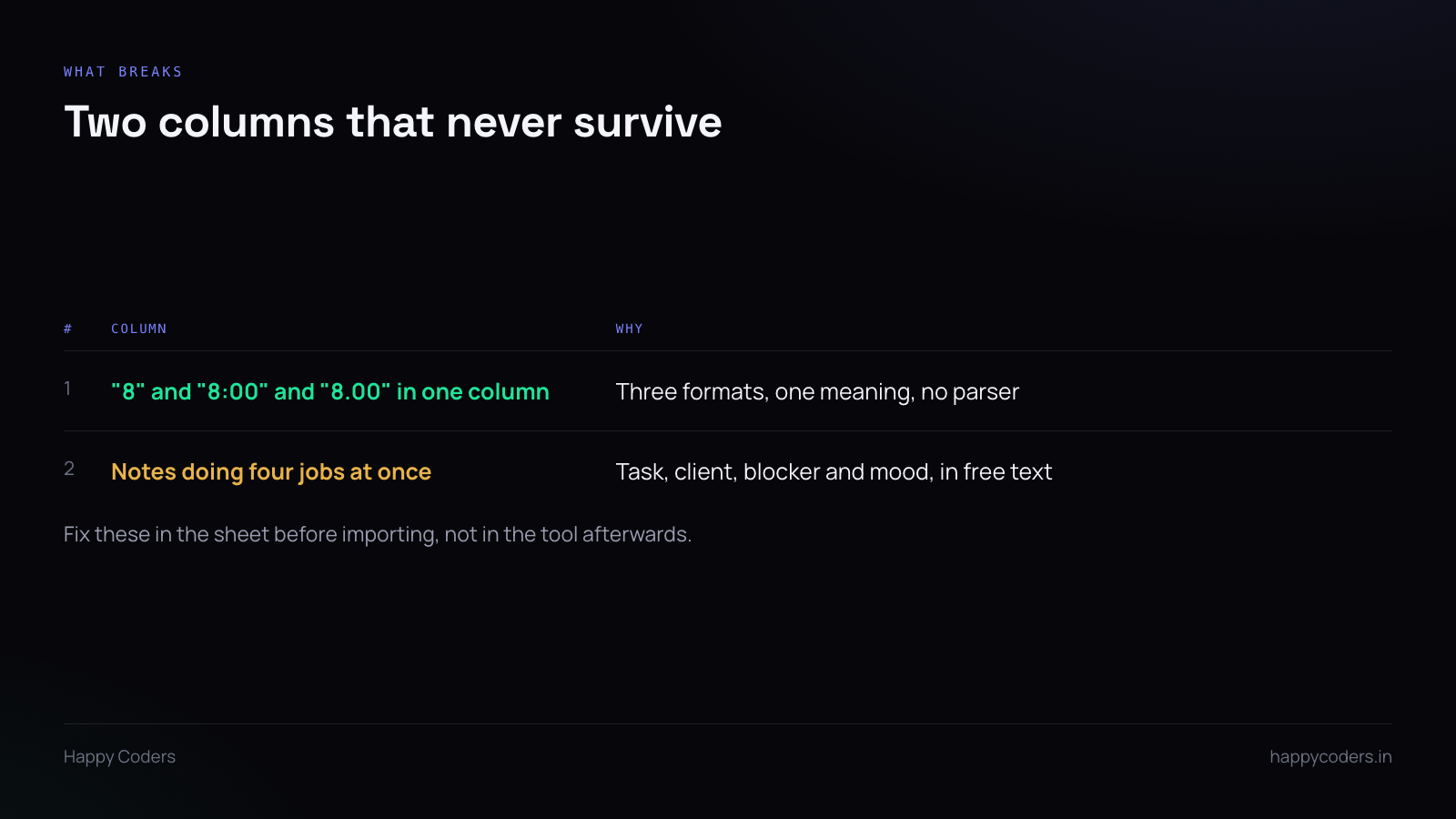
Open it and look. You will find 8, 8:00, 8.00, 8 hrs, and at least one cell that Excel has helpfully turned into a date.
Every one of those means eight hours and no importer can read all five. Fix it in the sheet, where you can see what you are doing, before exporting. A decimal column with one meaning is what you want.
Watch for the half-hour convention too. Someone writing 8.30 may mean eight and a half hours or eight hours thirty minutes, and those are different numbers. Ask them before you guess.
The notes column, doing four jobs
“Acme – homepage fixes, waiting on content from Priya, long day”. That single cell contains the client, the task, a blocker and a comment.
In the new tool those are separate fields, and nothing can split them automatically. You either do it by hand for the rows worth keeping — another reason to import less — or you import the whole string as a note and accept that it is not searchable in any structured way.
For the current year it is usually worth an hour of splitting. For older rows it is not.
Set up the structure first
Create the projects and clients in the new tool before importing anything. Otherwise the import creates them from whatever strings are in the sheet, and you end up with “Acme”, “ACME”, “Acme Ltd” and “acme website” as four separate projects.
Go through the sheet’s project column, make a list of the distinct real projects, and create those. Then map each spreadsheet variant to one of them during the import.
This is the single step that decides whether the first month of reports are usable.
Pick a cut-over date and do not straddle it
Choose a date — the start of a month is easiest. Before it, the sheet. After it, the tool. Nobody fills in both.
The failure mode is running both “for a few weeks to be safe”. What happens is that half the team uses one and half the other, neither is complete, and the first month’s invoice has to be assembled from two sources. The safety was imaginary and the mess was real.
Announce the date, and on the morning of it make the sheet read-only. A sheet that can still be edited will be edited.
What the first month actually looks like
Worse than the sheet. Expect it.
People forget to clock in. Someone logs a day against the wrong project. The totals do not match what anyone expected because the sheet was rounded and the tool is not.
That last one is worth being ready for. A spreadsheet filled in on Friday from memory produces tidy numbers. A tracker produces 7h 42m. The first month will look like people worked less, and they did not — the sheet was generous because memory is generous.
Say this out loud before the first month closes, because somebody will notice and draw the wrong conclusion.
What you get that the sheet never gave
Three things, and they arrive at different times.
Immediately: nobody can overwrite anybody else’s week.
After a month: an invoice that assembles itself from hours already attached to a client and a project, instead of a morning of copying.
After six months: an honest answer to where the time goes. The sheet could have told you that too, in theory. It never did, because nobody was going to pivot three thousand rows of free text.