Somebody messages a question. Answering it in writing will take four paragraphs and they will still not be sure. So a call gets booked, and twenty minutes of two people’s time goes on something that took forty seconds to show.
A one-minute recording is better than both, and the reason is not speed. It is that the recording can be watched again.
Spotting the ones that should be a clip
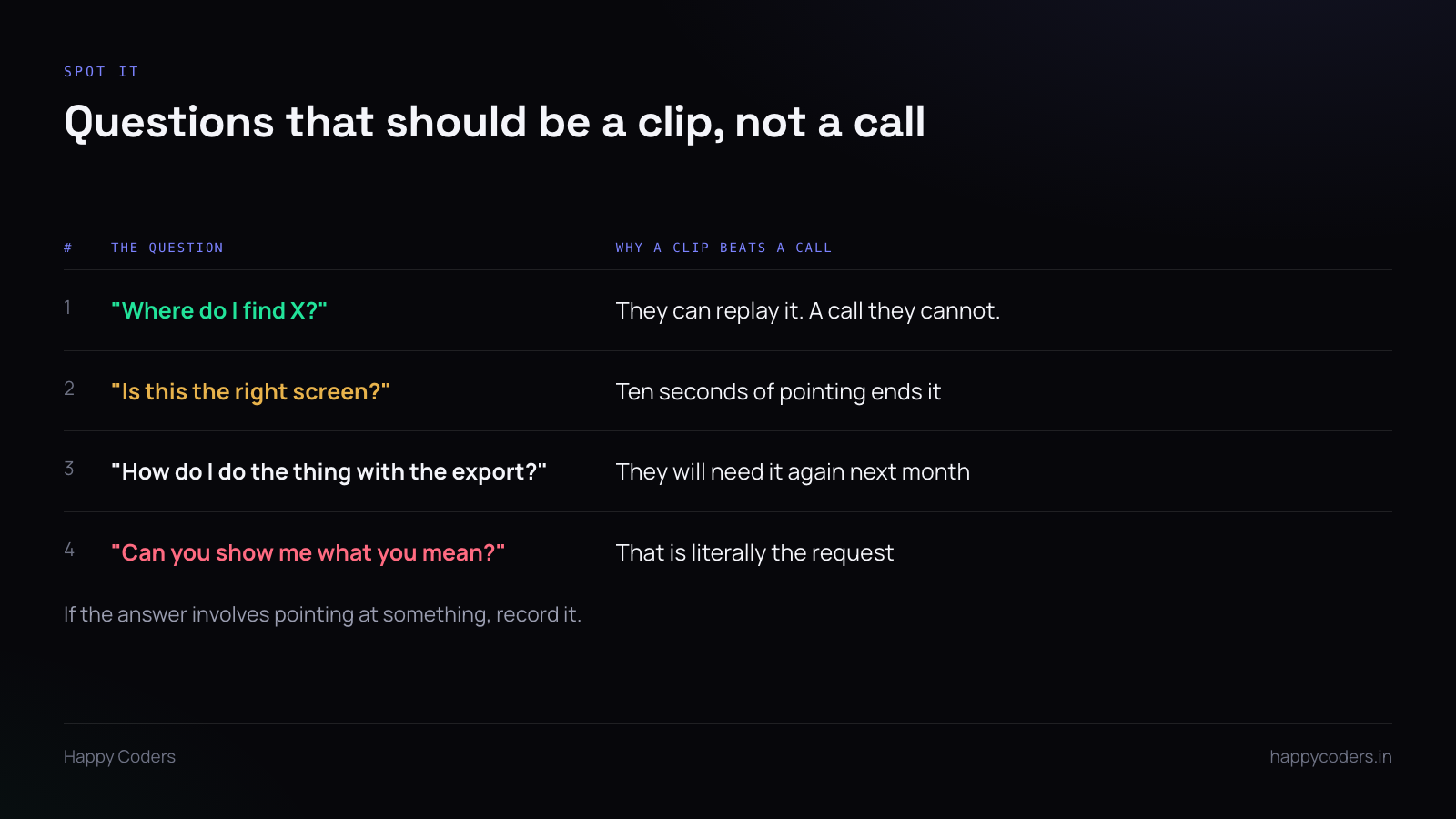
The test is simple: would answering this involve pointing at something?
“Where do I find the export?” — pointing. “Is this the right screen?” — pointing. “How do I set up the thing we discussed?” — pointing, several times, in order.
Those are clips. Anything where the answer is a decision, a number or an opinion is not — that is writing.
Why it beats the call
They can watch it again. This is the whole argument. On a call they understand it, and three weeks later they have forgotten and have to ask again. A clip is still there.
It reaches whoever actually needed it. The person who asked is rarely the only person who did not know. A clip gets forwarded; a call does not.
Nobody has to find a slot. The twenty-minute call is often scheduled for Thursday, which means the person is blocked until Thursday on something that took a minute to answer.
Why it beats writing
Not always — but for anything visual, writing it down is a translation exercise. You are converting a thing you can see into words, and the reader is converting the words back into a mental picture. Both steps lose something, and the loss shows up as “I followed the steps but it does not look like that.”
Where writing wins is anything with a value in it — a command, a URL, a setting name. Those have to be copyable. The good answer is often both: the clip for the shape of it, two lines of text with the exact values.
Keeping it to a minute
The minute is not arbitrary. Under a minute, people watch it immediately. Over three, they save it for later, and later rarely arrives.
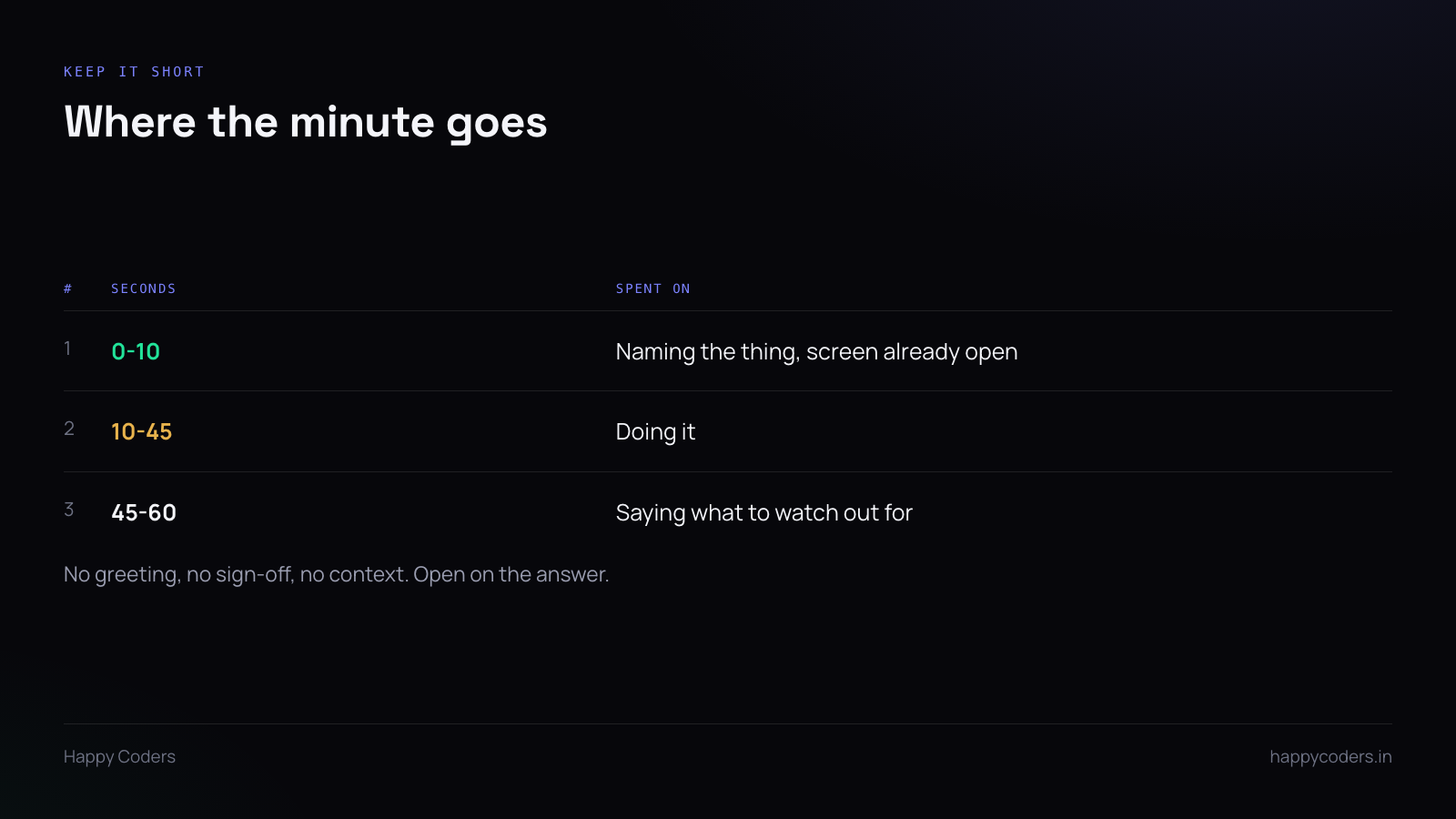
Have the screen open before you hit record. Most clips are ninety seconds because the first thirty are the person finding the window.
Open on the answer. “This is where the export lives.” Then show it. No greeting, no “so you asked about…”, no context-setting. They know what they asked.
Stop when the question is answered. The temptation at fifty seconds is to add the other thing they might wonder about. Do not. That is the second clip, if anyone asks.
No sign-off. “Hope that helps, let me know” is six seconds of nothing. Stop the recording on the last useful frame.
Do not re-record it
If you stumble, keep going. A clip with a stumble that exists is infinitely more useful than a perfect one you did not have time to make.
The only reason to re-record is if you got it factually wrong.
Name it for the question
This is the step that turns a one-off answer into something that keeps paying.
Name the file after what was asked, in the words they used. “where-to-find-the-monthly-export.mp4”. Then the next person who asks the same thing gets the file instead of your time, and the person after that finds it by searching.
Do that for a month and you have a small library built entirely out of real questions — which is a far better library than one somebody sat down and planned.
Where it does not work
Anything about a person. Feedback, a difficult decision, anything that could be read two ways. A recording is permanent, forwardable, and carries tone that cannot be re-read generously. Write that one, or have the call.
Anything they need to copy. Commands, keys, exact values. Nobody should be transcribing from a video.
Anything that needs a reply. If you are asking rather than telling, a clip makes them respond on your terms instead of theirs. Write it.