There is a category of thing that is faster to say than to write and faster to hear than to read: the explanation of why the code is like that, the context behind a decision, the three caveats on an estimate. People write them badly because writing them well takes twenty minutes and saying them takes ninety seconds.
Voice recording is the obvious answer and almost nobody reaches for it, partly out of habit and partly because the cases where it is genuinely better are not obvious until somebody lists them.
When voice beats writing
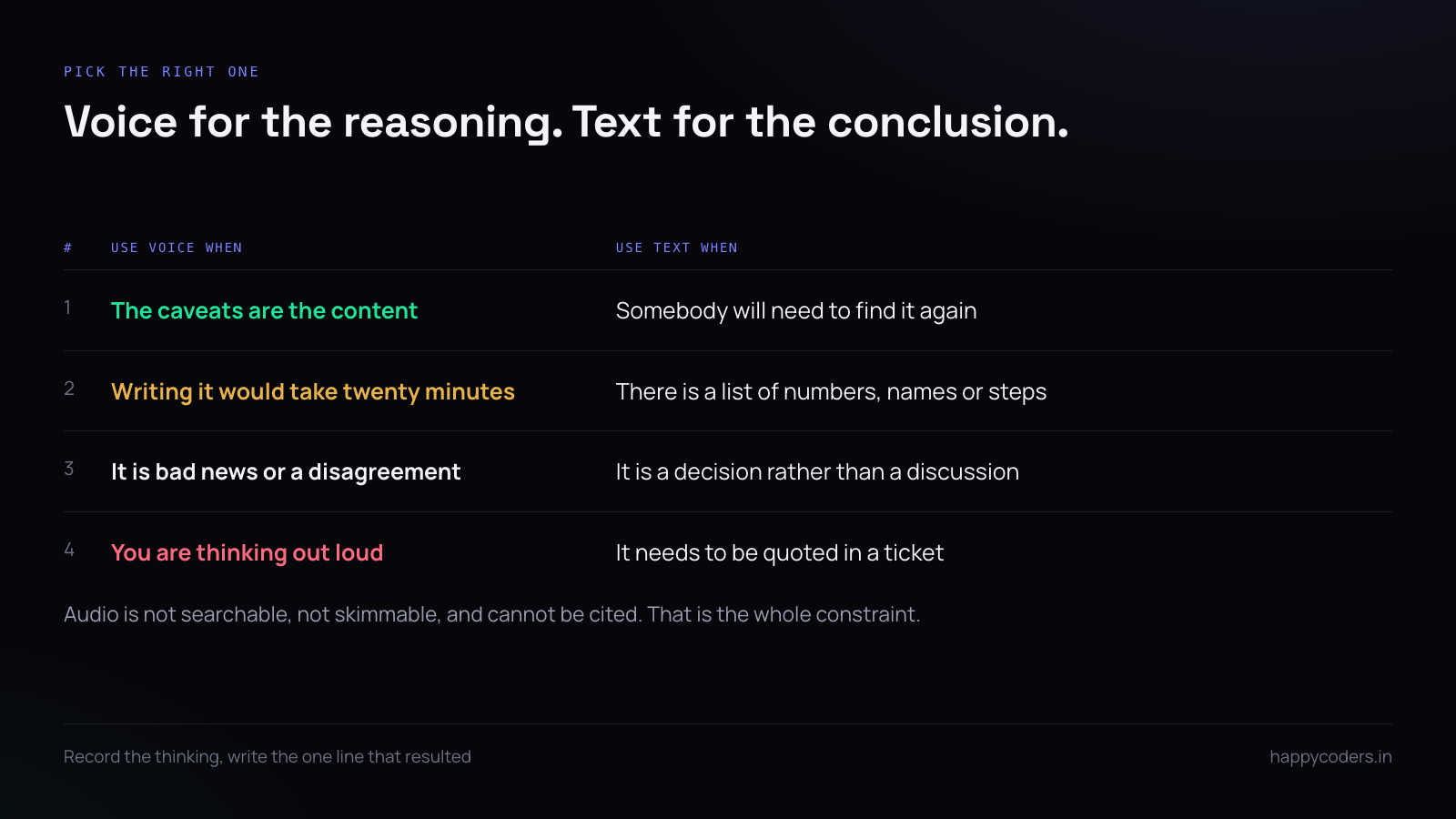
- Nuance with caveats. “We could do it that way, but” — the qualifications are the content, and they come out naturally in speech and stiltedly in text.
- Anything that would take twenty minutes to write. If you are rewriting the second paragraph, stop and say it.
- Emotional temperature. Disagreement, bad news, an apology. Text flattens tone, and the reader supplies a tone of their own, usually a worse one.
- Thinking out loud. A problem you have not solved yet, shared so somebody can think alongside you.
When writing wins
Just as important, because voice used in the wrong place is worse than text.
Anything somebody will need to find again should be written. Audio is not searchable, not skimmable, and cannot be quoted in a ticket. Anything with a list of numbers, names or steps should be written — the listener cannot hold six items and will ask you to repeat them. And anything that is a decision rather than a discussion should be written, because a decision that exists only in audio is a decision nobody can cite.
The useful rule: voice for the reasoning, text for the conclusion. Record the thinking, write the one line that resulted.
Replying to a voice note
The thing that kills voice at team level is not the first recording, it is the fourth — a chain of four-minute replies that nobody can follow and that cannot be summarised.
A workable convention: voice is for the first message, text for the reply, unless the reply genuinely needs the same nuance. That keeps the useful property — somebody explained something complicated quickly — without turning the thread into something that has to be listened to end to end.
The other half of it is that the person who sent the voice note writes the conclusion afterwards. One line. That way the thread is scannable even though the reasoning was spoken.
Ninety seconds, not nine minutes
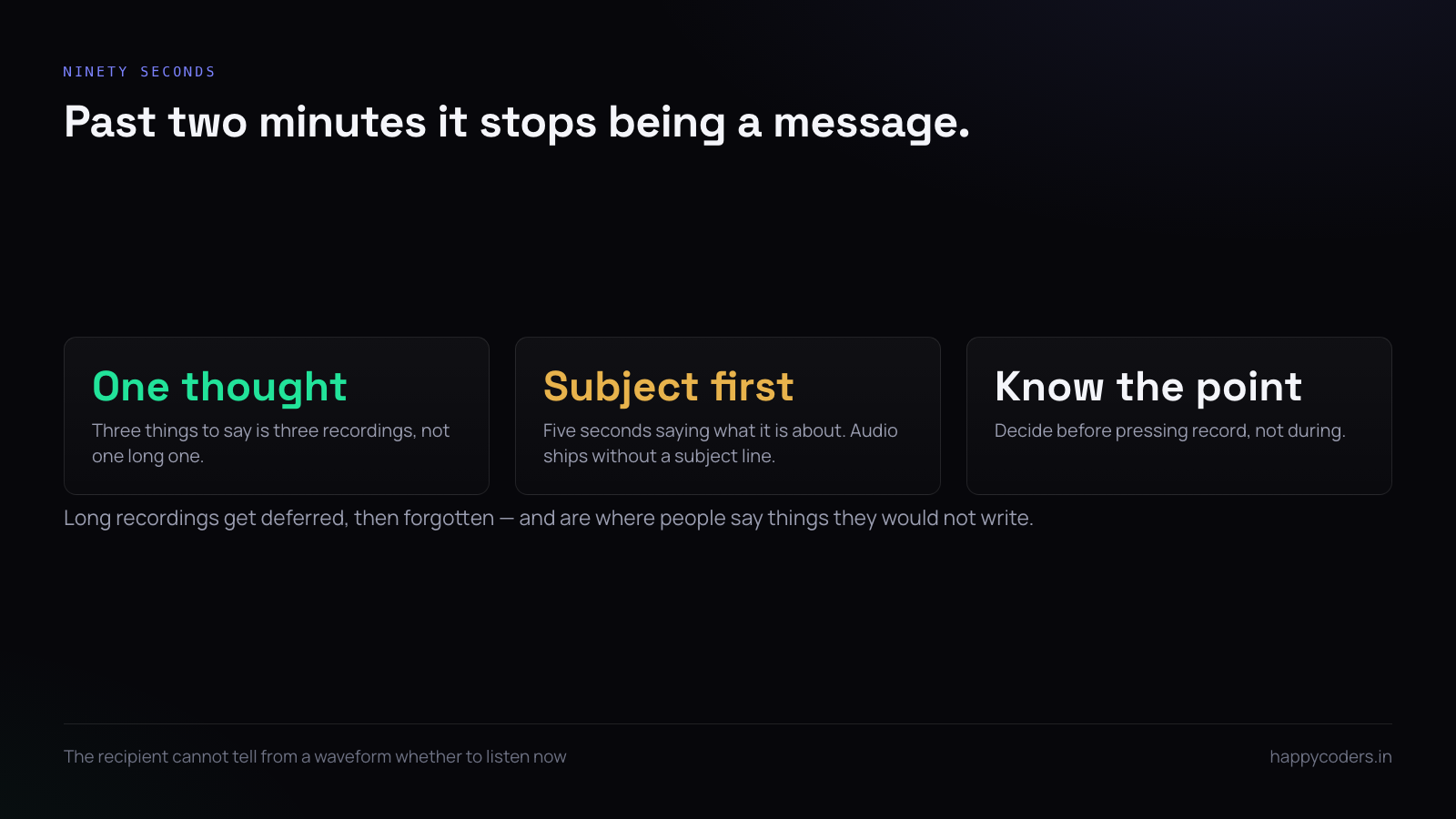
A voice note that runs past about two minutes stops being a message and becomes homework. People defer it, then forget it.
The discipline is to know the point before you press record. One thought per recording. If you have three things to say, that is three recordings, and the recipient can deal with them separately rather than scrubbing back to find the second one.
Long recordings are also where people wander into saying something they would not have written, which is worth bearing in mind for anything work-related.
Say the subject first
The first five seconds should say what this is about, because the recipient has to decide whether to listen now or later and cannot tell from a waveform.
“This is about the pricing page estimate, about a minute” is a perfect opening. It is the subject line, and audio messages are the only common format that routinely ships without one.
Recording yourself to think, not to send
A use almost nobody tries: recording a problem out loud with no intention of sending it to anybody.
Explaining a problem to an imaginary colleague forces the same clarity that explaining it to a real one does, which is why people solve things halfway through asking. Recording makes that available without needing somebody else’s time, and the recording is usually deleted immediately.
It works especially well before writing a long message or a specification. Say it first, listen back once, then write — the written version comes out shorter and in a better order, because the wandering happened in the audio instead of in the document.
Voice with a screen is usually better than either alone
For anything about something visible — a design, a report, a piece of code — recording the screen alongside the voice removes the entire category of “which bit do you mean”.
This is the real reason to have a recorder rather than only a voice memo app. The cost is the same ninety seconds and the explanation becomes unambiguous, because you can point at the thing while you talk about it.
Where it goes, and what it leaves behind
A voice note in a chat thread is gone in a week. That is fine for most of them — a message is a message. It is not fine for the one where you explained the reasoning behind an architectural decision, which somebody will want in eight months.
For those, do both: record it, and write the one-line conclusion into the place the decision lives. The recording explains why; the line is what people find.
The accent question, honestly
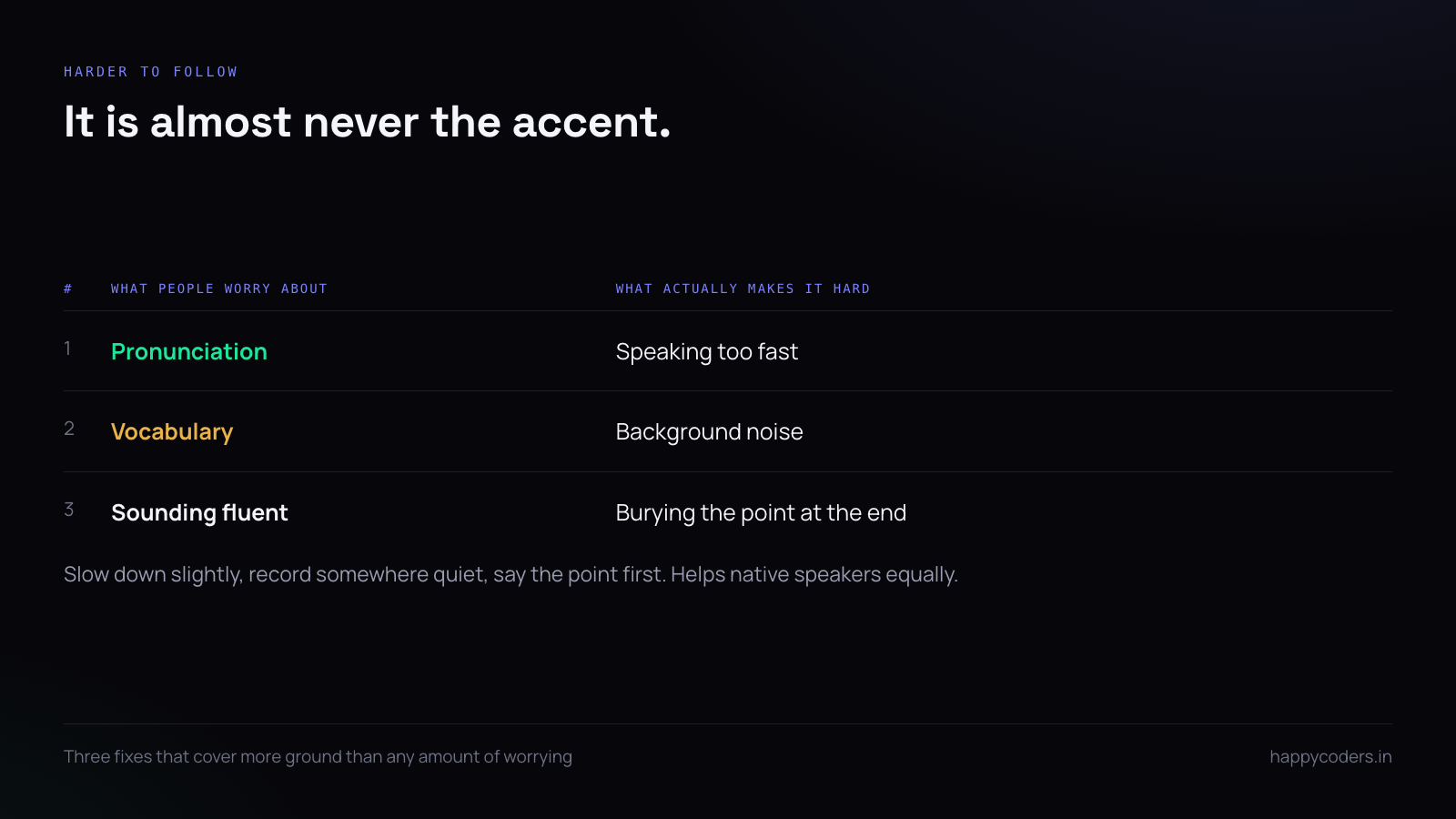
People working in English as a second language often avoid voice for fear of being harder to understand. In practice the thing that makes a recording hard to follow is almost never the accent — it is speed, background noise, and burying the point at the end.
Slow down slightly, record somewhere quiet, and say the point first. Those three cover more ground than any amount of worrying about pronunciation, and they help native speakers just as much.
A short answer
Use voice for reasoning, caveats, bad news and thinking out loud. Use text for decisions, lists and anything anybody will search for later. Ninety seconds, one thought, subject first. Add the screen whenever the thing you are discussing is visible, and write the one-line conclusion wherever the decision lives.
HappyRec records voice on its own or alongside the screen, saves to M4A or WAV, and keeps everything on your own machine.