Weekly timesheet approval is, in most companies, a button. The manager opens the list on Monday, sees that the hours look roughly like a week of work, and approves. The whole thing takes forty seconds and catches nothing, which is fine until the quarter when it turns out a third of the team’s hours were never billed to anybody.
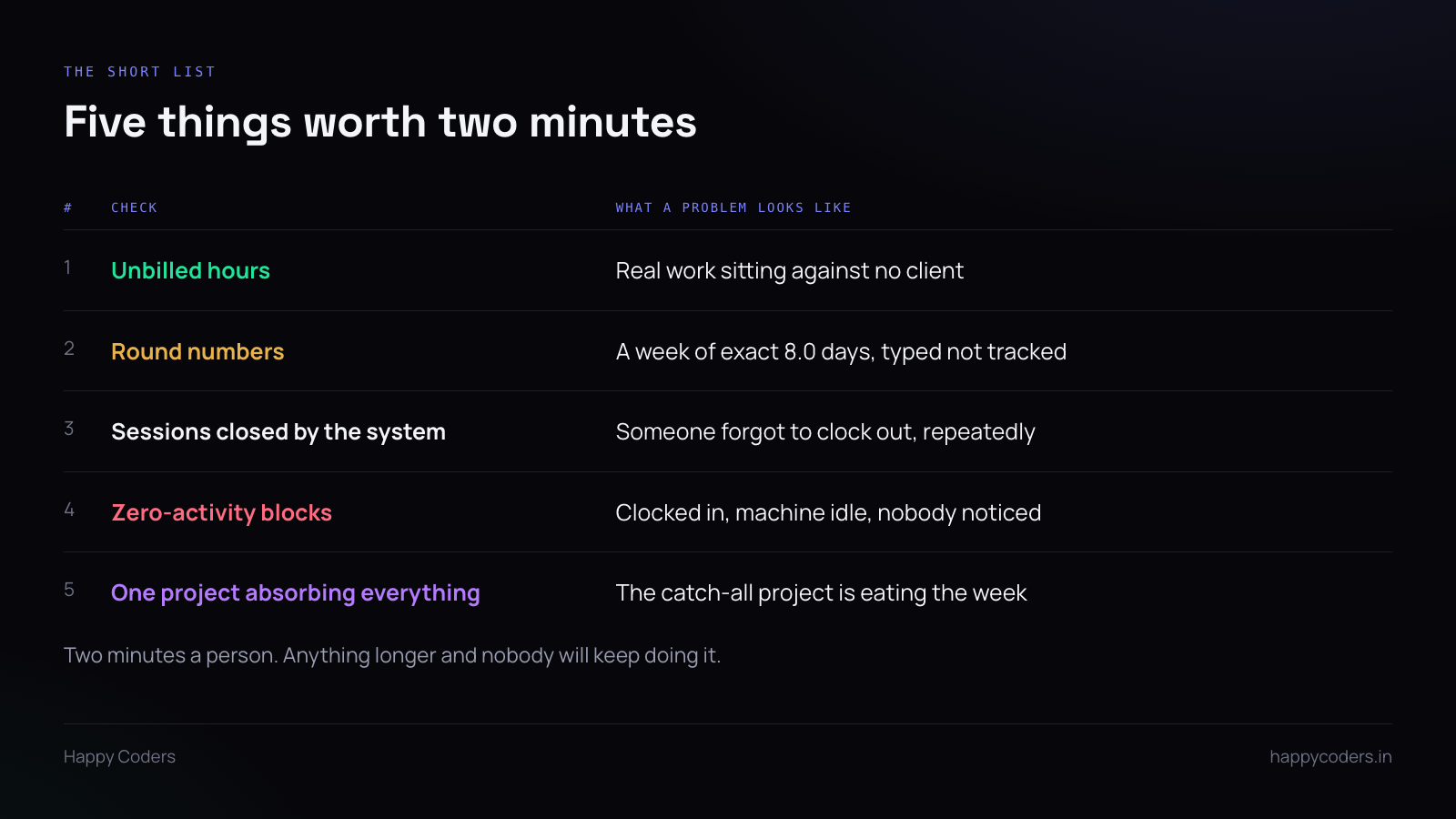
Approval is worth doing properly, and properly does not mean slowly. Two minutes a person, looking at five specific things.
Why the click is not enough
Approving a timesheet locks the week. Entries cannot be edited afterwards, which is exactly the point — it is the moment the record becomes final. If the week is wrong, approval is the step that makes it permanently wrong, and the correction later involves unlocking, explaining and a conversation nobody enjoys.
So the question at approval is not “does this look like forty hours.” It is “would I defend this record in three months.”
The five checks
Unbilled hours
Look for real work sitting against no client. This is the single most expensive thing a timesheet hides, and it is almost never deliberate — someone did four hours on a request that came in by phone, logged it honestly against an internal project, and nobody connected it to an invoice.
Four hours a week across a small team is a meaningful amount of money by the end of a quarter. The fix is not disciplinary; it is usually that the project did not exist yet when the work started.
Round numbers
A week of exact eight-hour days is a typed week, not a tracked one. Real tracked time is untidy — 7h 42m, 8h 11m, 6h 55m. Perfect numbers mean someone reconstructed the week from memory on Friday afternoon.
That is worth noticing but not worth a confrontation. It usually means the tracker was not running, and the reason is usually mundane: a new laptop, a forgotten install, or work done somewhere the app does not run. Find the reason before assuming the worst.
How sessions ended
This is the field most approvers never open, and it is often the most informative one on the page.
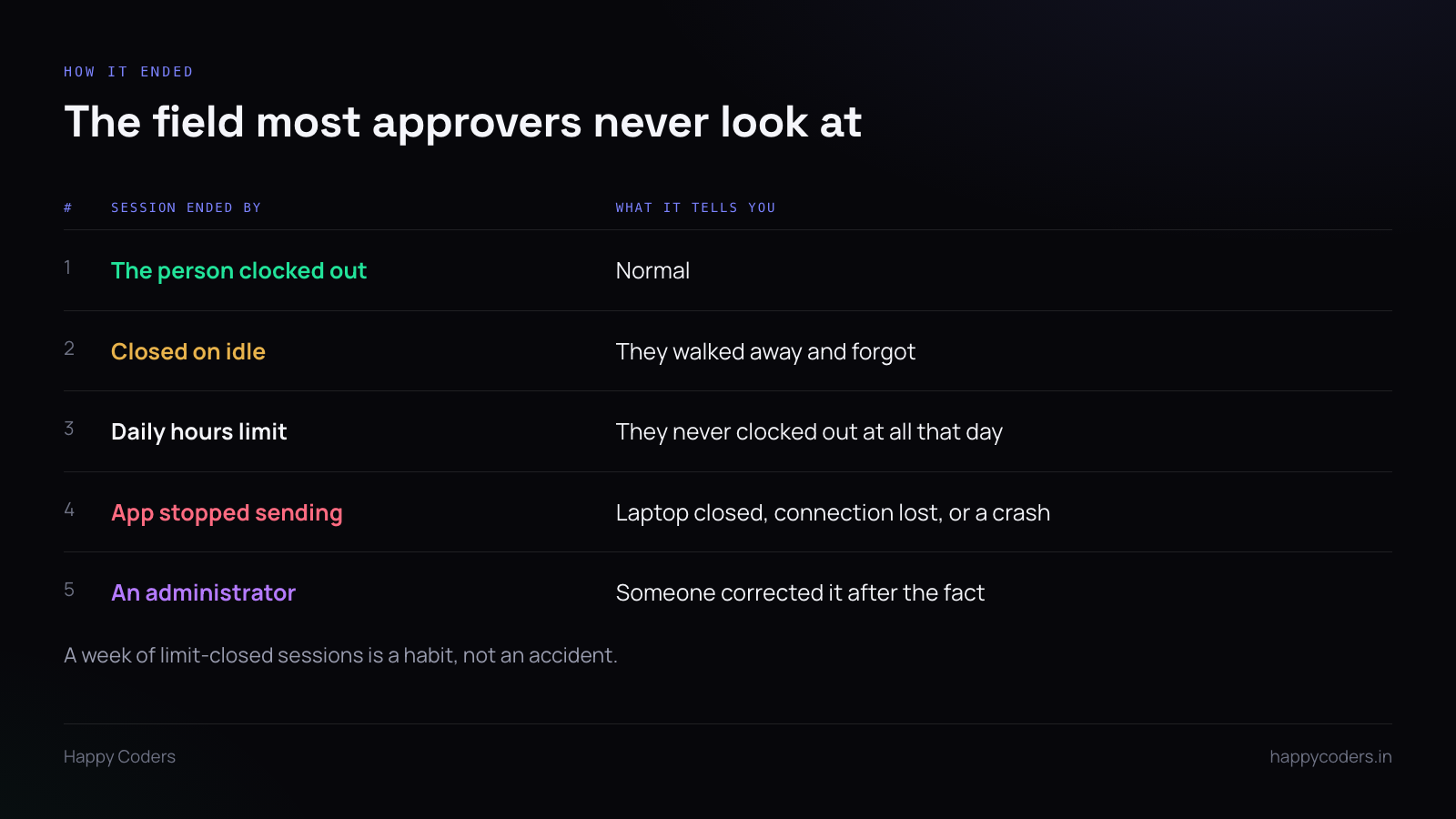
A session that ended because the person clocked out is normal. A session closed because the daily hours limit was hit means they never clocked out at all that day, and the system stopped it rather than recording a fourteen-hour shift that did not happen.
One of those is an accident. Five in a week is a habit, and the entry is wrong by however long the gap was between the last real work and the limit. That is the single most common source of inflated hours, and it is not dishonesty — it is a person who closed their laptop lid and went home.
Zero-activity blocks
Clocked in, machine idle, nobody noticed. If idle detection with an auto-stop is switched on this mostly solves itself, but with it off you get hours that look like work and were not.
The honest version of this conversation is worth having once rather than repeatedly: if someone is reading a printed document or on a phone call with a client, the machine is idle and the work is real. Idle time is a flag, not a verdict.
One project absorbing everything
Most teams have a catch-all project — “Internal”, “General”, “Admin” — and it grows. When a third of the week lands there, the timesheet has stopped telling you where time goes, which was the entire reason for keeping it.
Usually the fix is a new project rather than better discipline. People put time in the catch-all because the right place did not exist.
What approval is not for
It is not a performance review. The approver is checking that the record is accurate, not whether the person did enough. Mixing the two turns a two-minute administrative check into something people learn to manage, and managed timesheets are useless timesheets.
It is also not the place to fix a systemic problem. If four people all have unbilled hours against the same client, approving three and querying one is pointless. That is a projects problem, and it belongs in a conversation, not in the approval queue.
Two rules worth enforcing in the tool
Nobody approves their own timesheet. Even if the person is the most senior one in the room. The point of approval is a second pair of eyes, and a self-approval is a click with no eyes behind it at all.
Every correction leaves a trail. Administrators and managers can add, edit or delete an entry for any member, which is necessary — someone has to be able to fix a forgotten clock-out. What makes it safe rather than alarming is that every change is written to the audit log with who made it. Then an edited timesheet is a corrected record rather than a disputed one.
The Monday habit
Do it on the same day every week and do it fast. The value is in the regularity, not the depth. An approval that takes two minutes and happens every Monday catches far more than a thorough review that happens twice a year because it takes an afternoon.
And when you do find something, go and ask. Almost every anomaly in a timesheet has a dull explanation, and the dull explanation is usually something worth fixing in how the work is organised rather than in how the person fills in their week.