You have a folder of recordings that answered real questions. Somebody suggests writing them up properly, and it sounds like the responsible thing to do.
Sometimes it is. Often it is forty minutes spent making something nobody needed in that form.
The arithmetic
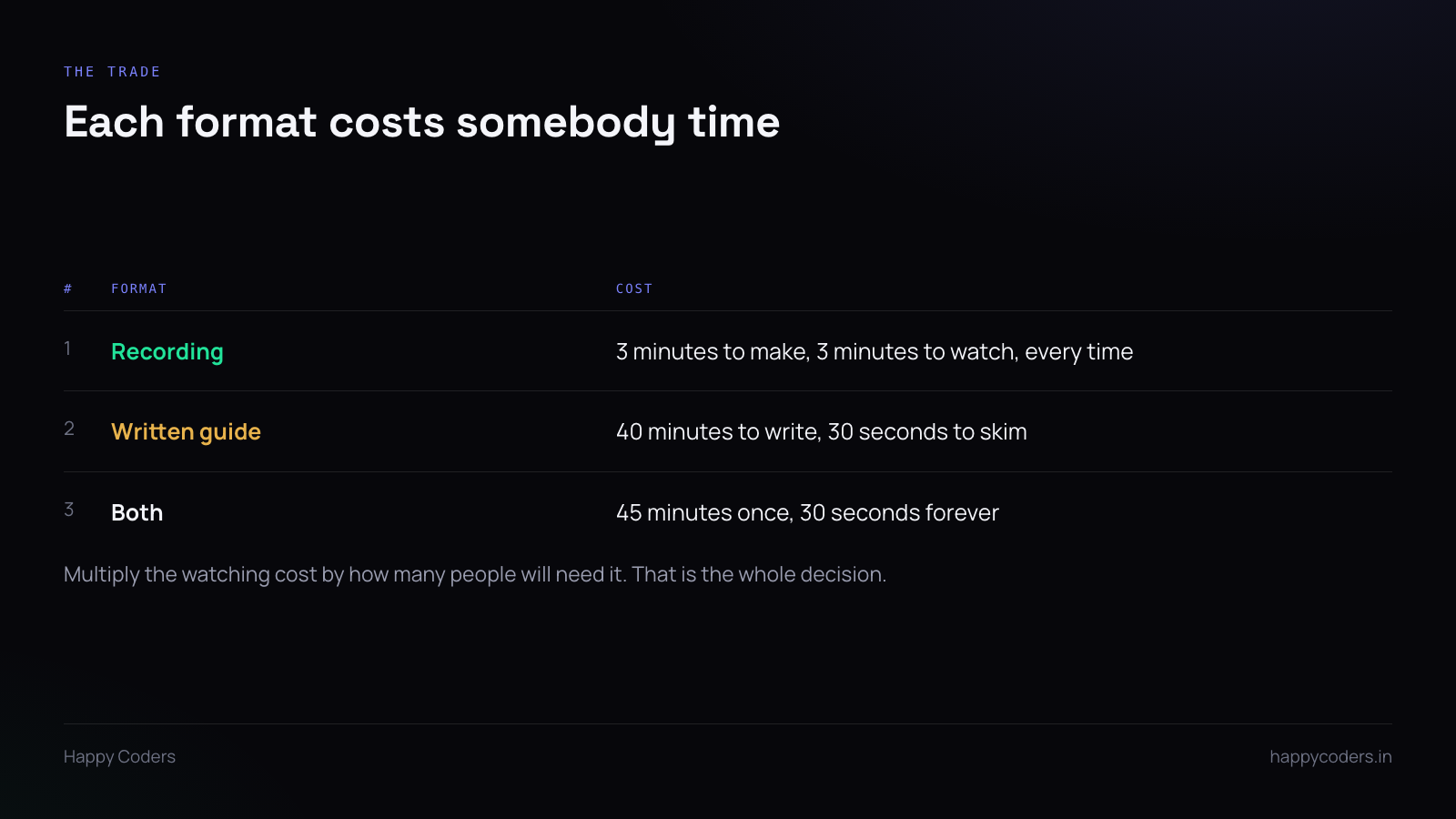
A recording is cheap to make and expensive to consume. Three minutes to record, and three minutes of somebody’s attention every single time it is used.
A written guide is the reverse. Forty minutes to write properly, and then thirty seconds to skim, forever, by anyone.
So the question is just: how many times will this be used, by how many people?
Used twice by one person, the recording wins easily. Used by every new joiner for the next three years, writing it up pays for itself in the first month.
The three-question test
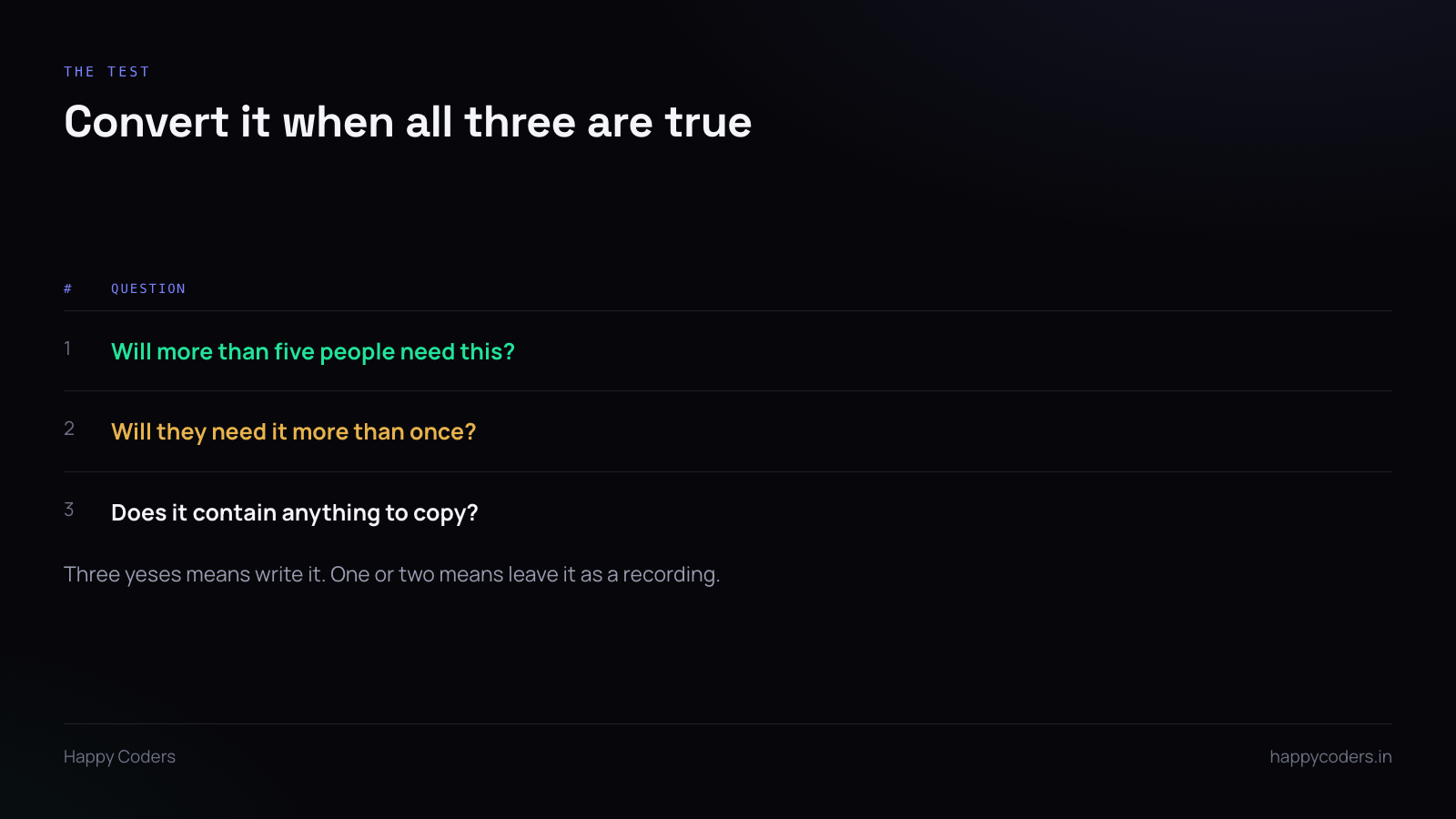
Will more than five people need it? If this is a thing one team does, the recording is fine. If every new joiner needs it, write it.
Will they need it more than once? Setup tasks are done once per person and then never again — a recording is fine. Anything consulted repeatedly wants to be skimmable.
Does it contain anything to copy? A command, a URL, a configuration value, a name spelled a particular way. If yes, it has to exist as text regardless of everything else. Nobody should be transcribing from a video, and the one character they get wrong will cost an hour.
Three yeses: write it. One or two: leave it alone.
What video is genuinely better at
Do not convert these, because the writing loses the thing that made them useful.
Anything about where something is on screen. “The export is under the three dots at the top right, next to the date filter” is four times longer to read than to see, and still ambiguous.
Anything about timing. That a step takes eight seconds and looks frozen is almost impossible to convey in text and obvious in a recording.
Anything intermittent. The failure that happens sometimes. A description is a guess; the recording is evidence.
The hybrid, which is usually the right answer
Write the steps. Keep the clip for the one part that needs seeing. Link the clip from the step it belongs to.
So a guide looks like: six numbered steps, the commands and values as copyable text, and next to step four a forty-second clip of the bit that is hard to describe.
This takes slightly longer than either alone and it is what people actually use, because it is skimmable, copyable, and still shows the thing words could not carry.
Writing it up from the recording
If you are converting, do it from the recording rather than from memory. The recording contains the steps you would skip when writing, because you know them.
Watch it and write the steps as they happen. Where you said “and this takes a few seconds”, that becomes a line in the guide. Where you went back because you clicked the wrong thing, that is a note about which thing is confusing.
Those asides are the difference between a guide that works and one that assumes.
Keep the recording afterwards
Converting is not replacing. Link the recording from the written guide and keep both.
Different people learn differently, and more practically, the written version will go stale before the recording does — somebody will update a screenshot and not the steps, or the reverse. Having both means a reader who is confused by one can check the other.
Where this most often goes wrong
Someone decides to write up the whole folder. Forty recordings, each a morning of work, and after three they stop.
Now there are three polished guides and thirty-seven recordings, and nobody knows which exist in which form.
Convert one when it has been watched often enough to be annoying. That is the signal, and it arrives on its own without a project.