Software pricing pages are built to be compared on the monthly figure, because the monthly figure is the small one. The useful comparison is annual cost for your actual headcount, and almost nobody does that sum before signing up.
It takes thirty seconds and it changes which product you pick.
Do the sum for your team
Take your headcount, take the per-user price, multiply by twelve if it is monthly. That is it.
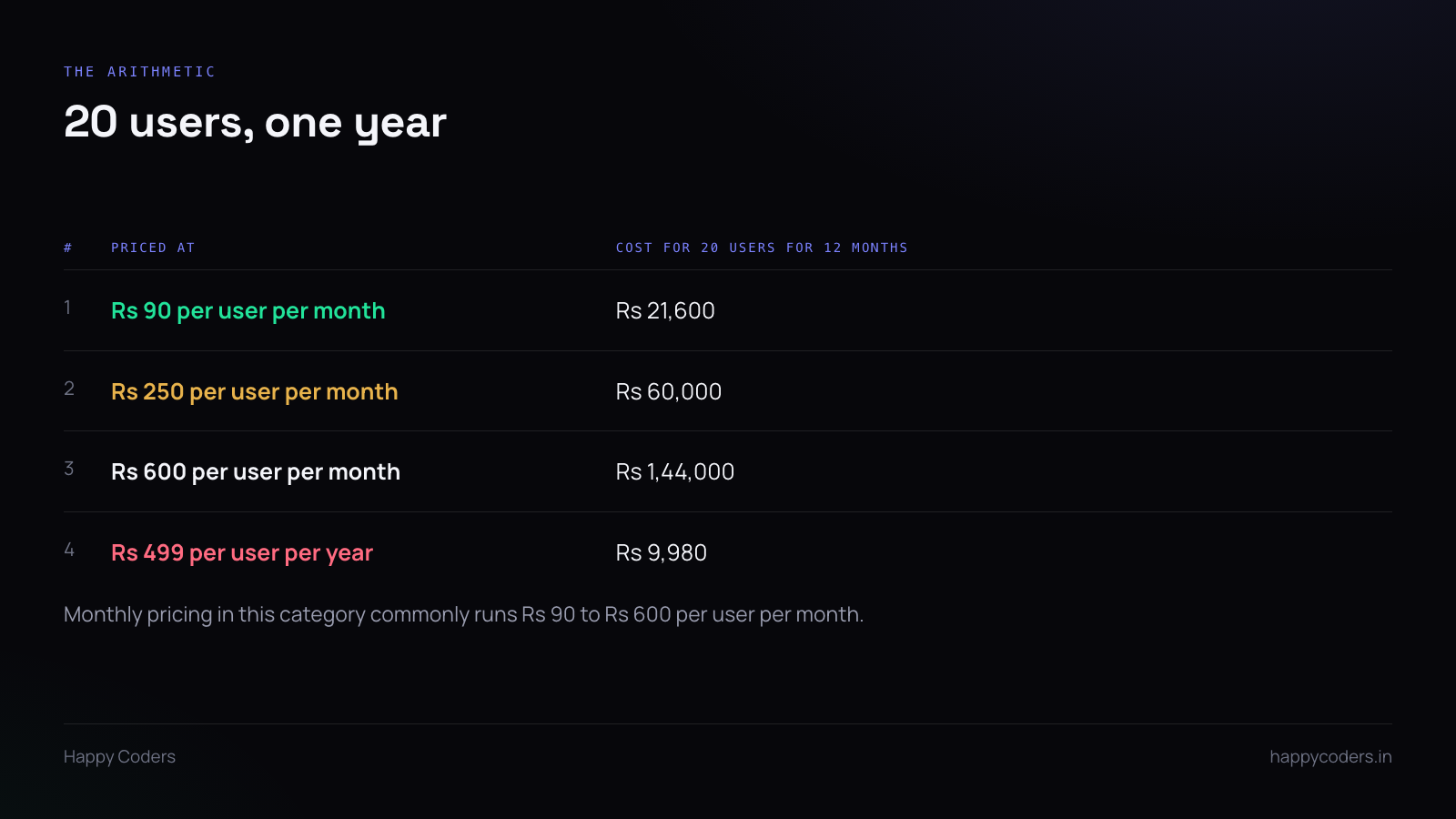
For a twenty-person team, software at Rs 250 per user per month costs Rs 60,000 a year. The same team on software at Rs 499 per user per year costs Rs 9,980. The monthly figures look comparable on a pricing page — Rs 250 against something that works out at about Rs 42 — but the annual numbers are six times apart.
This category genuinely does range from about Rs 90 to Rs 600 per user per month. At the top of that range, twenty people costs Rs 1,44,000 a year, which is a hire’s worth of budget for a tool that records when people clocked in.
Why the monthly figure is the one you are shown
Not because anyone is being dishonest. Monthly pricing is genuinely easier to start and easier to leave, and for a team whose size changes every quarter it is the sensible structure.
But it is also the figure that makes the decision feel small. Rs 250 a month per person is a number you approve without a meeting. Rs 60,000 a year is a number that gets a meeting. They are the same decision.
The test is simple: if the annual figure would have needed approval and the monthly one did not, you have found the reason the page is laid out that way.
What else changes with the model
The number is not the only difference.
Monthly plans flex. If your team goes from twenty to fourteen in March, monthly billing reflects that in March. Annual billing usually does not, and you have paid for six seats you are not using.
That is the real argument for monthly, and for a business with seasonal staff it is a good one. For a stable team of twenty it is an argument about something that will not happen.
Annual plans need a decision once a year, which sounds like a disadvantage and is often the opposite. A monthly subscription that nobody is reviewing is the most common way companies end up paying for software they stopped using. The annual renewal is the one moment somebody looks.
Auto-renewal is the setting to ask about
This matters more than the billing period and it is rarely on the pricing page.
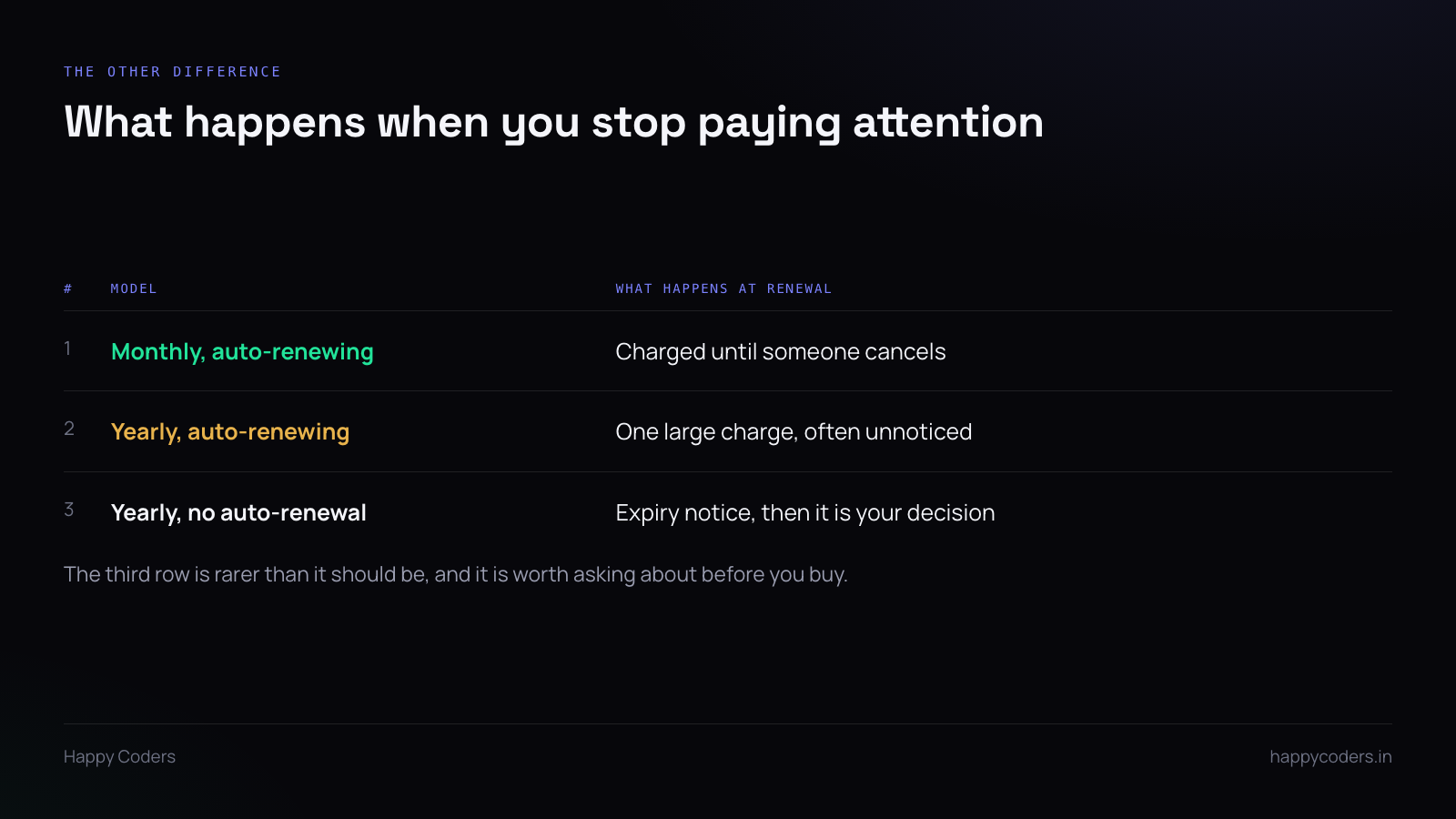
Most subscriptions renew automatically. For monthly that means a charge every month until someone cancels, which is fine while you are using it and invisible when you are not. For annual it means a single large charge appearing on a card, often to a card belonging to someone who has since left.
The alternative — expiry with a notice, and nothing charged unless you choose to pay again — is rarer than it should be. It means the product has to be worth re-buying every year rather than worth not-cancelling, which is a meaningfully different relationship.
Ask before you sign up. “Does this renew automatically, and can I turn that off?” is a fair question and the answer tells you something about the company.
Two things to check beyond the price
What a higher plan actually buys. Sometimes it is features, sometimes it is only capacity — more users, more projects, longer retention. Capacity-based tiers are easier to reason about, because you can work out which one you need from your headcount instead of from a feature matrix. Feature-gated tiers need reading carefully: the thing you assumed was included may be two tiers up.
What happens when you outgrow the plan. Teams grow mid-year. Find out whether you buy additional seats on the current plan or jump to the next one, and whether it is prorated. If it is prorated you pay for the time remaining in the term, which is the fair version. If it is not, growing in month eleven costs the same as growing in month one.
The free tier question
A free plan is either a trial wearing a different name or a real permanent tier, and the difference is worth establishing on day one.
A real free tier has a user cap and no clock. Five users, no card, no expiry. You can run a small team on it indefinitely, and the paid plans exist for when you are not small any more.
A trial dressed as a free plan has a countdown somewhere, usually mentioned once. If you cannot find the words “no time limit” or “does not expire” anywhere, assume there is a clock and ask.
The sum, again
Headcount, times the per-user price, times twelve if monthly. Then compare that number, not the one on the button.
For most small teams the annual figure for time tracking should be a few thousand rupees, not a few lakh. If your shortlist produces numbers that differ by a factor of six for software that does roughly the same job, that is not a quality difference. It is a pricing model difference, and you are allowed to pick the cheaper one.