The tracker is installed, people have accounts, and somebody clicks clock in. The next screen asks which project they are working on, and the list is empty.
That moment decides whether the rollout survives. The person in front of it will either create something sensible, create something called “work”, or close the window and go back to what they were doing. Two of those three outcomes are bad, and the third depends on luck.
Ten minutes of setup before anyone logs in removes the problem entirely.
Five projects
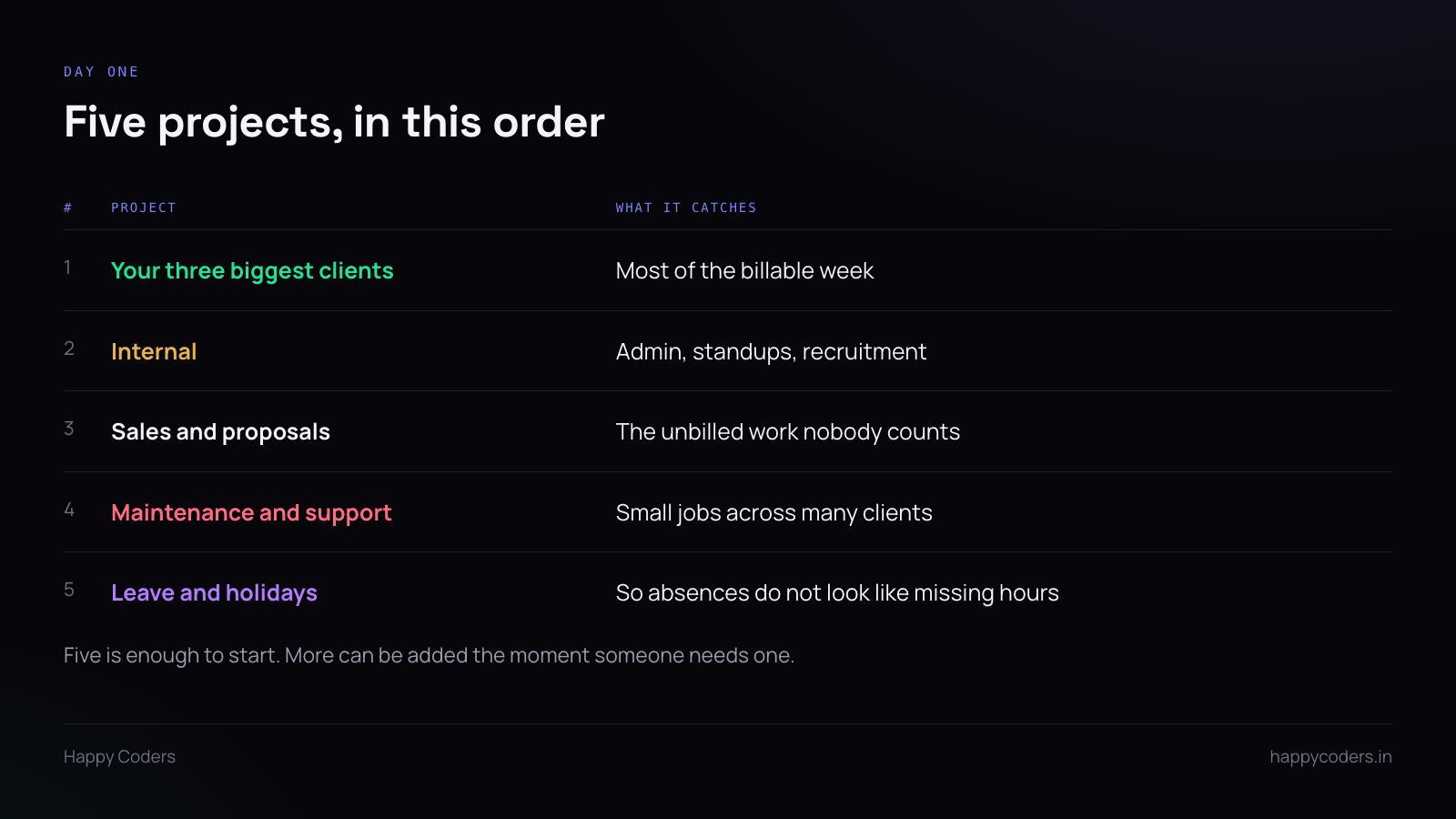
1. Your three biggest clients, by name
Not “Client Work”. The actual names, one project each. These three will absorb most of the billable week, and they are the projects whose numbers you will eventually put on an invoice.
Use the name the client uses for themselves, and the name your team says out loud. If everyone calls them by a short form, use the short form. A project nobody recognises in the dropdown gets skipped.
2. Internal
Standups, one-to-ones, recruitment, the Friday thing nobody can name. This is real work and it is not billable to anyone, and it needs a home or it ends up charged to whichever client was open at the time.
Mark the whole project non-billable at the start and the question never comes up again.
3. Sales and proposals
Separate from Internal, deliberately.
Writing a proposal is a day of senior time that produces no invoice. It is the most invisible cost in a service business, and when it has its own project you can finally answer the question every agency guesses at: how many hours did we spend winning the work we won, and on the work we did not?
Most teams are shocked the first time they see that number. You cannot act on it while it is buried in Internal.
4. Maintenance and support
The twenty-minute jobs. A bug on an old site, a client who rings with a question, a certificate that expired.
These never get logged because creating a project for a twenty-minute job feels absurd, so they get swallowed. Across a month and a team they are not small. One project for all of it, tasks underneath for individual clients if you want the detail.
5. Leave and holidays
If your tool handles leave separately, skip this one. If it does not, create it — otherwise somebody who took two days off shows up with sixteen hours missing and no explanation, and the timesheet looks like a problem instead of a holiday.
Why not just let people create their own
Because you get eleven versions of the same thing. “Acme”, “ACME Corp”, “acme website”, “Acme – new site”. Every report splits across them, and merging projects later is either fiddly or impossible depending on the tool.
Create the first five yourself. Let people ask for more — and say yes quickly, because a person who needs a project and cannot get one will use the catch-all instead, permanently.
The catch-all
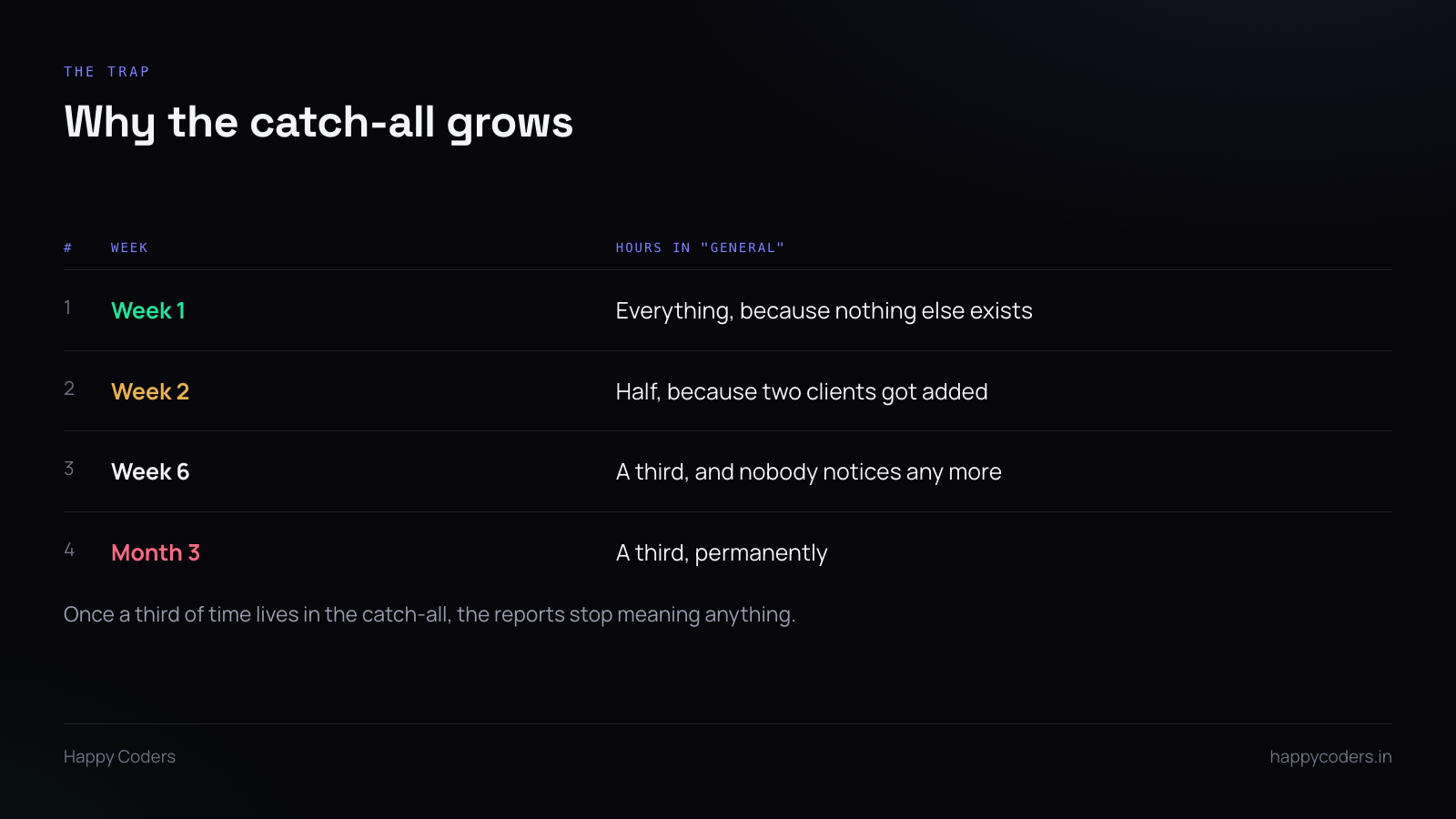
Someone will create a project called “General” or “Misc” in the first week. It is not a disaster, but it does not shrink by itself.
Week one it holds everything, because nothing else exists. By week six it is a third of all time, and by then nobody notices it any more. A third of your hours in an unnamed bucket means your reports cannot answer where time goes, which was the entire reason for the exercise.
Watch it for the first month. Every time it grows, the fix is a new project, not a rule about discipline — people put time in the catch-all because the right place did not exist.
Tasks, later
Resist breaking projects into tasks on day one. Five projects and no tasks is usable immediately. Five projects and forty tasks is a form people learn to avoid.
Add tasks where you actually need the detail — a fixed-price job where you want to know which part overran, or a client who queries invoices. Everywhere else the project is enough.
A test for whether it worked
At the end of week two, look at where the hours went. If most of them are against named clients and the catch-all is small, the structure is right.
If a third is sitting in “General”, that is not a people problem. It means the list is missing something the team does every day, and the fastest way to find out what is to ask them.