A new person joins. Somebody spends a morning walking them through things, they nod, and two weeks later they ask a question that was definitely covered on day one.
That is not a failure of attention. On day one they had no context to attach anything to. The walkthrough was information about a system they had not used, and almost none of it stuck.
What they need is the same information available again in week three, when they have a reason to want it.
The three
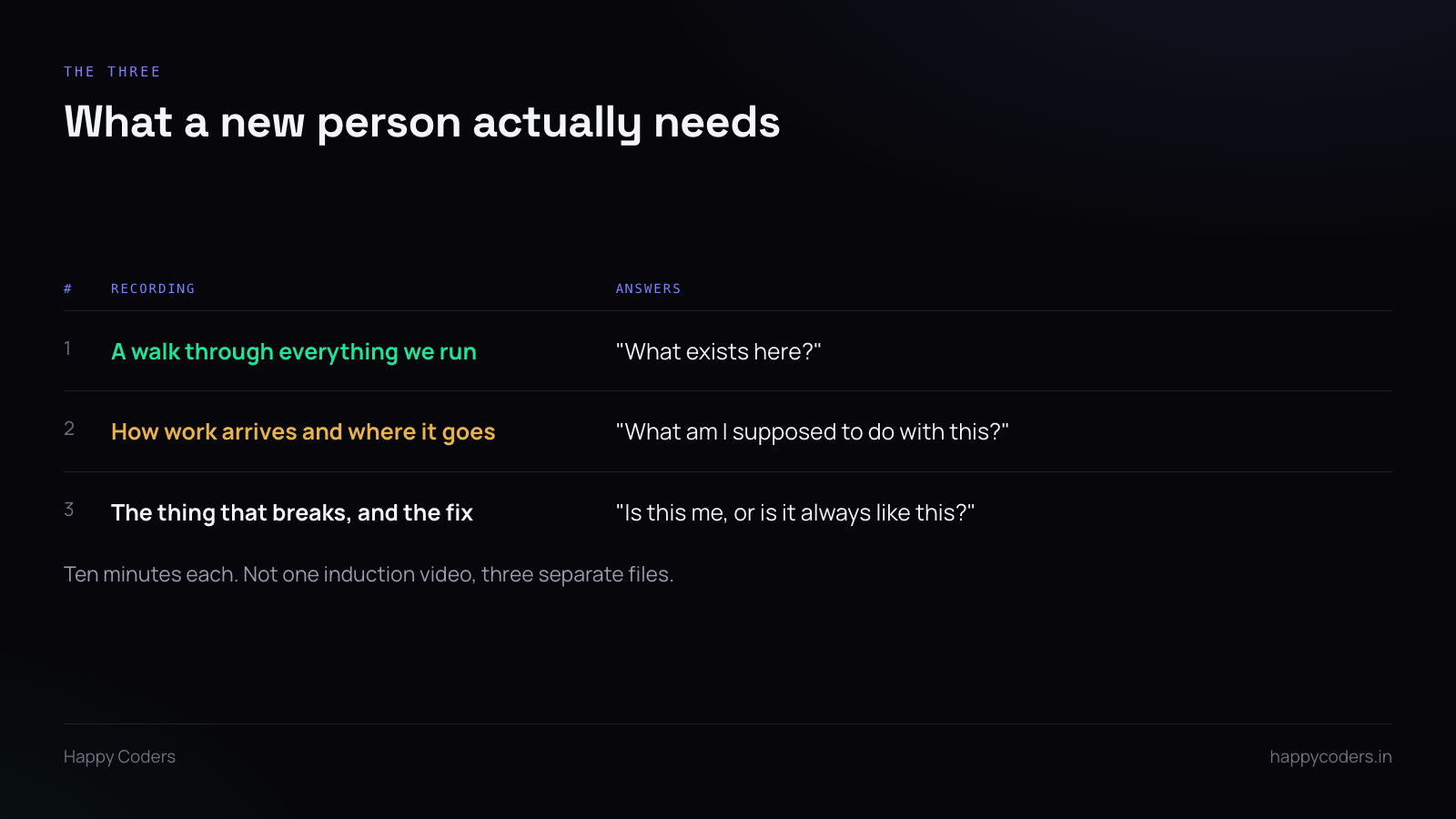
1. A walk through everything we run
Screen share, no preparation. Open each system in turn and say what it is and who uses it. The project tool, the time tracker, the deployment, the client sites, the shared drive, the thing everyone forgets exists.
Ten to fifteen minutes. This is the index. It is not teaching them to use anything — it is telling them what exists, so that in week three they know there is a thing to go and look at.
The question it answers is the one nobody asks out loud: what is here?
2. How work arrives and where it goes
Follow one real task from the moment it appears to the moment it is finished. A client emails, it becomes a task, somebody picks it up, it gets reviewed, it ships, the time goes against a project, the hours end up on an invoice.
Most places have never described this out loud, which is why new people spend their first month guessing at the parts between the steps they were shown.
Use a real task, not a hypothetical one. The hypothetical version always skips the step everyone actually finds confusing.
3. The thing that breaks, and how it gets fixed
Every team has one. The deploy that fails intermittently, the import that needs a retry, the client whose file always arrives in the wrong format.
The new person will hit it in their first month, and what they will not know is whether it is them. Having seen a recording of somebody senior saying “this happens, here is what you do” turns a half-day of quiet panic into a two-minute fix.
This is the single highest-value recording of the three, and it is the one nobody thinks to make.
Why not one induction video
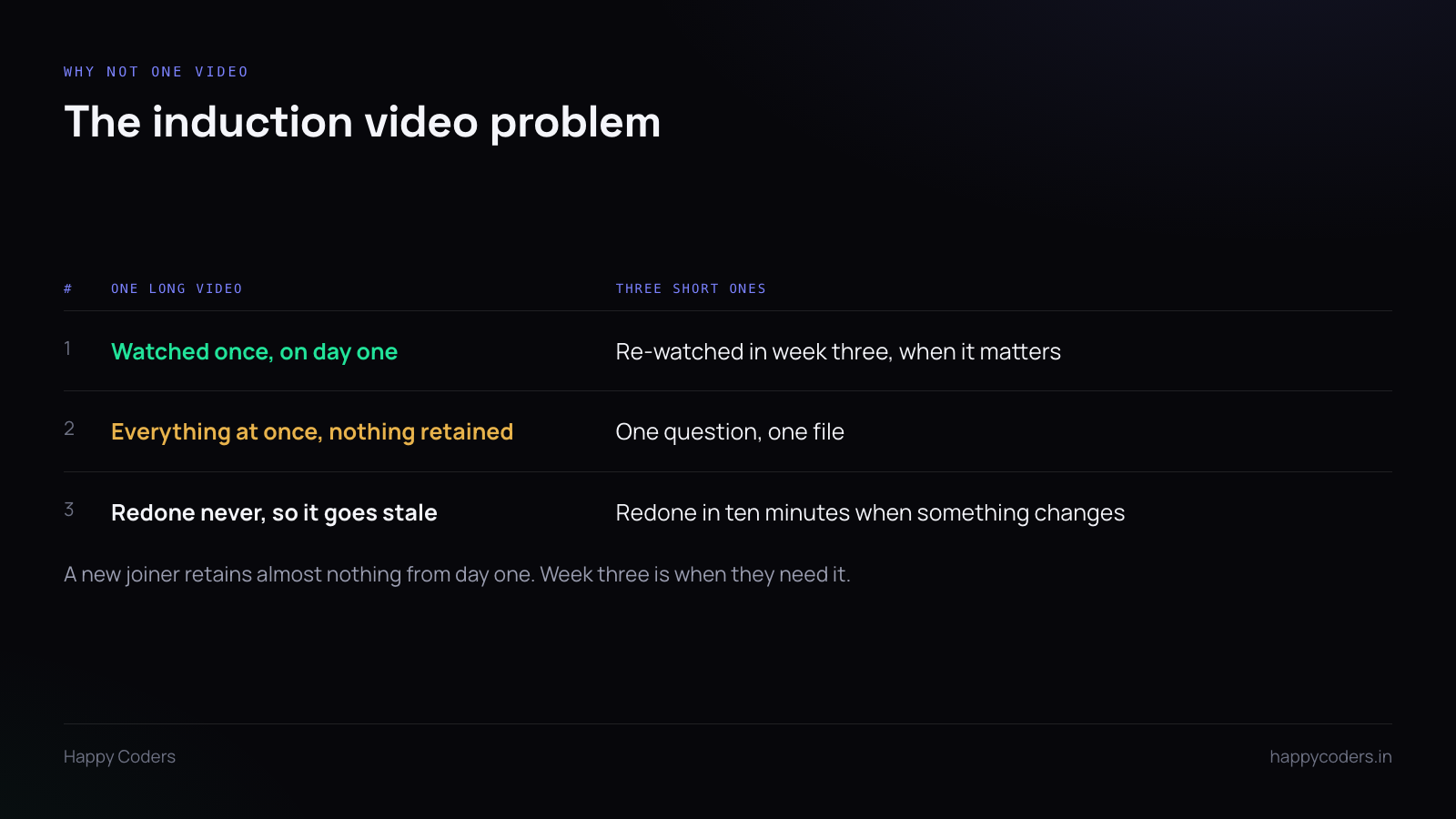
The instinct is to record it all in one sitting. Forty minutes, everything covered, done.
That file gets watched once, on day one, when none of it means anything. It never gets re-watched, because finding the two minutes you need inside forty is harder than asking a colleague.
Three files with obvious names get opened in week three. That is when they are worth something.
Short files also get replaced. A ten-minute recording that is now wrong because a system changed can be redone in ten minutes. The forty-minute one never gets redone, so it sits there slowly becoming misleading, which is worse than nothing.
Practical notes
Record the screen, not the person. The face adds nothing here. If it helps the speaker talk naturally, a small camera bubble is fine, and so is an avatar for anyone who would rather not be on camera.
Have the senior person do it, once, unrehearsed. The asides are the content. “We used to do it the other way and it caused problems” is exactly the kind of thing a new person needs and that no document ever contains.
Name them for the question. what-systems-we-use.mp4, how-a-job-moves-through.mp4, when-the-deploy-fails.mp4. Not induction-1.
Put them somewhere the team owns. Not in the recorder’s personal drive. The most common way these are lost is that the person who made them leaves and their account is deactivated.
Send them before day one
If you can, send the first recording the week before they start. Fifteen minutes of context on a Sunday evening is worth more than the same fifteen minutes on Monday morning, because they can watch it without also trying to remember eleven names.
Add one a month
The three are a start, not a library. The useful habit is: when a new person asks something that took more than two minutes to answer, record the answer while giving it.
After six months you have a set built entirely out of questions people actually had, which is a far better set than anything you would have planned.