This comparison is usually written as though the answer is obvious. It is not. CodeIgniter is smaller, faster to learn and runs on hosting that Laravel struggles with. Laravel gives you a great deal that you would otherwise write yourself, and charges you in complexity and machine resources.
For an Indian development team the deciding factors are often not the ones these articles list — hosting, hiring and the existing codebase usually matter more than the framework features. Here is the whole picture.
What they actually are
CodeIgniter is a small MVC framework. It gives you routing, a database layer, some helpers, and stays out of the way. CodeIgniter 4 modernised it considerably — namespaces, a proper autoloader, a decent query builder, migrations — without changing the philosophy that the framework should be thin.
Laravel is an application framework with opinions. Eloquent, queues, a scheduler, events, broadcasting, policies, a mail system, a testing setup, a large first-party ecosystem, and a well-defined way to do almost everything. You are not only choosing a router; you are adopting a way of structuring applications.
Where CodeIgniter is genuinely the better answer
Shared hosting, and small servers
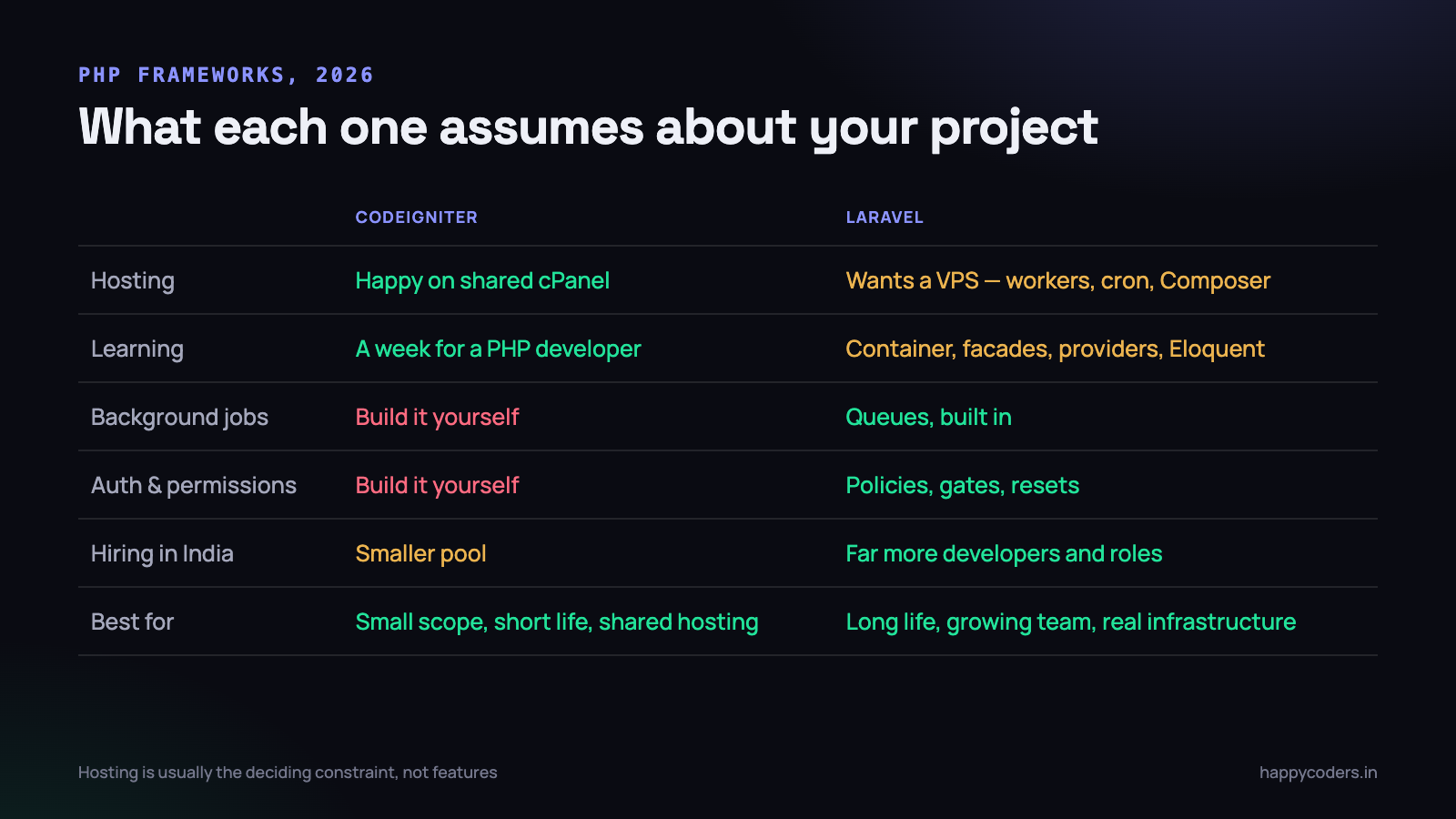
A great deal of Indian web work runs on shared cPanel hosting. CodeIgniter is comfortable there: few files, low memory, no build step, and it works with whatever PHP version the host provides.
Laravel on the same hosting is possible and unpleasant. The public directory has to be the document root or you need a workaround, Composer may not be available, queue workers need a process supervisor that shared hosting does not give you, and the scheduler needs cron access you may not have. You can get it running — we do — but the workarounds are permanent.
Small projects with a short life
A booking form, a brochure site with an admin panel, an internal tool for twelve people. CodeIgniter gets it done with less ceremony, and the whole application stays comprehensible to one person.
Laravel’s structure pays for itself as an application grows. On a project that will never grow, it is overhead you pay every day and never collect on.
Teams that are new to frameworks
CodeIgniter can be learned in a week by somebody who knows PHP. Laravel takes considerably longer, because the framework has concepts — service container, facades, middleware, providers, Eloquent relationships and their pitfalls — and a developer who has not learnt them writes Laravel code that works and is difficult to maintain.
Raw performance per request
CodeIgniter boots faster and uses less memory. On modern hardware with an opcode cache the difference is measured in a few milliseconds and rarely decides anything — but on a ₹300-a-month shared plan running a dozen sites, it is not nothing.
Where Laravel earns the weight
Things you would otherwise build and maintain yourself
This is the real argument, and it is stronger than the feature list suggests. Every non-trivial application ends up needing:
- Background jobs — sending mail, generating reports, processing uploads without making the user wait.
- Scheduled tasks — nightly reports, cleanups, reminders.
- Authentication and authorisation — not just login, but roles, policies, password resets, verification.
- Database migrations that the whole team runs in the same order.
- A testing setup that is actually used, because it was there from the first day.
- Mail templating, file storage abstraction, validation, events.
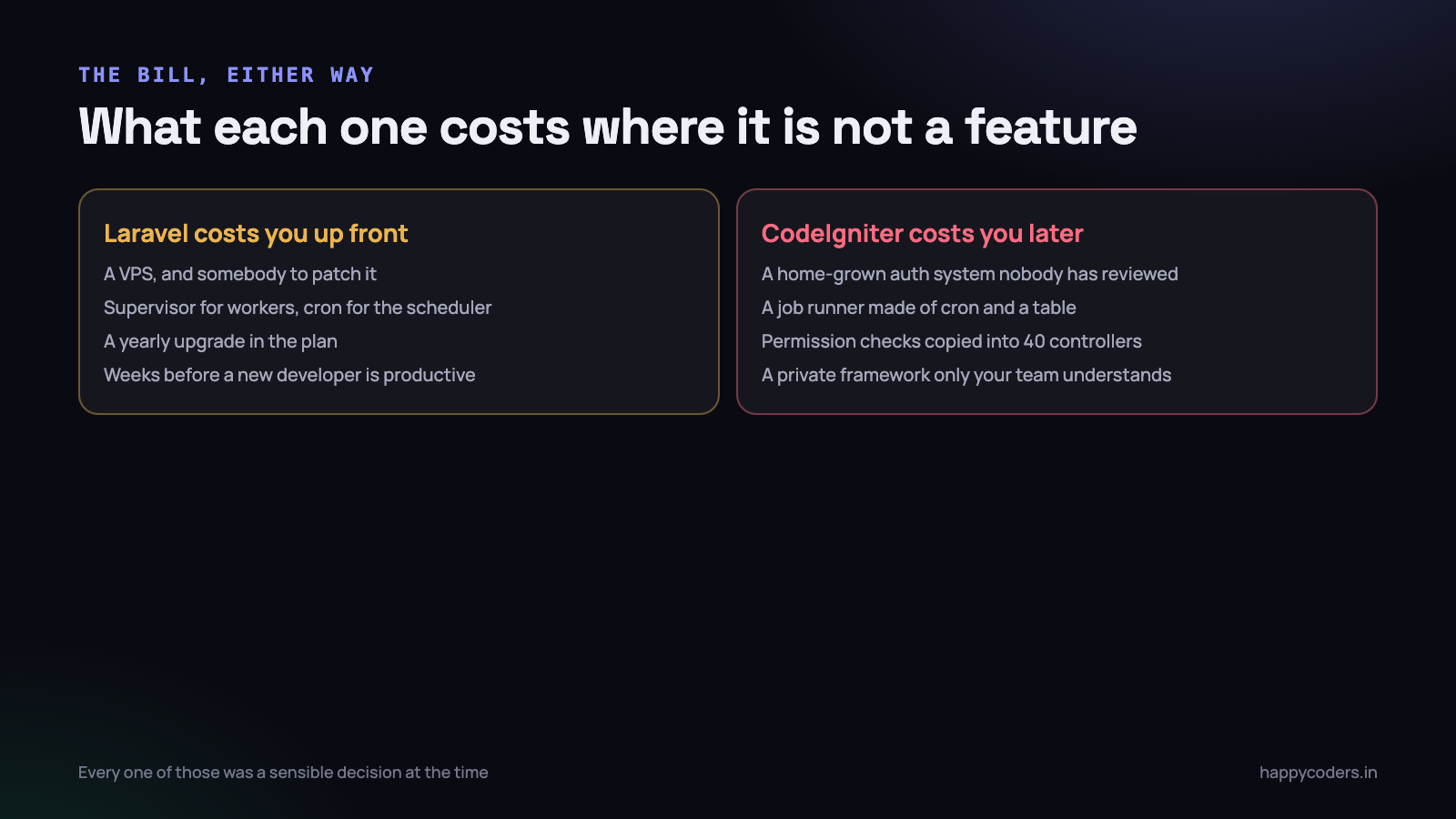
You can build all of this on CodeIgniter. Teams do. What you end up with is a private framework that only your team understands, that has no documentation, and that becomes the reason a new developer takes two months to become productive.
Eloquent, when used carefully
Relationships, eager loading, scopes, accessors and soft deletes remove a large amount of repetitive query code. The caveat is real: Eloquent makes it very easy to write an N+1 query without noticing, and the fix requires knowing to add with(). A team that does not know this ships a page doing four hundred queries.
Hiring, and the size of the community
This is a genuinely important and under-discussed factor. In India in 2026, Laravel roles and Laravel developers are far more numerous than CodeIgniter ones. A new developer is more likely to know Laravel, more likely to find an answer to a problem, and more likely to want the experience on their CV.
For a company that expects to hire, this can outweigh every technical consideration on the page.
One caveat about the hiring argument, since it cuts both ways: choosing a framework because it is fashionable rather than because it fits is how a small team ends up maintaining infrastructure it did not need. The point is strong when you will genuinely be hiring within a year or two. It is not a reason on its own.
Upgrades and security
Both are actively maintained. Laravel’s release cadence is faster and the ecosystem tracks it closely, which means both more frequent upgrades and quicker fixes. CodeIgniter moves more slowly, which is either stability or stagnation depending on your temperament.
The costs nobody lists
Laravel needs infrastructure that shared hosting does not have
Queue workers must run continuously, which needs a process supervisor. The scheduler needs a cron entry. Composer needs shell access. The document root has to point at public/. None of these are hard on a VPS and all of them are obstacles on a ₹200-a-month cPanel plan.
Budget for the hosting when you budget for the framework. A VPS with enough memory to run PHP-FPM, MySQL, Redis and a couple of workers is a different monthly number, and somebody has to keep it patched.
CodeIgniter costs you in code you write twice
The bill arrives later and is harder to see. Three years in, a CodeIgniter application of any size has a home-grown auth system, a home-grown job runner built on cron and a database table, a home-grown permissions check copied into forty controllers, and no tests. Every one of those was a sensible decision at the time.
The cost shows up when a developer leaves, or when a security question gets asked about the auth code nobody has looked at since 2023.
Upgrades cost in both directions
Laravel releases yearly and the ecosystem follows; staying current is real, recurring work, and falling three versions behind turns a small job into a project. CodeIgniter moves slowly, which is comfortable until the PHP version it needs stops receiving security updates and you discover the upgrade path is wider than you thought.
Either way, put framework upgrades in the plan as maintenance rather than treating them as an emergency when they arrive.
What about the other options?
The question is usually framed as these two, and in 2026 that is worth questioning.
- Symfony — more configurable, more explicit, steeper to learn. Chosen by larger teams who want control over the structure rather than opinions handed to them.
- Slim or a micro-framework — for an API with no interface. Lighter than CodeIgniter and honest about being only a router plus middleware.
- Plain PHP with a few packages — genuinely viable for something small, and how many CodeIgniter projects effectively end up anyway.
- Not PHP — worth an honest thirty seconds. If the team is stronger in Node or Python, that matters more than any framework comparison here.
For most Indian development shops the realistic shortlist stays Laravel and CodeIgniter, because that is where the hiring pool and the existing client codebases are. That is a legitimate reason and worth stating rather than pretending the decision was purely technical.
The four questions that actually decide it
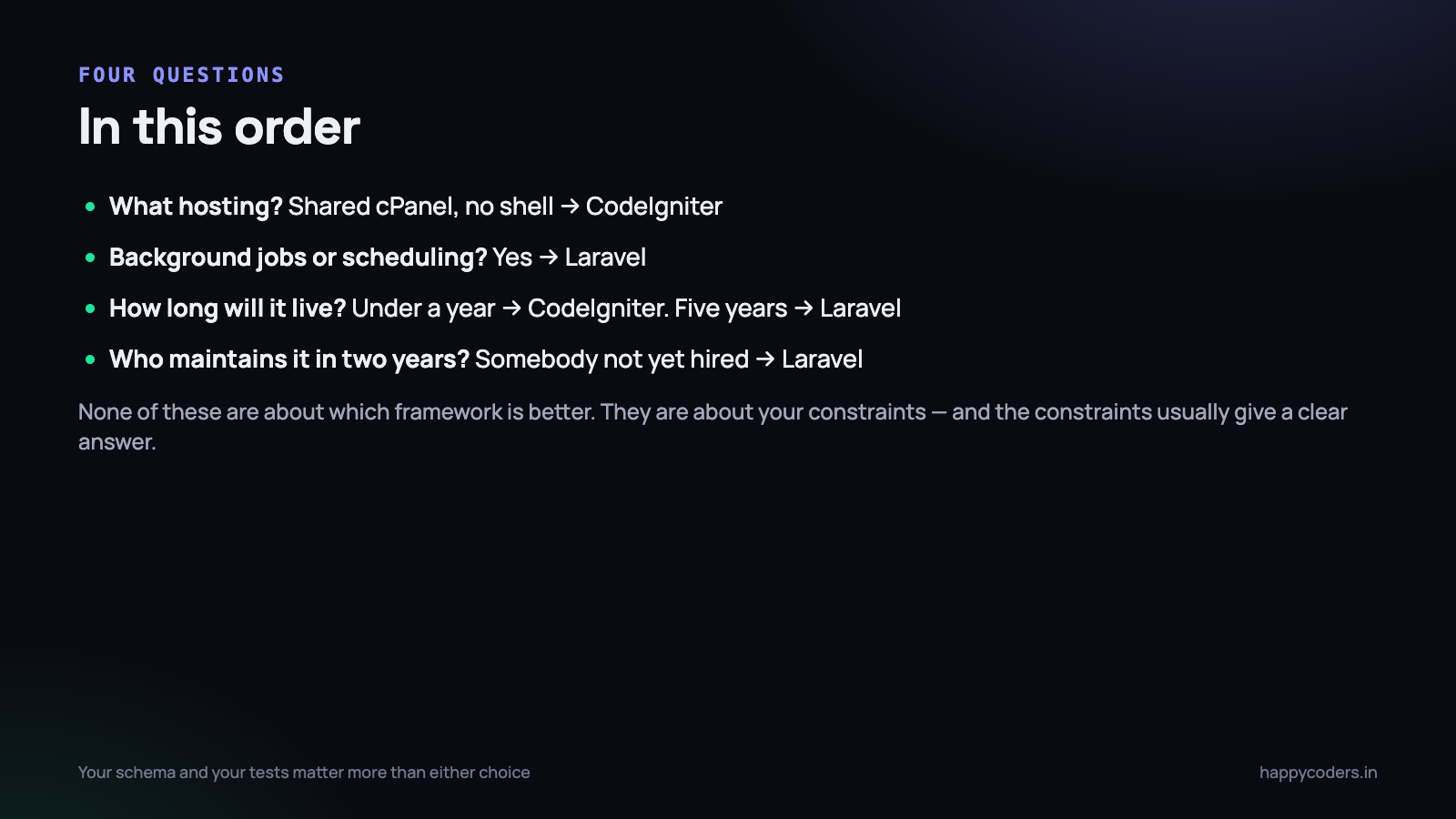
- What hosting will this run on? Shared cPanel with no shell access points at CodeIgniter. A VPS or a cloud instance removes the constraint entirely.
- Will it need background jobs or scheduled tasks? If yes, Laravel gives you both properly, and building them yourself on CodeIgniter is where private frameworks come from.
- How long will this application live? Under a year, CodeIgniter. Five years and growing, Laravel’s structure is worth its cost.
- Who will maintain it in two years? If the answer is “somebody we have not hired yet”, weight Laravel heavily.
Notice that none of these are about which framework is better. They are about your constraints, and the constraints usually give a clear answer.
What about an existing CodeIgniter application?
This is the more common real question, and the honest answer is usually: do not rewrite it.
A full rewrite of a working application is six months of work that produces, on a good day, exactly what you already had, plus new bugs in features that had been stable for years. The business gets nothing visible. Most rewrites that begin this way are abandoned halfway, leaving two codebases.
Better approaches, in order of how often they are right:
- Leave it alone and maintain it. If it works and the changes are small, this is the correct answer more often than developers want it to be.
- Upgrade CodeIgniter 3 to 4. Substantial work, but it is modernisation rather than replacement, and the application keeps working throughout.
- Build new modules in Laravel alongside it. A separate application, sharing the database or talking over an API, with the web server routing certain paths to each. New work gets the better tooling; old work stays untouched.
- Rewrite, only when the old application is genuinely blocking the business — it cannot be secured, cannot be hosted on a supported PHP version, or nobody can safely change it.
And if you do rewrite: one module at a time, in production, with both running. Never a big-bang cutover.
A two-hour way to decide
If the four questions leave you genuinely undecided, stop reading comparisons and build the same small thing twice. Pick the least glamorous feature in the project — a login, a list with a filter and a form that writes one record — and implement it in both, in an afternoon.
You learn things no article tells you: how the team feels about the syntax, how long the setup took on your actual hosting, whether anybody got stuck, and how readable the result is to the person who did not write it. Then delete both and start properly.
Four hours spent this way is cheaper than the fortnight teams routinely spend arguing, and considerably cheaper than finding out in month three.
A comparison that is not about frameworks
Two things matter more than this choice and get a fraction of the discussion.
Your database design. A badly modelled schema will make an application slow and painful in either framework, and it is far harder to change later than the framework is.
Whether you write tests. A CodeIgniter application with a test suite is more maintainable than a Laravel application without one. Laravel makes testing easier, which matters only if the team actually does it.
Teams routinely spend a fortnight on this decision and then skip both of those. The framework choice is worth an afternoon.
What we use, and why
Our own products are Laravel — multi-tenant SaaS with queues, scheduled jobs, role-based permissions and a Vue front end. Every item on that list is something Laravel gives us and we would otherwise be maintaining ourselves.
We also maintain client applications on CodeIgniter, on shared hosting, that work perfectly well and that we have no intention of rewriting. Both statements are true at once, and that is the honest shape of this question.
The short version
- CodeIgniter for shared hosting, small scope, short life, or a team new to frameworks.
- Laravel for background jobs, scheduling, real authorisation, long life, or a team you will hire into.
- Hosting is usually the deciding constraint, not features.
- Hiring is the factor most often ignored and most often decisive.
- Do not rewrite a working CodeIgniter application. Build new work alongside it.
- Your schema and your tests matter more than either choice.
If you go with Laravel, the first two things worth reading are how queues differ from cron jobs and how to avoid the N+1 queries that Eloquent makes so easy to write.