Almost every leave policy gets written twice. The first version is a line in the offer letter saying twelve days a year. The second version gets written in pieces, over eighteen months, each piece decided during an argument with a specific person about a specific day.
The second version is the real policy, and it is bad in a predictable way. It is inconsistent, because each decision was made under different pressure. It favours whoever asked first or argued hardest. And nobody can tell you what it is, including the person who made most of it.
What follows is the set of questions that produce that second version. None of them sound urgent. All of them will be asked eventually, by somebody, at the worst possible moment.
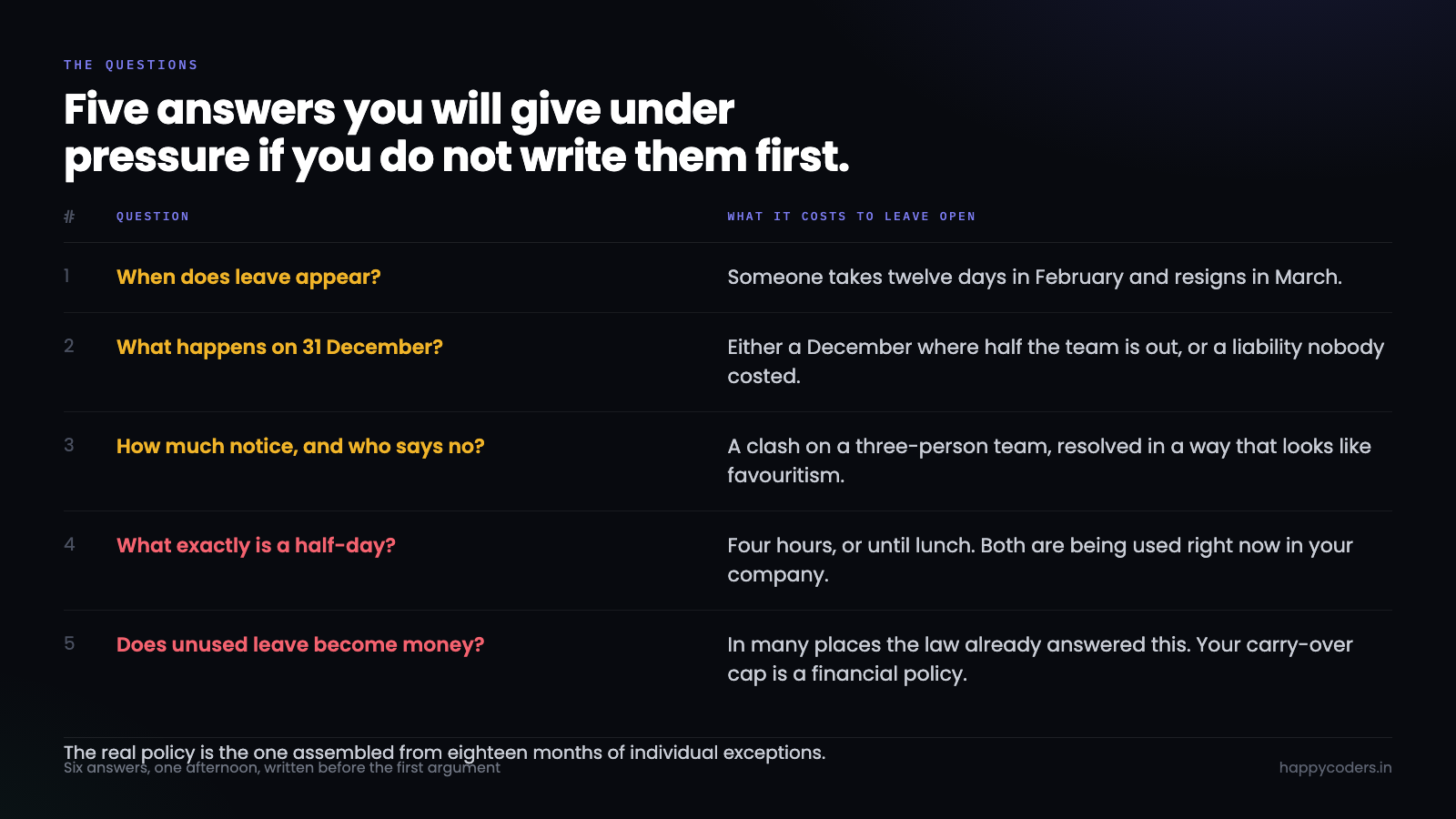
When does leave actually appear
“Twelve days a year” does not say when you have them, and that ambiguity is the single most common leave dispute.
If leave accrues monthly, somebody in March has three days and cannot take a week off. If it lands in full on the first of January, somebody can take all twelve days in February and leave in March, and you have paid for nine days that were never earned. Both are defensible policies. Having neither written down is not.
Then the awkward corollary: what about a person who joins in August? Twelve days for four months of work is generous in a way you probably did not intend. Pro-rating is the normal answer, and it needs to be in the offer letter rather than explained afterwards, because “actually you only get five” is a terrible conversation to have in week one.
The probation question sits here too. Many companies do not allow leave during probation, which is reasonable until somebody’s sister gets married in month two. Decide now whether that is unpaid leave, an exception, or a refusal, because you will be deciding it under pressure otherwise.
What happens on the thirty-first of December
Carry-over is where the money is, and most small companies do not realise they have made a decision until it costs them.
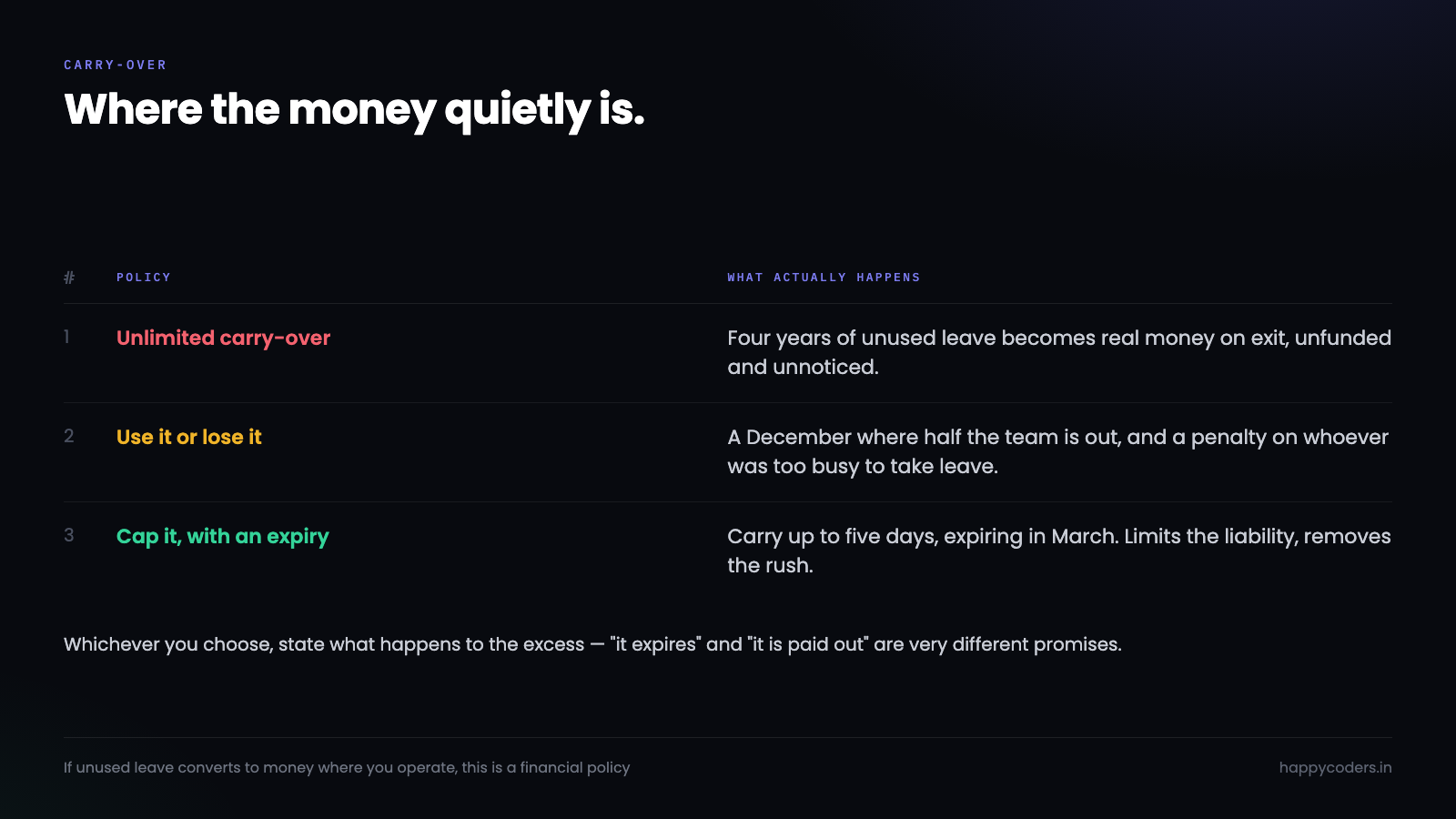
Unlimited carry-over sounds generous and quietly accumulates a liability. Someone with four years of unused leave has a substantial balance, and if your local law says unused leave is paid out when employment ends, that balance is real money you have not accounted for anywhere.
Use-it-or-lose-it is clean and creates a different problem: a December where half the team is out at once, because everybody suddenly noticed. It also punishes the people who were too busy to take leave, who are usually the people you least want to annoy.
The middle position is a cap — carry up to five days, and they expire by March. It limits the liability, it removes the December rush, and it accepts that a person who could not take leave in November should not simply lose it. Whatever you pick, say what happens to the excess, because “it expires” and “it is paid out” are very different promises.
How much notice, and who can say no
A notice period without a stated exception is a policy that gets broken the first time something real happens.
Two weeks for a single day and a month for anything longer is a reasonable shape. What matters more is the exception, because bereavement, illness and emergencies do not give notice, and if the policy has no room for them, a manager has to break it. Once a manager has broken the policy once, it is no longer the policy.
The harder half is refusal. Can a manager decline leave that was requested correctly, and on what grounds? “Business needs” is the usual phrase and it means nothing on its own. If two people on a three-person team ask for the same week, somebody is getting refused, and the fair way to handle it is a rule decided in advance — first to ask, or rotate who gets priority at peak times — rather than a judgement made in the moment that looks like favouritism whether it is or not.
Write down who approves. In a small company this is often ambiguous, and an employee who asked their team lead and heard nothing has, in their mind, given notice.
The half-day, which is more trouble than it is worth
The half-day is the smallest question here and generates the most confusion.
A half-day is not a fixed quantity. Is it four hours, or is it until lunch? If someone works ten hours on a normal day, is their half-day five? If they leave at 2pm having started at 8am, is that a half-day or a full one? Every one of those has been argued about somewhere this month.
Two clean answers exist. Either half-days are exactly half of a standard working day, defined in hours, and the clock does not matter. Or you do not have half-days at all, and short absences are handled by flexibility rather than by the leave system. Both work. What does not work is a half-day that means whatever the person taking it thought it meant.
Related and worth deciding at the same time: does a public holiday inside a week of leave count against the balance? It should not, and if your system counts calendar days rather than working days, it will, and somebody will notice.
Does unused leave turn into money
Encashment is partly a legal question and partly a cultural one, and the legal part varies enough by jurisdiction that it needs checking rather than assuming.
In much of India, for example, earned leave is treated as a right that converts to money on exit. If that applies to you, then your carry-over policy is a financial policy whether you meant it to be or not, and an unlimited balance is an unfunded obligation sitting in a spreadsheet nobody reviews.
The cultural part is whether people can cash out leave while still employed. Allowing it sounds employee-friendly and reliably produces a team that never takes time off, because the money is immediate and the rest is not. Most companies that try it stop.
The pragmatic position for a small company: encash on exit if the law requires it, cap the carry-over so the number stays small, and do not offer encashment during employment. Then actually track the balance, because a liability you cannot see is one you cannot plan for.
Sick leave is a different thing
Folding sick leave into one pot of annual leave is the simplification that seems tidy and is not.
When sick days come out of holiday, a person who is genuinely ill is spending their holiday to be ill, and the rational response is to work while sick. In an office that spreads an infection. Everywhere else it produces bad work, slowly, and a person who takes longer to recover.
A separate allowance, even a small one, changes the incentive completely. Alongside it, decide when you require a medical certificate — three consecutive days is the usual threshold — and say it in advance rather than asking for one after the fact, which always reads as an accusation.
The person who leaves owing you days
Here is the case that catches small companies out, and it follows directly from the accrual decision.
If leave lands in full in January, somebody who takes eight days by May and resigns in June has taken more than they earned. Do you recover it from the final salary? Many companies assume they can and discover that local law does not allow a deduction that was never agreed in writing. Others do recover it, and turn an ordinary resignation into a bitter one over a small amount of money.
The sentence that prevents all of it is short and belongs in the offer letter: leave taken in excess of leave accrued may be adjusted against the final settlement. Written up front, it is an ordinary term. Raised for the first time during an exit conversation, it is a dispute.
The related case is the opposite one — a person leaving with a balance, in a place where that converts to money. Both are the same underlying problem: the balance is only ever looked at on the day somebody resigns, which is the one day it is too late to do anything about.
Write it down before you need it
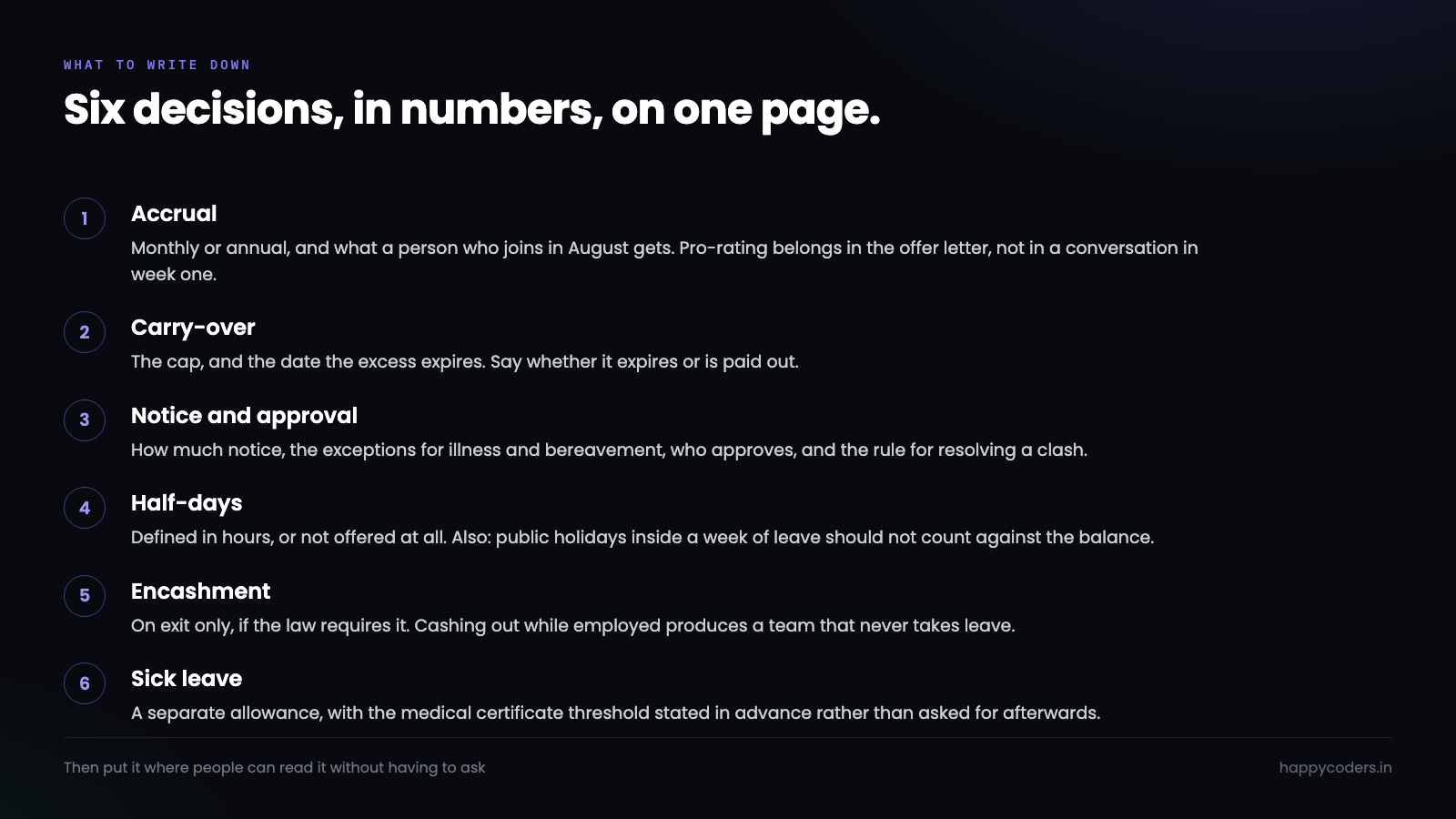
The document does not need to be long. It needs to answer the questions above in specific numbers, and it needs to exist before the first argument rather than after it.
Accrual: how leave appears, and what happens to somebody who joins mid-year. Carry-over: the cap and the expiry date. Notice: how much, the exceptions, who approves, and how a clash is resolved. Half-days: defined in hours or not offered. Encashment: on exit only, if at all. Sick leave: separate, with the certificate threshold stated.
Six answers. An afternoon. Then put it where people can read it without asking, because a policy that requires asking HR is a policy most people will simply guess at.
The part that makes it work
A written policy still fails if nobody can see their own balance. If checking how many days you have left means emailing someone, two things happen: people stop checking, and the number in their head drifts away from the number in the system. The gap surfaces at exactly the wrong time, usually when leave has already been booked and paid for.
The balance should be visible to the person it belongs to, the request should go through the same place, and the approval should be recorded rather than remembered. Not because anybody is dishonest, but because a year later nobody will recall whether that Friday in March was approved leave, unpaid, or simply a day somebody did not come in.
Happy Tracker keeps leave types, balances and requests in the same place as attendance and timesheets, so a member can see their own balance without asking and every approval is recorded rather than remembered.