The daily standup starts as fifteen minutes and a good idea. Two years later it is twenty-two minutes, twelve people, and a queue of individuals describing yesterday to a manager while everybody else waits for their turn and thinks about something else.
Nobody defends that meeting on its merits. It survives because cancelling it feels like giving up on visibility, and because the manager who cancels it is the one who has to answer “so how do you know what the team is doing?”. Both of those are solvable. Most of what the standup produces can be written down in sixty seconds and read in thirty, and the part that genuinely needs people in a room takes twenty minutes a week, not seventy-five.
This is not an argument for fewer conversations. It is an argument for stopping the daily one that has stopped being a conversation.
What a standup is actually for
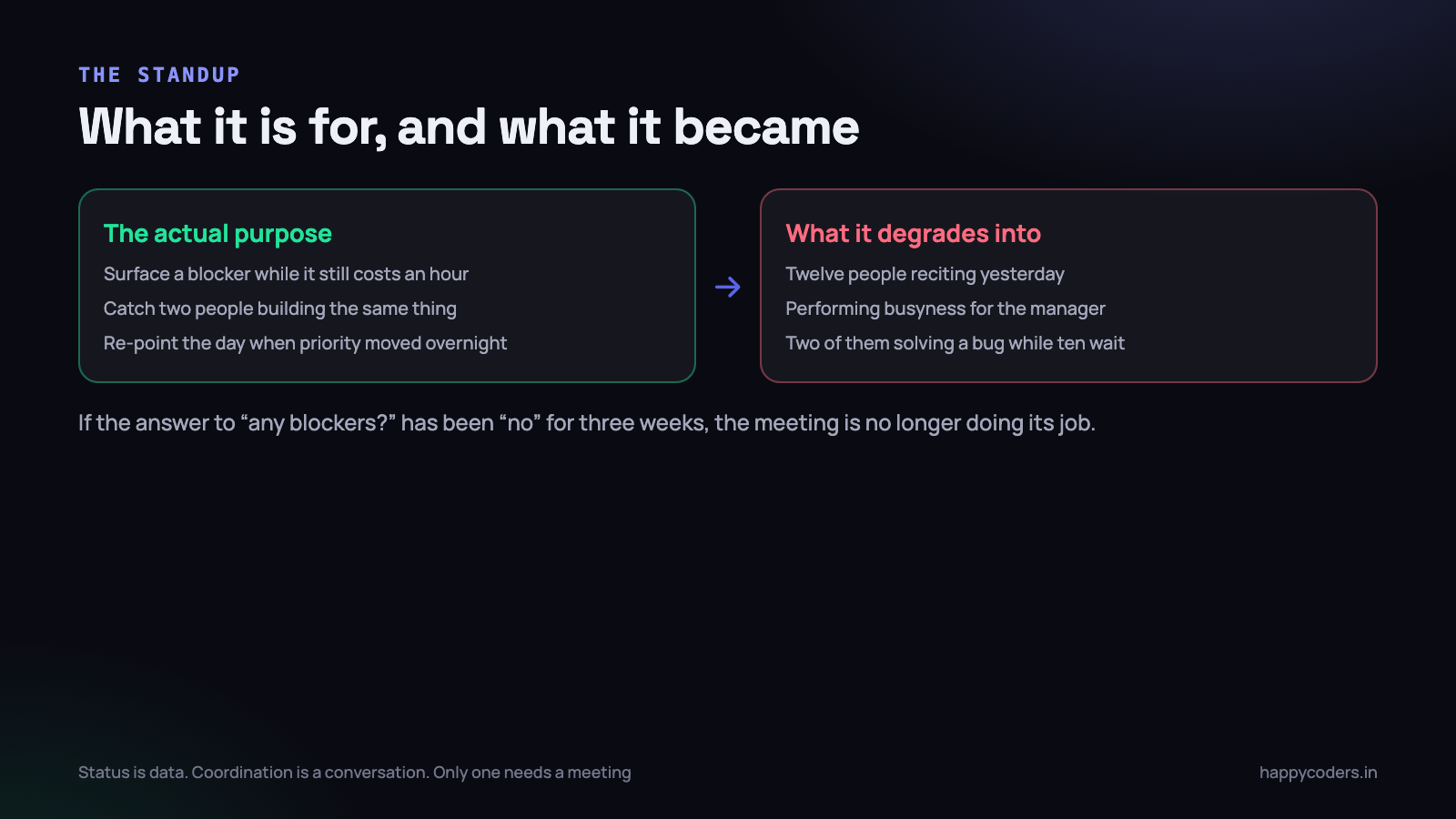
Strip away the ritual and there are exactly two things a daily standup is good at, and both of them are about the immediate future rather than the recent past.
Surfacing a blocker while it is still cheap
Somebody is stuck. They need a credential, an API sandbox key, a decision about how the invoice numbering should work, or five minutes of the senior developer’s attention. Left alone, that stays stuck for a day or two because raising it feels like an interruption. In a standup it comes out in one sentence and is resolved by 11:30.
This is the genuine value, and it is real. A blocker caught on day one costs an hour. The same blocker caught on Thursday cost three days, and the project plan absorbed it silently.
Catching collisions and reprioritisation
Two people about to build the same helper. A change one person is making that will break what another is halfway through. A client escalation that arrived at 08:00 and reorders the day for three people. These are things that cannot be discovered by reading a report, because nobody knows to write them down — they surface when two people hear each other speak.
What it actually degrades into
Now the honest version of what happens at 10:00 in most teams. Each person says what they did yesterday, what they will do today, and “no blockers”. Eleven of the twelve updates are irrelevant to any given listener. The manager nods. The meeting ends five minutes late because two people started debugging something in front of ten spectators.
Three failure modes turn up again and again:
- Status recital. The update is aimed at the manager rather than the team, which is why it is full of effort and light on specifics. “I worked on the reports module” conveys nothing and cannot be questioned, which is precisely why it is the most common sentence in the meeting.
- Performed busyness. Once people believe the standup is where their work is evaluated, the update becomes a small daily performance. This is not dishonesty. It is a rational response to being asked every morning to justify a day.
- The two-person debug. A real problem surfaces, two people start solving it live, and ten people lose eleven minutes. The problem is genuine and the meeting is the wrong place for it.
A useful test: if the answer to “any blockers?” has been “no” from everybody for three consecutive weeks, the meeting is no longer doing either of its jobs. Either nobody is ever stuck, which is false, or the format has stopped surfacing it.
The arithmetic, in rupees
Most teams have never costed the standup, and the number is larger than people expect — not because of the fifteen minutes, but because of what the fifteen minutes sits inside.
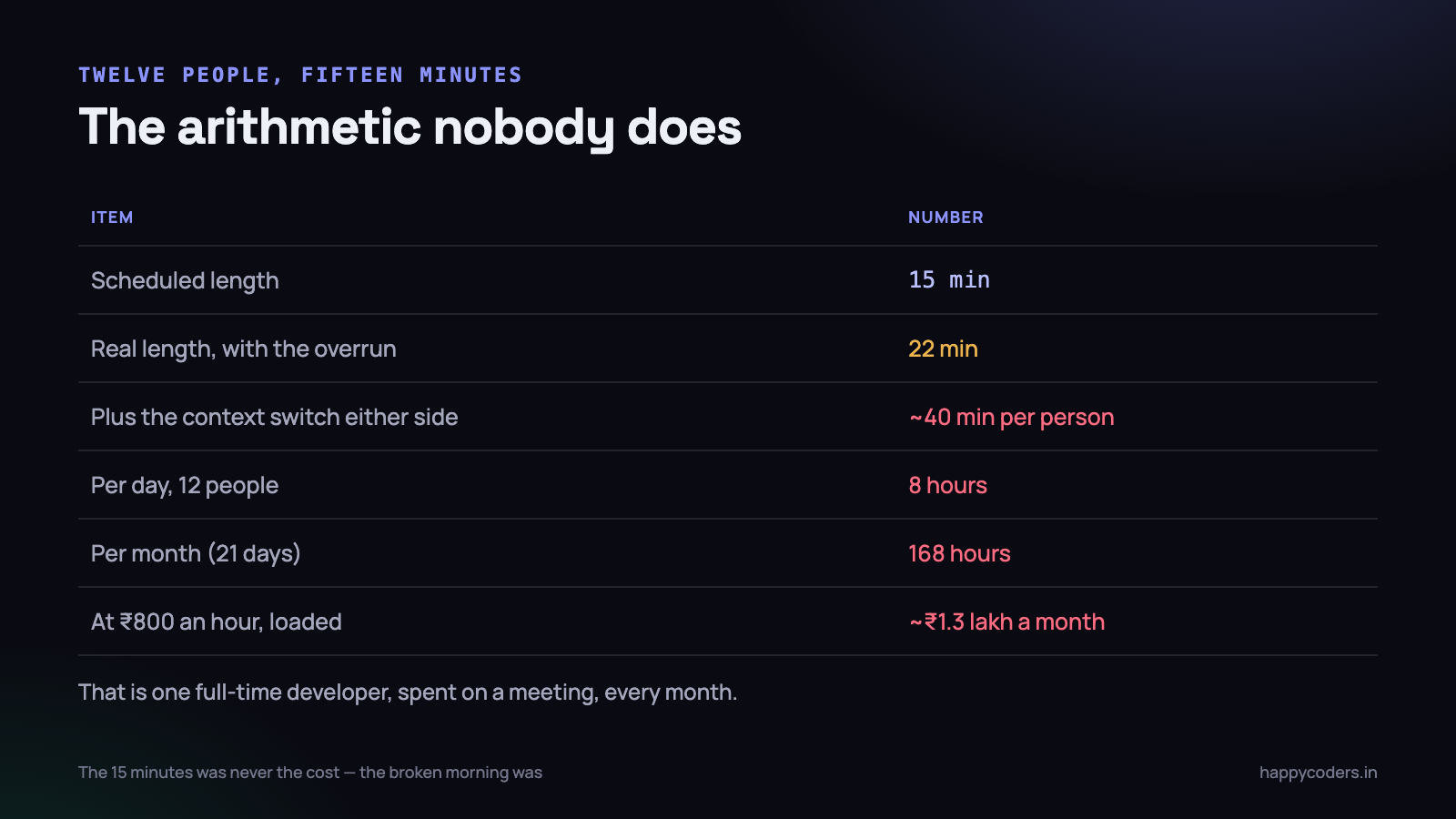
Work it through for a twelve-person team:
- The meeting is scheduled for 15 minutes and runs about 22, because two people needed to finish a thought.
- Nobody starts deep work in the 20 minutes before a meeting. That time goes on email and small tasks.
- After it ends, getting back into a non-trivial problem takes most people 10 to 15 minutes.
- So the real cost is roughly 40 minutes per person per day, not 15.
- Twelve people, 40 minutes: 8 hours a day. Twenty-one working days: 168 hours a month.
- At a loaded cost of around ₹800 an hour, that is roughly ₹1.3 lakh a month, or over ₹15 lakh a year.
That is one full-time developer, spent on a meeting. Whether that is worth it depends entirely on what the meeting produces — and the honest answer for most teams is: three or four useful blocker escalations a week, and a lot of recital.
The point of the arithmetic is not that meetings are bad. It is that a meeting costing a developer a year should be held to the standard of a developer, and most standups are not.
What a written report can replace
Almost all of the status half. A short written update, posted asynchronously before a fixed time, replaces the recital completely and does it better in several ways.
- It is searchable. In November you can find out what happened to the GST rounding bug in August. The standup version of that information evaporated the moment it was spoken.
- It is read at the reader’s convenience. Nobody is held in a meeting for eleven updates that do not concern them.
- It is more specific. Writing forces a ticket number. Speaking permits “I was on the reports module”.
- It costs the writer about a minute and the reader about thirty seconds, against forty minutes for everyone.
- It works across timezones and half-days, which matters if anybody on the team is remote, in a different city, or has a hospital appointment.
If you already run a tracker, some of this is produced without anyone writing anything. Hours against tasks, what moved on the board, what was committed — that is the factual layer, and it is more reliable than a spoken summary because it was recorded as the work happened rather than remembered afterwards. Our post on reading the reports covers the daily view. The written update then carries the part the system cannot know: intention, risk, and what somebody is stuck on.
What a written report cannot replace
Be honest about this, because teams that go fully async and then wonder why coordination got worse usually skipped it.
- Hesitation. “Today: finishing the migration script” reads the same whether the person is confident or quietly terrified. In a live conversation you can hear the difference, and a good lead acts on it.
- The thing nobody knew to write. Collisions surface because two people hear each other, not because either of them thought their work was worth mentioning.
- Disagreement. Two people with different views of an approach need to talk. Written threads on a design disagreement expand until somebody calls a meeting anyway.
- The blocker people are embarrassed by. Some blockers are “I do not understand this code”. Those are far more likely to come out in conversation than in a written post that the whole team can read.
- New joiners. Somebody in their first month genuinely benefits from hearing the team talk daily. Async is efficient for people who already have the context.
The blockers point is the one to plan around. If you remove the daily meeting and do nothing else, blockers get slower, not faster — because the one moment when raising a problem was socially free has gone.
The format of a written update people actually read
Most written standups fail because they are the spoken standup typed out: three paragraphs of what I did yesterday, which nobody reads by day four. The format below works because it is short, specific, and has a line that is genuinely useful to the reader.
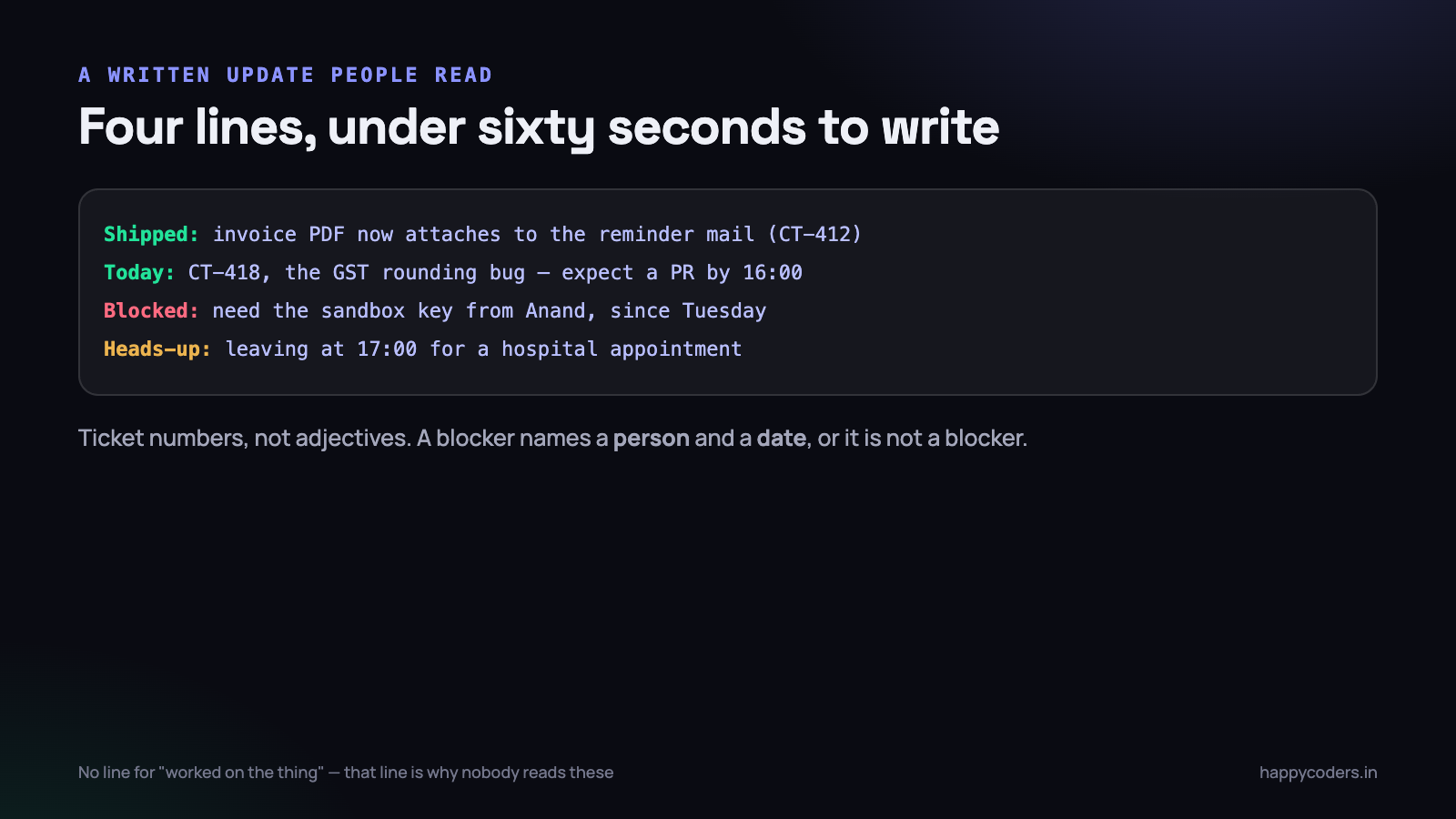
Four labelled lines, posted in one channel, before a fixed time:
- Shipped — what is actually done, with a ticket number. Not “worked on”. If nothing shipped, say nothing shipped; that is information too, and it is fine on most days.
- Today — one or two items with ticket numbers and, where it matters, an expected time. “PR by 16:00” is a commitment the team can plan around.
- Blocked — and this line must name a person and a date. “Waiting on the sandbox key from Anand, since Tuesday” is a blocker. “Blocked on API access” is a complaint with nowhere to go.
- Heads-up — anything the team needs to know about your availability. Leaving at 17:00, on leave Thursday, on a client call from 11 to 13.
Three rules make it stick. Keep it in one channel, not per-person DMs, or the searchability is lost. Set a time — before 11:00 IST works for most Indian teams — because an update posted at 18:00 is a diary entry, not coordination. And ban the words “worked on”, which sounds harsh and is the single most effective thing you can do to the format.
The lead has to actually read them
This is where most rollouts die. If the team writes updates for two weeks and nobody visibly responds, everybody correctly concludes it is paperwork and the quality collapses to one line each.
The fix is small: whoever leads reads the channel every morning and replies to something. Not to everything — to the blocker that needs unblocking, the heads-up that affects a date, the shipped item that deserves acknowledgement. Ten minutes, visible, every day. That is the whole maintenance cost of the system.
The weekly meeting that should survive
Do not go to zero. Removing the daily meeting and replacing it with nothing produces a team that is efficient and slowly loses shared context, which shows up three months later as duplicated work and decisions nobody remembers making.
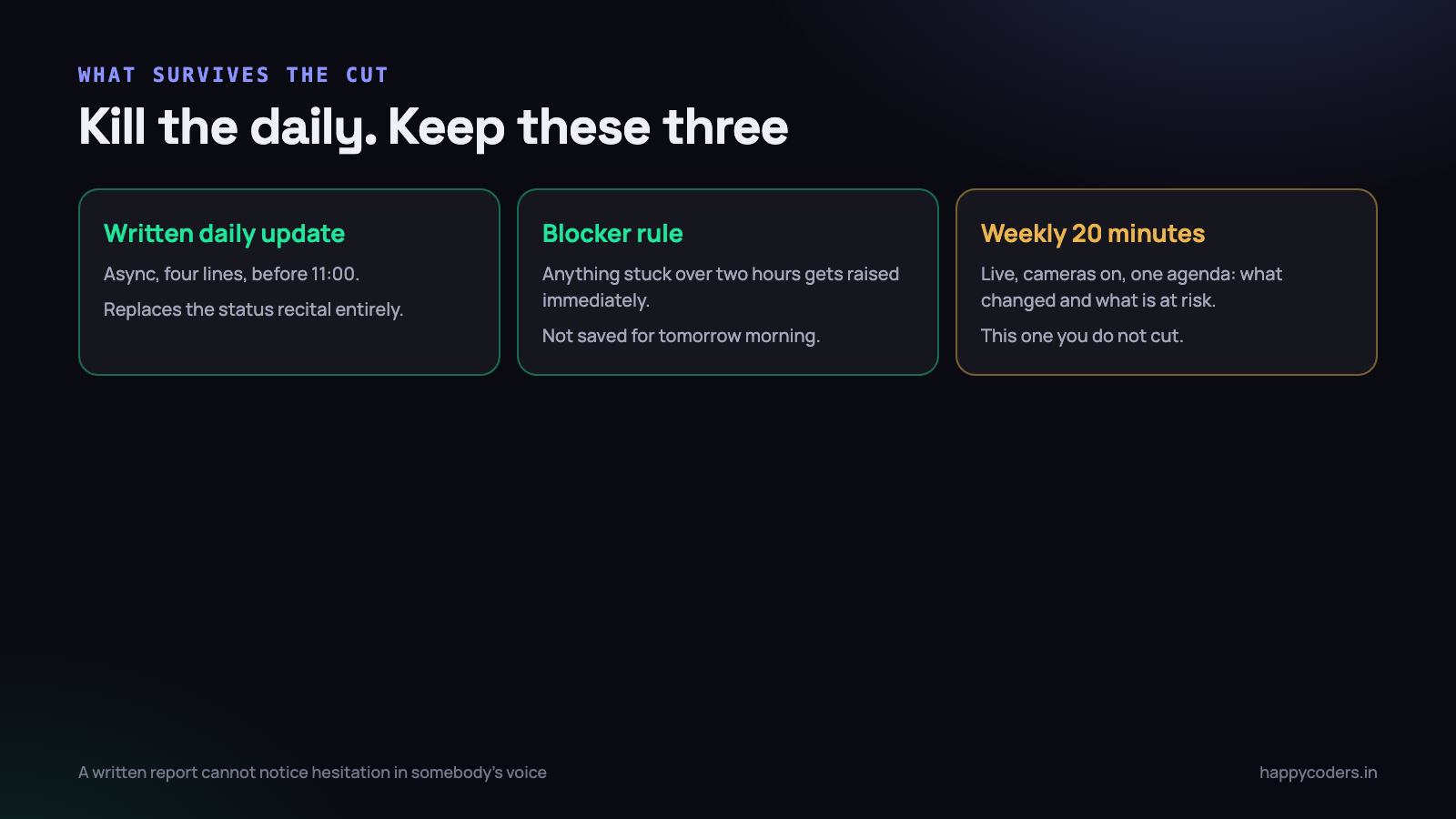
Keep one live meeting a week, twenty to thirty minutes, with a fixed agenda that is deliberately not a status round:
- What changed — decisions taken, priorities that moved, anything a client said that reorders the next two weeks. Five minutes, from whoever leads.
- What is at risk — anything that will not make its date, said out loud, early. This is the part that needs voices, because people flag risk more readily in conversation than in writing.
- What we should stop doing — two minutes, genuinely asked. This is where the standup would have been cancelled a year earlier if anybody had asked.
- One thing worth sharing — something somebody learned, a tool, a pattern. Keeps the meeting from being purely defensive.
Cameras on, if the team is remote. Twenty minutes with faces does more for a distributed team’s coordination than five daily audio calls where three people are on mute doing something else.
And a blocker rule that runs all week
The rule that replaces the daily blocker slot: anything stuck for more than two hours gets raised immediately, in the team channel, by the person who is stuck. Not saved for tomorrow morning.
This only works if the first few times somebody uses it, the response is help rather than a question about why they did not know. The lead sets that tone in the first fortnight, or the rule dies and the team goes back to sitting on problems quietly.
The four objections you will hear
Every team raises roughly the same four, and each one has a real answer rather than a rhetorical one.
- “But agile requires a daily standup.” It does not. The Agile Manifesto asks for individuals and interactions over processes and tools, and a meeting that has become a recital is a process, not an interaction. Scrum prescribes a daily event for the development team to plan its own next day — not a reporting session with a manager at the head of the table. If your standup is the second thing, you left the framework a long time ago.
- “Juniors will get lost.” A fair point, and the answer is not to keep a meeting for twelve people because two of them need it. Give new joiners a daily fifteen minutes with their buddy for the first month. It is more useful to them than a round-robin they barely follow, and it costs two people rather than twelve.
- “People will hide problems.” People hide problems today. A public daily meeting is one of the least comfortable places to admit you have been stuck for two days, which is exactly why the answer is always “no blockers”. The two-hour rule plus a lead who responds helpfully does more for problem visibility than the meeting ever did.
- “I will lose visibility of what everybody is doing.” Written updates, a board, and tracked hours give a lead considerably more visibility than eleven spoken sentences they will not remember by lunchtime. If anything, the risk runs the other way — the written record makes it easier to see a person quietly struggling for three weeks.
There is a fifth objection nobody says out loud: the standup is the only time the team talks to each other. If that is true for your team, the meeting is not the thing to fix.
How to actually make the change
Do not announce the cancellation of the standup as a productivity initiative. Run it as an experiment with an end date, which makes it safe to try and safe to reverse.
- Week 0. Say what you are trying: four weeks of written updates instead of the daily call, a weekly 20-minute meeting, and a two-hour blocker rule. Say you will review it at the end and go back if it is worse.
- Week 1. Keep the daily meeting and add the written update. Yes, both. One week of overlap shows everybody that the written version carries the information.
- Week 2. Drop the daily. Expect the updates to be poor for a few days and correct them specifically: ask for the ticket number, ask who the blocker is with.
- Weeks 3–4. Leave it alone. Read the channel every morning and respond visibly.
- End of week 4. Ask the team directly, and take the answer seriously. Some teams genuinely want the daily call back, usually smaller or newer ones, and that is a legitimate result.
One warning. If your standup exists because the manager does not trust the team, removing it will not fix that and the written updates will inherit the same problem — they will become a daily justification document, which is worse than a meeting because it is permanent. Fix the trust question first, or the format change just relocates it.
What to do on Monday morning
- Do the arithmetic for your own team: people, real meeting length, plus 20 minutes of context switch, times your loaded hourly cost. Write the monthly rupee figure down.
- Post the four-line format in your team channel and ask everybody to use it tomorrow, alongside the existing standup.
- Put a 20-minute weekly slot in the calendar with the four-item agenda written into the invite.
- State the two-hour blocker rule explicitly, and make sure the first person who uses it gets help within ten minutes.
- Set a date four weeks out to review it with the team, and actually hold that review.
If it works, you have recovered roughly a developer’s worth of time a month and made your status history searchable. If it does not, you have lost four weeks and learned something specific about your team, which is a better outcome than continuing a meeting nobody can justify.