Screen recording has got easy enough that it has become the default for some people, and that is its own problem. A two-minute video where a two-line message would have done is not faster for anyone except the person who made it.
There is a short test for which one a situation needs.
Three questions
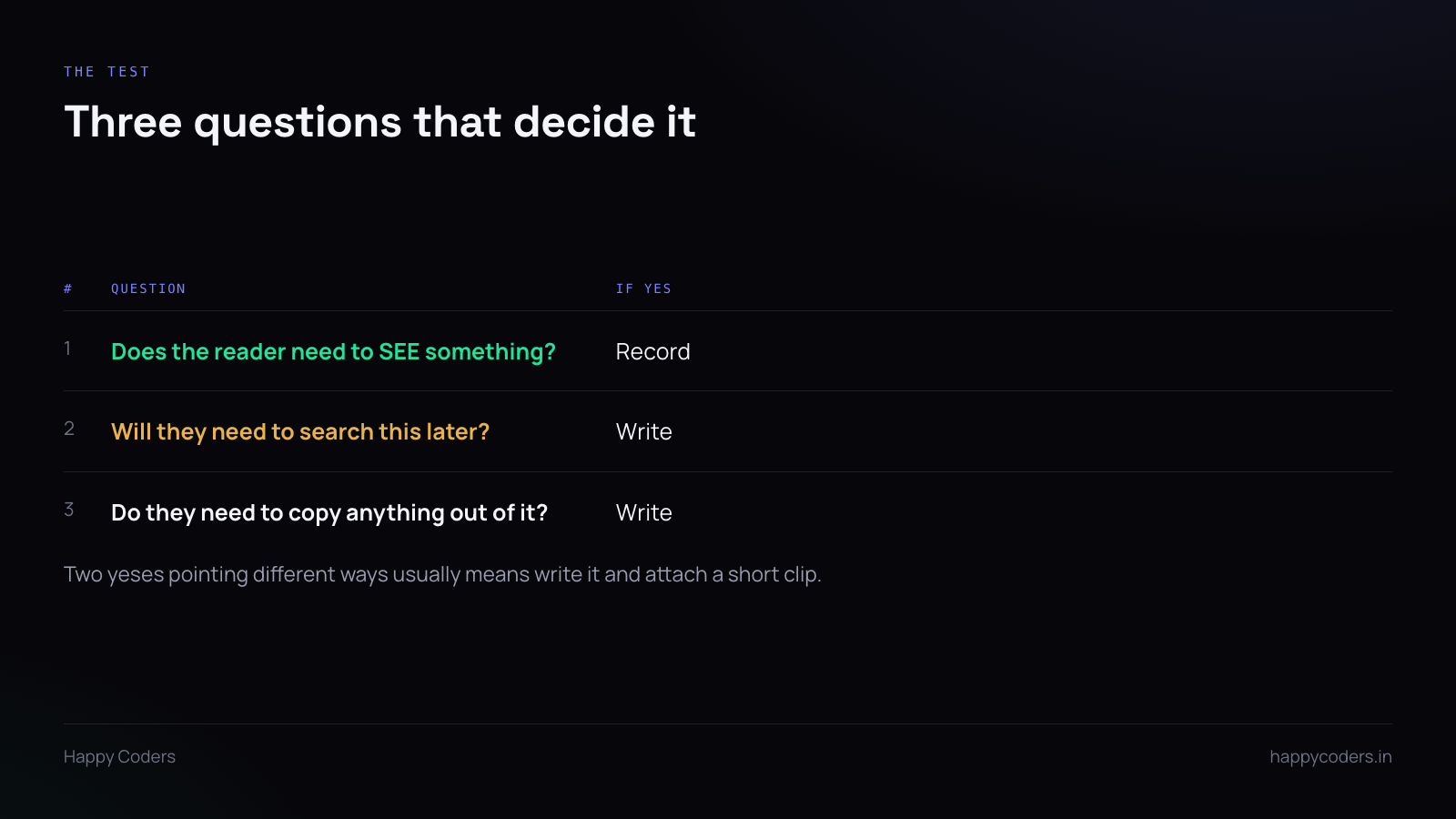
Does the person need to see something? A layout that is wrong, an error that appears and disappears, a sequence of clicks that is hard to describe. If the information is visual, writing it down is a translation exercise that loses most of the content.
Will they need to search this later? This is the one that most often overrules the first. Video is unsearchable. If the answer is going into a knowledge base, or if it is the kind of thing six people will look up over the next year, a recording buries it.
Do they need to copy anything out of it? A command, a URL, a configuration value, a name spelled a particular way. Nothing is more irritating than watching someone type a command on screen and having to transcribe it by pausing. If there is anything to copy, it has to be text.
When recording wins clearly
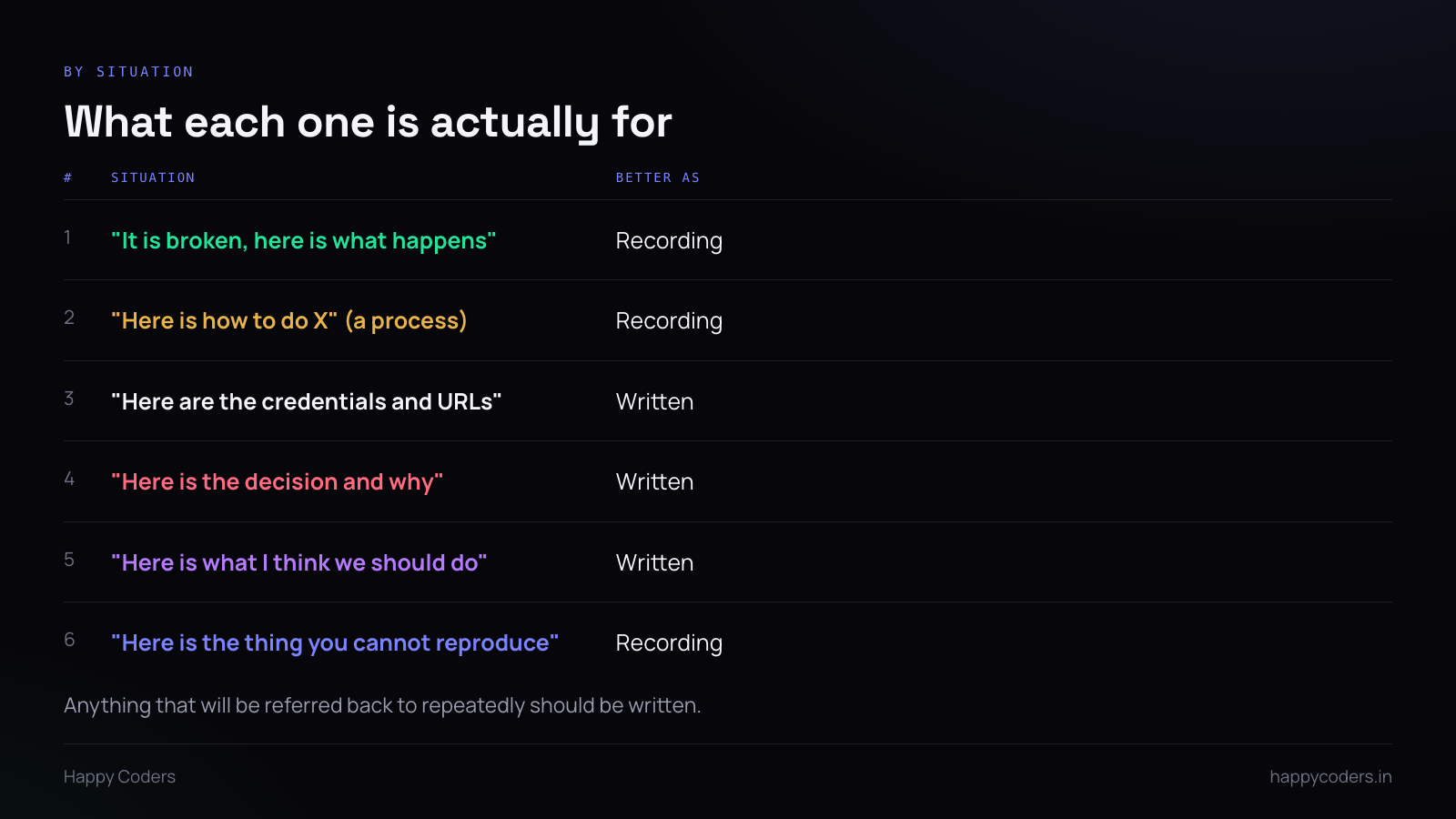
Reporting something broken. “It does not work” takes three rounds of questions to become useful. Thirty seconds of the thing not working, with the console open, skips all three. The developer sees the sequence, the timing, the exact message, and what was on the screen before it happened.
Showing a process. Anything with more than about five steps across more than one screen is faster to watch than to read, and far faster to produce. A written version of a nine-step process takes forty minutes to write and still misses the step that is obvious to you.
Something you cannot reproduce on demand. The intermittent failure, the thing that only happens on the client’s machine, the layout that only breaks at one window width. If you have it in front of you now, record it now. You may not get it back.
When writing wins clearly
Anything with values in it. Credentials, URLs, IDs, commands, configuration. These have to be copyable and they have to be correct, and reading them off a video is how a character gets transposed.
A decision and its reasoning. Decisions get revisited, usually by someone who was not there. They need to be findable by search, quotable in a later discussion, and amendable when something changes. All three argue for text.
A proposal. If you are asking someone to agree to something, give them something they can read at their own pace, re-read the paragraph they are unsure about, and reply to inline. A video asks them to sit through your pacing and then reconstruct the argument from memory before they can respond to it.
Anything that will be referred back to repeatedly. The more times a thing will be consulted, the more the balance tips to writing, because every viewing of a video costs the full duration while every re-reading of a document costs only the paragraph you needed.
The combination that usually wins
Most of the time the answer is both, with the written part doing the work and a short clip attached to the one bit that needs seeing.
Write the steps. Record the forty seconds where the thing goes wrong. Put the commands in the text where they can be copied, and link the clip next to the step it illustrates.
This takes slightly longer than either alone and it is usually the version people actually use, because it is searchable, copyable and still shows the thing that words could not carry.
The honest reason recording feels faster
It is faster for the sender. Three minutes of talking replaces twenty minutes of writing, and that saving is real.
But it moves the cost rather than removing it. The recipient now spends three minutes watching instead of forty seconds skimming, and if there are five recipients the arithmetic has gone badly wrong. Writing is slow to produce and fast to consume; recording is the reverse.
So the question is partly how many people are on the other end. One person who asked a direct question — record it. Five people who will each need it at a different time — write it.
One case where recording is the wrong answer entirely
Bad news, criticism, or anything about a person.
A recording of someone explaining what went wrong is permanent, forwardable and carries tone that cannot be re-read charitably. Written feedback can be edited before sending, read twice by the recipient, and quoted accurately. Spoken-and-recorded feedback can only be replayed, and it is replayed in whatever mood the person is in at the time.
Record the screen. Write the sentence about the person.