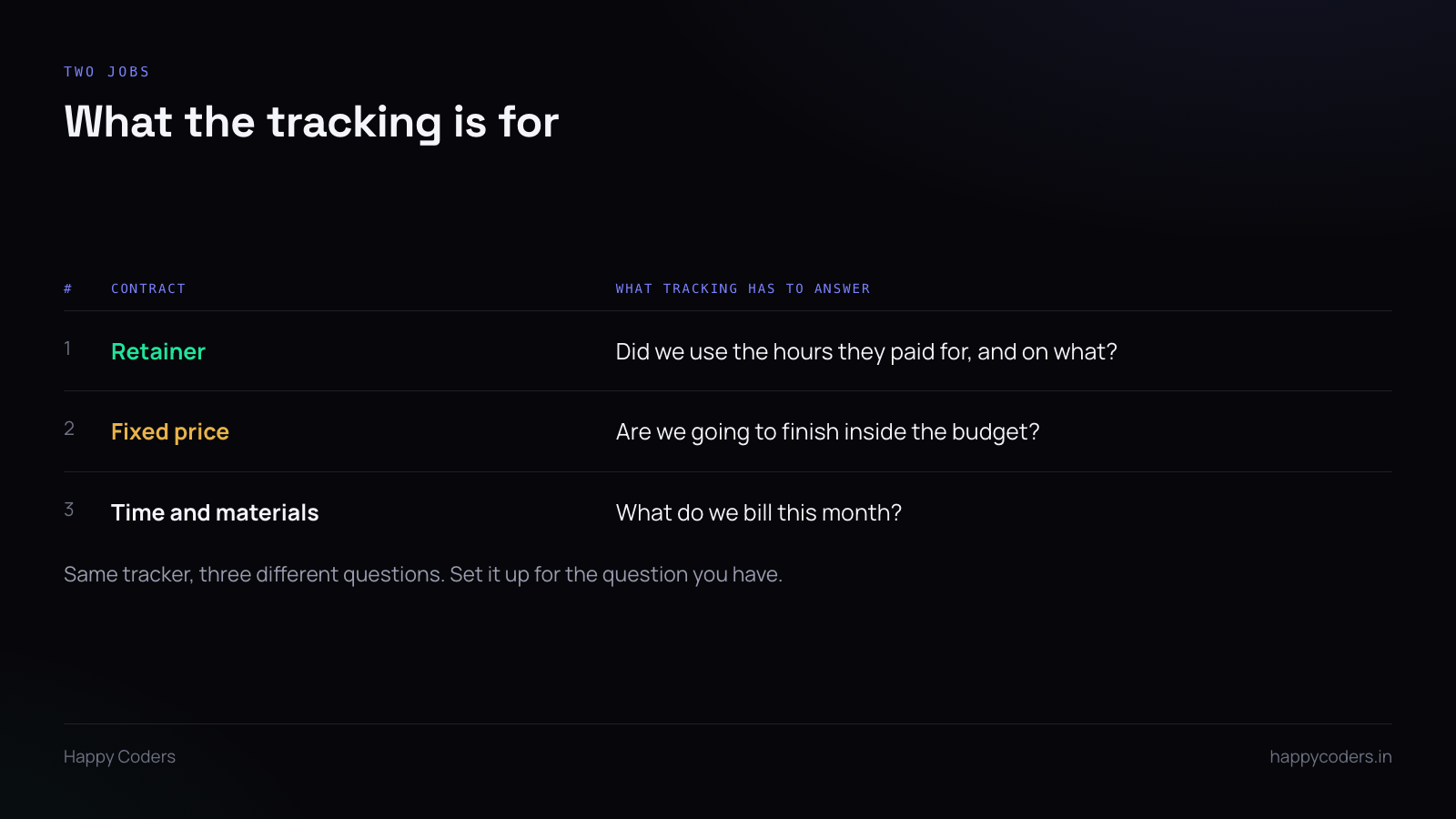
Most agencies run two or three kinds of contract at once and track all of them the same way. That works, in the sense that the hours get recorded. It also means the tracking answers a question nobody asked, while the question that matters goes unanswered until it is too late to act on.
The retainer problem: unused hours
A retainer client pays for, say, forty hours a month. The thing that goes wrong is almost never that you overrun. It is that by the 25th you have used twenty-six, and neither side noticed.
Those fourteen hours do not usually roll over. The client paid for them, did not get them, and will remember that at renewal — even if the reason was that they did not send any work.
So for a retainer, tracking exists to answer are we using what they bought, and on what. That is a mid-month question. Checked on the 1st it is history; checked on the 15th it is a prompt to send an email saying “you have nineteen hours left this month, is there anything you want us to pick up?”
That one email is the whole value of tracking a retainer properly. It converts an awkward renewal into a client who feels looked after.
The fixed-price problem: finding out late
A fixed-price job has a number agreed up front and an estimate behind it. The thing that goes wrong is finding out in week six that the work estimated at eighty hours is going to take a hundred and thirty.
By week six almost nothing can be done. The conversation about scope that would have worked in week two is now a conversation about money, and you will lose it.
For fixed price, tracking exists to answer are we going to finish inside the budget. That is a weekly question, and it needs the estimate stored next to the actual, not in someone’s head or a quote document nobody reopens.
The useful comparison is not hours used against hours quoted. It is hours used against work completed. Forty hours spent on an eighty-hour job is fine at the halfway point and alarming if two of eight features are done.
Time and materials: the easy one
Bill what you worked. Tracking exists to produce the invoice, the question arrives once a month, and there is nothing to manage in between.
Most teams set up their tracker for this case, because it is the simplest, and then wonder why it tells them nothing useful about the other two.
Setting it up so the question is answerable
One project per contract, not per client. A client on a retainer who also commissions a fixed-price build needs two projects. Put both in one and neither question can be answered — the retainer looks overspent and the fixed-price job looks fine, when the reverse may be true.
Put the number somewhere the tracker can see it. Forty hours a month, or an eighty-hour estimate. A budget that lives in an email thread cannot be compared to anything automatically, which means somebody has to remember to do the sum, which means it happens twice a year.
Estimate at task level on fixed price. A single number for the whole job tells you only that you are over, and only at the end. Estimates per task tell you which task went wrong, which is the thing you need for the next quote.
Mark non-billable as it happens. Internal discussion about a client’s project is real work that may not be chargeable. On a retainer it probably comes out of their hours; on fixed price it comes out of your margin. Either way, deciding at invoice time is guessing.
What to look at, and when
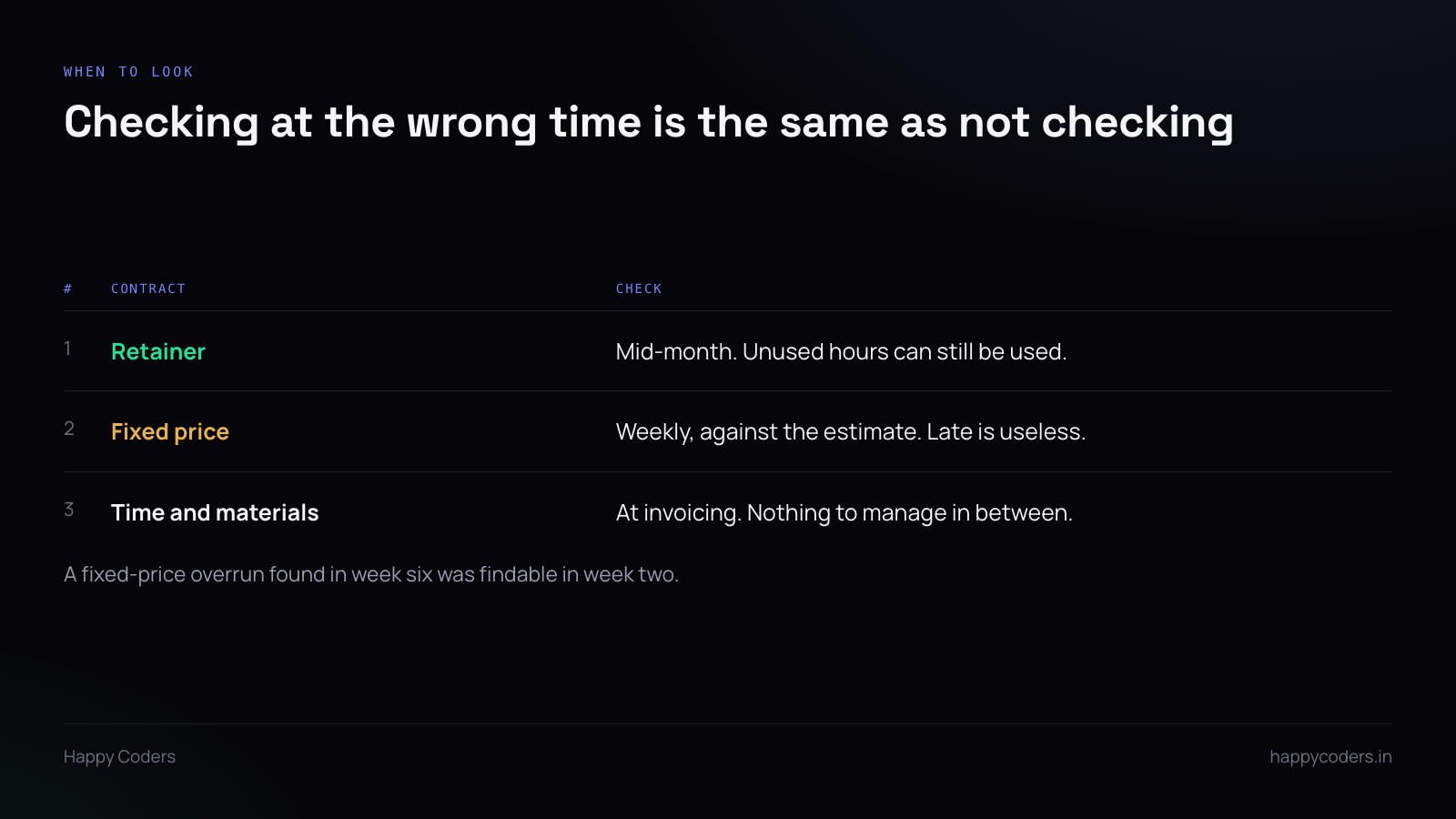
Retainer, mid-month: hours used against hours bought, and what they went on. If there is a gap, email the client.
Fixed price, weekly: hours against estimate, per task, next to what is actually finished. If the trend says overrun, raise it now. A scope conversation in week two is normal. The same conversation in week six is a dispute.
Time and materials, at invoicing: billable hours by task, anything sitting unbilled, anything in the catch-all project.
The estimate is the real output
One thing worth saying about fixed price specifically.
Every completed job gives you an estimate and an actual sitting side by side. That pair is the most valuable thing time tracking produces, and almost nobody looks at it.
After six jobs you know whether you estimate well, and more usefully where you estimate badly — most teams are accurate on the building and badly wrong on review cycles, client delays and the last ten per cent. You cannot know that without the record, and you cannot fix your quoting without knowing it.